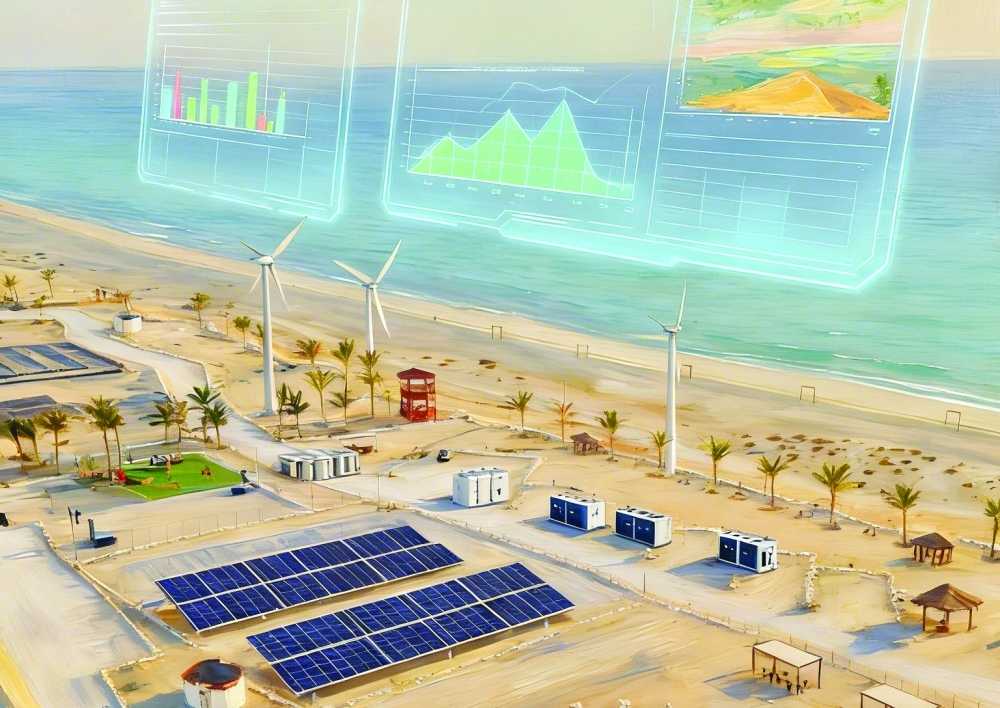





MUSCAT: In remote areas, where distance from major cities makes electricity not merely a service but a vital lifeline for daily life, development and stability, a study led by Professor Abdullah bin Hamad al Badi from the College of Engineering at Sultan Qaboos University has found that hybrid energy systems could provide more efficient and sustainable solutions for meeting electricity demand in isolated regions while simultaneously reducing costs and emissions.
The research examined the potential of hybrid power systems in Al Hallaniyat Islands, Masirah Island and Al Duqm. The study concluded that carefully designed combinations of renewable and conventional energy sources can offer reliable and economically viable alternatives for electricity supply in these locations.
The study employed a comprehensive technical, economic and environmental assessment based on actual data on electricity demand, wind speeds and solar radiation from the three sites.
Using the HOMER Pro simulation platform, the research team evaluated several energy scenarios incorporating solar power, wind energy and battery storage, alongside supporting technologies such as diesel generators, natural gas generators and fuel cells. The objective was to identify energy mixes capable of delivering greater reliability, lower costs and reduced environmental impacts.
The findings revealed that a renewable energy system integrated with natural gas provided the most favourable economic performance in areas with high electricity demand, particularly in Al Duqm.
The levelised cost of electricity was estimated at $0.100 per kilowatt-hour, compared with $0.126 per kilowatt-hour for a renewable–diesel configuration and $0.610 per kilowatt-hour for a renewable system supported by fuel cells.
Although fully renewable systems achieved greater reductions in carbon emissions, the renewable - natural gas option proved significantly more cost-effective than the alternatives assessed.
On Masirah Island, the study found that a system powered entirely by renewable energy and green hydrogen is technically feasible. However, the technology remains costly at present, with the estimated investment reaching approximately $966 million.
In contrast, for Al Hallaniyat Islands, where electricity demand is comparatively lower, a system combining solar and wind energy with battery storage emerged as a practical and suitable solution.
According to the researchers, the findings carry important implications for policymakers and the energy sector. The study demonstrates that there is no single energy solution suitable for all locations and that system design should be tailored to the specific characteristics of each area, including electricity demand, available natural resources and operational costs.
The research also recommends continued investment in energy storage technologies, smart grids, demand-side management and green hydrogen infrastructure to strengthen energy security, support sustainability goals and reduce emissions in communities located beyond the main electricity network.
Oman Observer is now on the WhatsApp channel. Click here