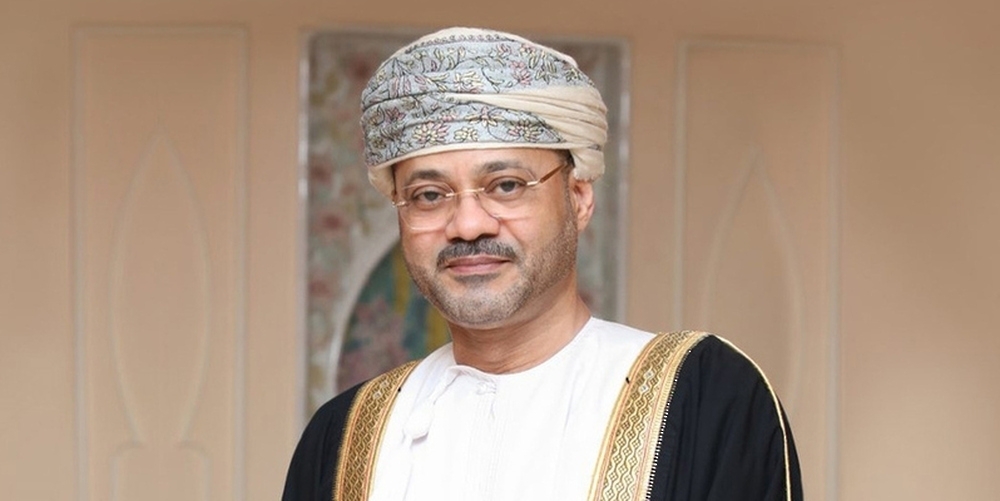
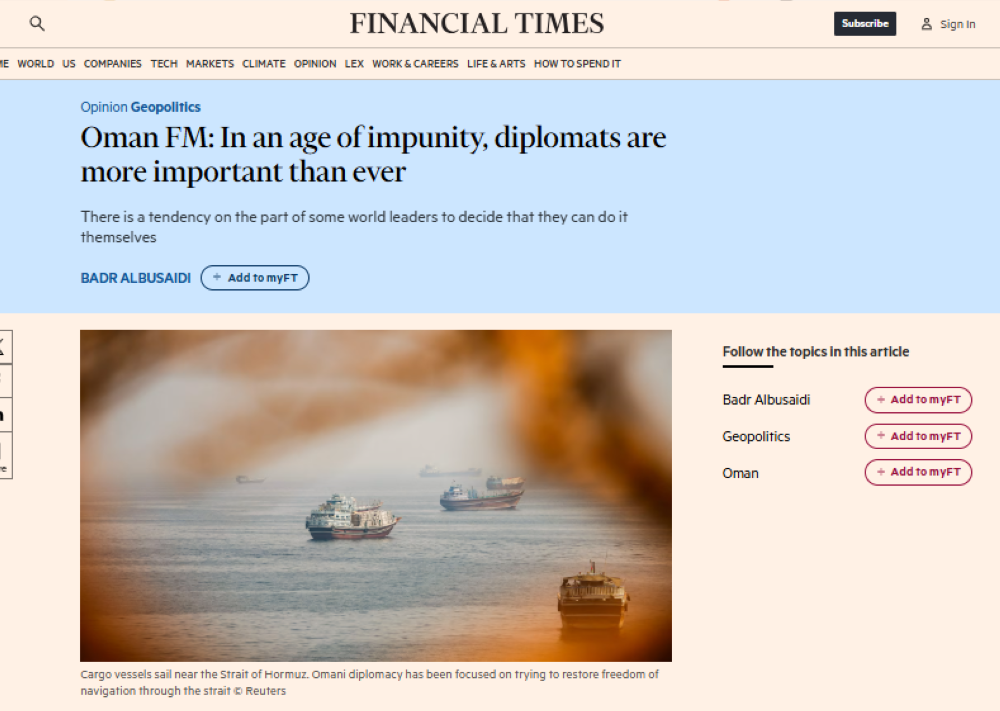
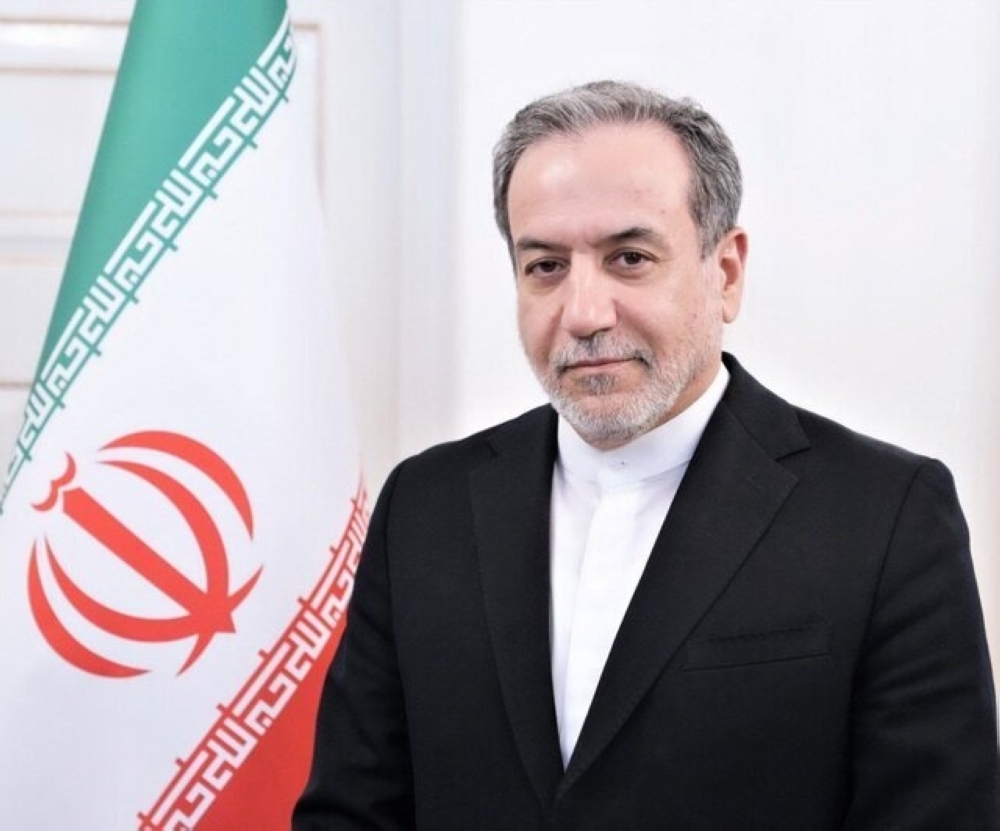
Recent global conflicts demonstrate a troubling shift in international politics driven by two primary factors: a declining adherence to international law alongside open contempt for multilateral institutions, and a tendency among world leaders to bypass professional diplomats in favor of unilateral military or economic coercion, wrote Sayyid Badr al Busaidi, the Foreign Minister, in Financial Times on Thursday.
"In response to this rising impunity, smaller states must protect themselves by patiently insisting on established norms and maintaining faith in continuous, persistent dialogue even when negotiations stall. Oman exemplifies this approach through its commitment to "constructive neutrality," actively using diplomatic channels to navigate complex issues like maintaining freedom of navigation in the Strait of Hormuz.
Ultimately, by remaining at the negotiating table and operating securely within legal frameworks, smaller nations can help preserve and strengthen the international rules-based order necessary to constrain illegitimate uses of power," Sayyid Badr said further in his article.
The original text:
In recent years diplomacy has been an unforgiving endeavour. A few provisional agreements have achieved limited de-escalations. But there have been no lasting resolutions to any of the dangerous global conflicts that directly threaten lives in Palestine, Iran, Yemen, Sudan, Lebanon, Israel and Ukraine, and which inflict serious damage upon regional neighbours and the global economy.
This is not for lack of activity: There have been numerous initiatives, mediations, negotiations, summits and memoranda, and many experienced diplomats have devoted time and ingenuity to these matters. Rather, it is the consequence of two troubling new dimensions of global politics, to which a collective response from the international community is urgently needed.
The first is a decline in adherence to international law. Recent years have seen the consolidation of occupations, the increased use of assassination and abduction as tools of policy, and reckless attacks on civilians, alongside open contempt for institutions such as the UN, the International Court of Justice and the International Criminal Court. This threatens a return to an earlier era in which major powers could act with impunity but, this time, with weapons of mass destruction.
Tendency to ignore diplomats
The second is the tendency on the part of some world leaders to decide that they can do diplomacy themselves, without involving diplomats. The problem is that they soon find they have very few tools at their disposal with which to advance their objectives. They are forced to resort either to the traditional 19th-century imperial method of 'gunboat diplomacy' or to the more refined but equally destructive modern equivalent of using economic power to bully entire populations into submission, in the hope of “regime change” and the installation of a compliant proxy administration.
How are smaller states to act when the rules that once restrained larger states are increasingly ignored? It may be that the best response is to start by patiently, even a little pedantically, insisting upon adherence to some of the old norms. Repeated invocations of international law may be dismissed as tedious by those whose instincts are to move fast and break things. But they are there to protect the vast majority of the global population. Now is not the time to give up on the principle that the law serves to constrain illegitimate uses of power.
In practical terms this means maintaining some faith in the process of diplomacy when it seems not to be working. In the face of apparent failure, an intractable problem or the intransigence of your interlocutors, the challenge is not to walk away. The task of the diplomat — perhaps especially the diplomat from a small nation — is to be the persistent interlocutor who remains at the table even when there seems to be nothing left to explore. One who is always picking up the phone, suggesting just one more way to inch a dialogue forward.
Omani Diplomacy
A key focus for Omani diplomacy over the last months has been on trying to achieve an agreement that would restore freedom of navigation through the Strait of Hormuz. This is a complex negotiation conducted under the ever-present threat of war — and one with well-known implications for the global economy. It involves balancing the details of international law with acute issues of national security. A solution has not yet been reached. But we are not walking away. This is, of course, because there is too much at stake in the negotiations themselves. And it is because the very process of negotiation — the idea that nations can resolve differences through dialogue — is also at stake.
Oman is trying to achieve three objectives through its continued engagement. To protect our own sovereignty, given that the present situation threatens the security of our territorial waters. To protect the interests of the international community, aware that it is inevitably the most vulnerable who will suffer most from the strait remaining closed. And finally, to affirm the continuing centrality of international law by opting to act securely within its framework.
Constructive neutrality
All three of these are consistent with what Oman means by constructive neutrality. This means more than just being helpful or prepared to facilitate. It means simultaneously preserving and constructing public international law, which is more than a text; it is sustained and strengthened through the actions taken in its name. The aim is progressively to develop a workable framework of mutual commitments that can serve as a normative order.
By doing this, smaller nations — the global majority — can protect themselves against the unpredictable actions of those whose power otherwise allows them to act with impunity.