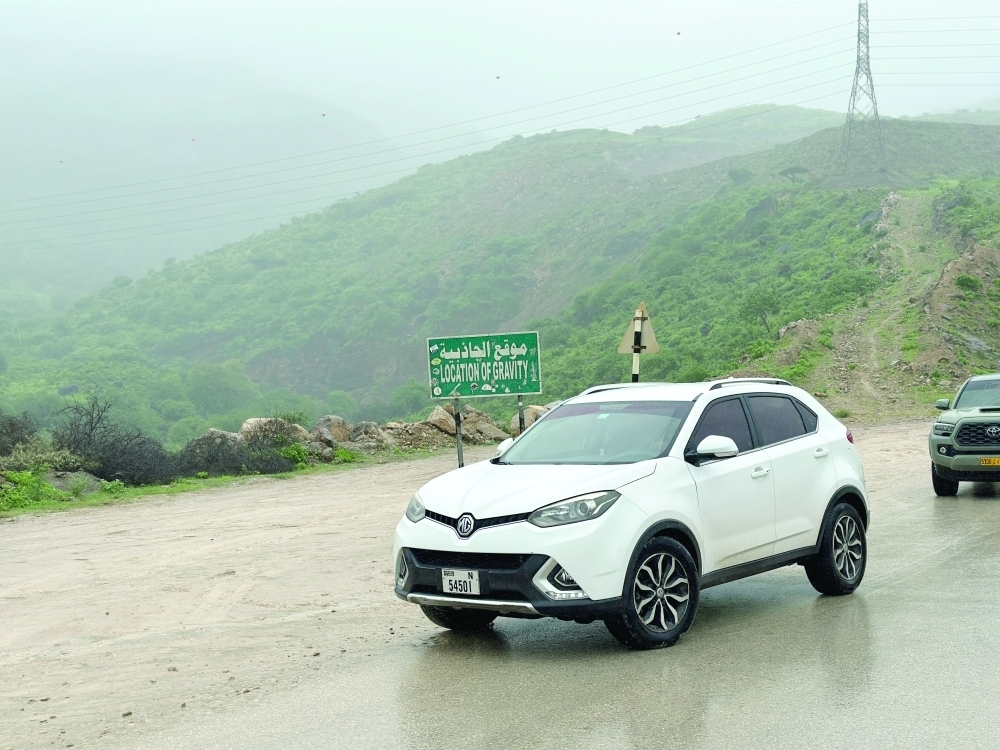





SALALAH: Vehicles at Dhofar’s famous Hashir Hill may appear to roll uphill on their own, but a new scientific study has found that the road is actually descending — by about 10 metres over a surveyed distance of 350 metres.
Researchers who carried out precision elevation and gravity measurements at the site found no local gravity anomaly behind the apparent uphill movement. Instead, the results point to the surrounding landscape and human visual perception creating the impression that a downhill road is rising.
The study, published on August 11 in the journal Geosciences, examined Hashir Hill — widely known as “Gravity Hill” or “Magnetic Hill” — using detailed topographic surveying and high-precision relative gravity measurements.
Researchers established 36 measurement points at intervals of about 10 metres along the road. The first point was measured at 96.937 metres above sea level, while the final point, 350 metres away, stood at 86.824 metres.
The measurements therefore show a continuous descent along the surveyed profile, even though parts of the road appear to motorists to slope upwards.
The effect becomes particularly convincing where the road gradient is very shallow. According to the study, the road descends more steeply at first before flattening substantially. At around 120 metres into the profile, the slope approaches zero in what the researchers identify as the main optical-illusion zone.
With few reliable visual references to establish the true horizontal, surrounding landforms can distort the way the brain interprets the road’s inclination, making a slight downhill gradient appear to be uphill.
The research team also tested whether variations in gravity could offer another explanation. Using a Scintrex CG-5 high-precision gravimeter, they recorded gravity at all 36 survey stations.
Gravity increased gradually by about 3.17 milligals as elevation decreased, a change the researchers said was consistent with the normal physical relationship between altitude and gravitational acceleration.
Crucially, the gravity profile showed no abrupt disturbances or local deviations that would indicate a detectable subsurface density anomaly at the scale and resolution of the survey. The measured variation was therefore attributed mainly to the difference in elevation rather than an unusual gravitational effect.
Put simply, a vehicle placed in neutral at the site is not overcoming gravity or being pulled uphill. It is moving towards lower ground under ordinary gravity while the surrounding terrain makes that direction appear to rise.
The study was conducted by Abdullah al Mashani of Dhofar University; Ram Raj Mathur of Osmania University in India; Asaad Al Hatmi of Oman’s National Survey and Geospatial Information Authority; Said Al Awaed of Dhofar University; and Luay Rashan of the university’s Biodiversity Unit, Research Center.
According to the authors, no previously published study had combined precise topographic surveying and relative gravity measurements to investigate Hashir Hill specifically.
Similar “gravity hills” have been documented in several countries, and previous scientific studies have generally linked the effect to visual misperception of terrain and distorted horizontal reference points rather than forces capable of pulling vehicles uphill.
The Hashir research adds site-specific measurements from Dhofar to that wider body of evidence. Its authors conclude that the apparent uphill movement is primarily the result of local topographic geometry and human visual perception.
One question, however, remains outside the study. Despite the site’s popular description as “Magnetic Hill”, the researchers did not measure the local magnetic field. They explicitly state that magnetic assessment was beyond the scope of the investigation and suggest that future work could incorporate magnetic-field measurements.
For the apparent uphill movement itself, the evidence is much clearer: at Hashir Hill, what looks like uphill is actually downhill.
Oman Observer is now on the WhatsApp channel. Click here