





In today’s fast-paced workplace, productivity is often measured by how long employees stay connected rather than by how effectively they perform. Tight deadlines, back-to-back meetings and the expectation of being constantly available have become part of everyday professional life.
While dedication remains an essential workplace value, experts say that working continuously without meaningful breaks can gradually undermine both employee well-being and organisational performance.
A growing body of evidence suggests that taking a short leave — whether for a few days or a week — is not a luxury but a practical investment in mental health, creativity and long-term productivity. Rather than slowing progress, stepping away from work can help employees return with renewed focus, higher motivation and better decision-making abilities.
Many employees postpone their annual leave, believing that doing so demonstrates commitment to their organisations. In reality, prolonged periods of uninterrupted work often lead to physical fatigue, mental exhaustion and declining enthusiasm. These early warning signs, if ignored, may eventually develop into occupational burnout, a condition that affects not only individual performance but also workplace morale and organisational efficiency.
Unlike extended vacations, short breaks are easier to plan and can be equally effective. Employees do not need expensive overseas holidays to benefit from time away. Spending a few days with family, reconnecting with hobbies, travelling within the country, or simply disconnecting from work-related communication can provide the mental reset many professionals need.
For Hood al Balushi, an employee in the private sector, taking short leave transformed the way he approaches work. “I used to believe that postponing my leave showed dedication,” he says. “But over time, I realised I was becoming mentally exhausted. I found myself making small mistakes and losing focus. Earlier this year, I took five days off, completely disconnected from work, and when I returned, I was more productive than I had been in months.”
Stories like his have become increasingly common as organisations begin recognising that employee well-being and business performance are closely linked. A refreshed employee is often more engaged, collaborative and capable of solving problems creatively than someone who has been working under constant pressure for months.

Social specialist Rashid al Siyabi believes that burnout develops gradually rather than appearing overnight. “People often misunderstand rest as a sign of weakness or reduced commitment,” he explains. “In reality, taking regular breaks allows employees to maintain emotional balance and sustain high performance over the long term. Ignoring the need for recovery can eventually affect not only job performance but also family relationships, physical health and overall quality of life.”
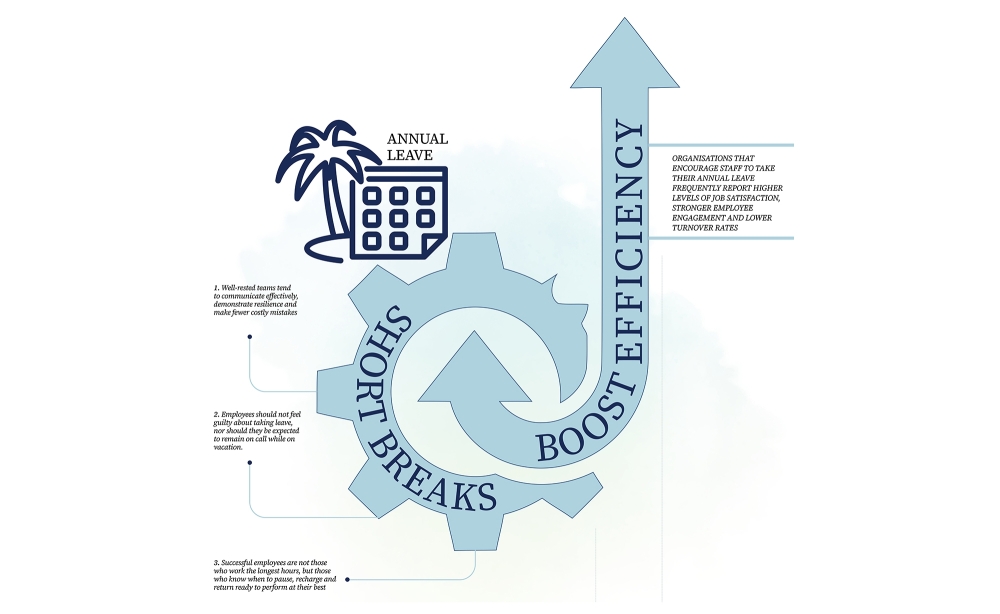
The benefits extend beyond individual employees. Organisations that encourage staff to take their annual leave frequently report higher levels of job satisfaction, stronger employee engagement and lower turnover rates. Well-rested teams also tend to communicate more effectively, demonstrate greater resilience during demanding periods and make fewer costly mistakes.
Human resource professionals increasingly argue that workplace culture plays a crucial role. Employees should not feel guilty about taking leave, nor should they be expected to remain available through emails, phone calls and virtual meetings while officially on vacation. Genuine time off requires genuine disconnection.
As conversations around workplace well-being continue to evolve, short breaks are becoming an important component of sustainable employment practices. Forward-thinking employers are recognising that investing in employee recovery ultimately strengthens organisational resilience and performance.
The modern workplace is unlikely to become less demanding. However, creating space for regular recovery may prove to be one of the simplest and most effective strategies for maintaining productivity in the long run. After all, the most successful employees are not necessarily those who work the longest hours, but those who know when to pause, recharge and return ready to perform at their best.
GRAPH POINTS
1. Well-rested teams tend to communicate effectively, demonstrate resilience and make fewer costly mistakes
2. Employees should not feel guilty about taking leave, nor should they be expected to remain on call while on vacation
3. Successful employees are not those who work the longest hours, but those who know when to pause, recharge and return ready to perform at their best
Oman Observer is now on the WhatsApp channel. Click here