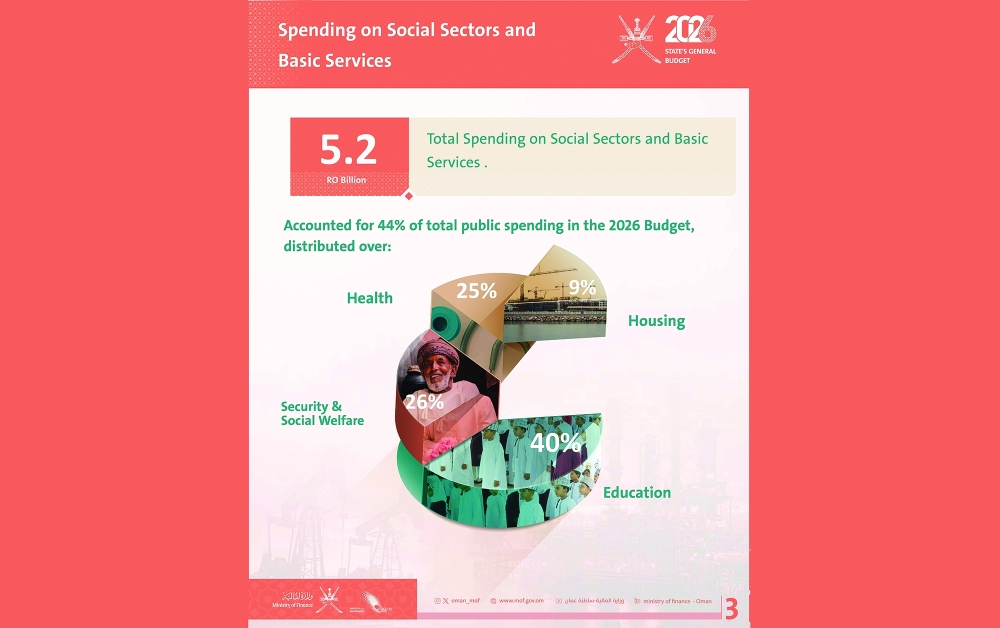





MUSCAT: Oman has earmarked RO 5.2 billion for spending on social sectors and basic services in its 2026 State General Budget, underscoring the government’s continued focus on human development, social protection and the delivery of essential public services.
According to figures released by the Ministry of Finance, allocations for social sectors account for 44 per cent of total public spending in the 2026 budget. The expenditure is distributed primarily across education, social security and welfare, health, and housing, reflecting national priorities aligned with Oman Vision 2040.
The education sector commands the largest share of social-sector expenditure, accounting for 40 per cent of the total allocation. Funding for school education alone stands at RO 2.109 billion.
Key initiatives include the ongoing construction of 42 new public schools and the delivery of 22 additional schools during the year. The budget also provides for the expansion of existing schools to meet rising demand across governorates, alongside investments in laboratories, educational resource centres, school furniture and air-conditioning units.
Further allocations support teacher professional development programmes, education quality enhancement initiatives, and higher education infrastructure. These include the construction and equipping of the College of Law at Sultan Qaboos University, rehabilitation works at Universities of Technology and Applied Sciences, the equipping of specialised laboratories, and an increase in enrolment capacity by 500 students for the 2025/2026 academic year.
Spending on the Social Security and Welfare Sector totals RO 1.372 billion, representing 26 per cent of total social-sector expenditure. Of this, RO 614 million is allocated to social protection benefits, covering old-age, child, disability, orphan and widow benefits, as well as family income support. A further RO 338 million is directed towards social insurance programmes, including insurance for old age, disability and death.
Additional provisions include RO 57 million for grants and assistance, RO 280,000 in annual support for Omani women’s associations across governorates, and RO 126,000 for the development and enhancement of rehabilitation services at Al-Wafa Centres and related facilities for persons with disabilities. The Ministry noted that 9,359 cases are expected to benefit from social care and rehabilitation services nationwide.
The housing sector, which accounts for 9 per cent of social-sector spending, has been allocated RO 464 million in the 2026 budget. Key measures include enhancing the lending portfolio of the Housing Bank and national housing programmes, alongside efforts to reduce the current six-month waiting period for housing loan approvals. Ongoing housing-sector projects under the 11th Five-Year Development Plan (FDP), valued at RO 227 million, are expected to be completed during the period.
The allocation also supports the development of infrastructure at Al-Thuraya City and the completion of the first phase of Sultan Haitham City, both key urban development initiatives.
The health sector receives 25 per cent of total social-sector spending, with an allocation of RO 1.318 billion aimed at expanding healthcare infrastructure and strengthening service delivery.
The budget supports the ongoing construction of several government hospitals, including Sultan Qaboos Hospital in Salalah, SamaYil Hospital, Al-Namaa Hospital, the new Madha Hospital, Khasab Hospital, and Al-Falah Hospital in Jalan Bani Bu Ali, as well as the ongoing expansion of Nizwa Hospital.
Funding is also directed towards the construction and upgrading of government health centres in Jalan Bani Bu Ali, Al-Dhariz, Shahb Asayb, Abu Abali, Sur Al-Balush, Ibra and Al-Mudaybi, in addition to a dialysis unit in Barka. Other projects include the extension of a health centre and the construction of a regional medical warehouse in Musandam Governorate.
The budget further supports the provision of consultancy services at the National Centre for Women and Child Health, alongside measures to strengthen health institutions through the appointment of 3,706 qualified personnel.
Oman Observer is now on the WhatsApp channel. Click here