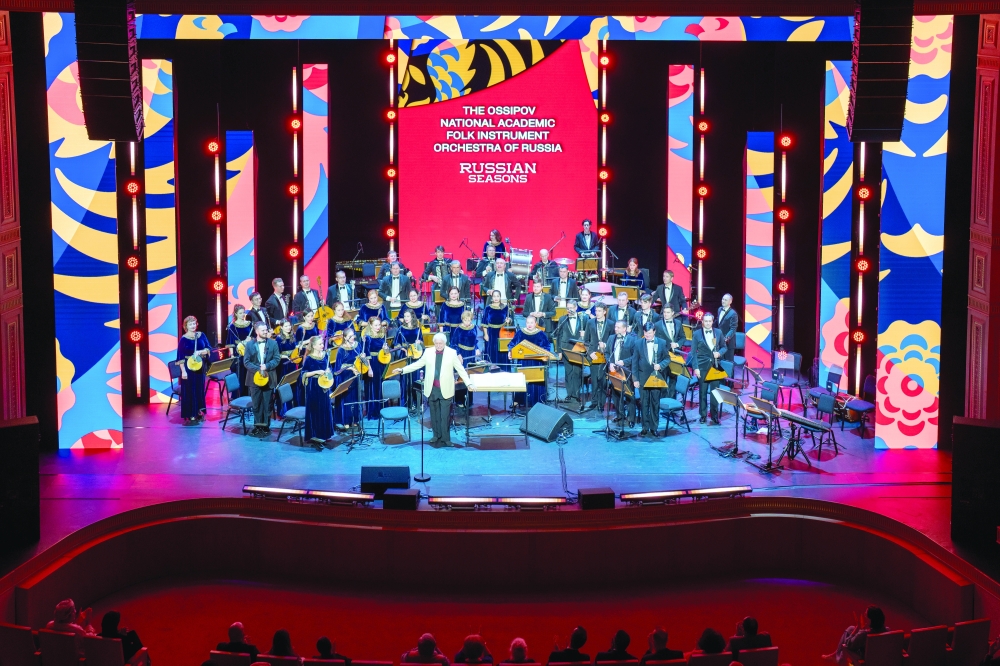





If you thought you knew all the Russian folksongs there are, think again. The Ossipov National Academic Folk Instrument Orchestra Of Russia did not play any well-known until the Finale, and one you did know - but did not know was Russian! The concert at the Royal Opera, House of Musical Arts on Monday evening was such fun it had patrons clapping along, and after an hour and twenty minutes of sheer exuberance, leaving the auditorium with a smile on their faces.
A punctual start brought the musicians to the stage, ladies in deep blue velvet and men in black jackets bearing their traditional instruments proudly. The distinguished white-haired Belarusian conductor, Vladimir Andropov swept on stage, raised his baton and they were off. Tchaikovsky’s, “Dance of the Buffoons” from ‘The Snow Maiden’ opened the concert with a romp against a beautiful backdrop of the Kremlin in snow, like a stained-glass window.
The orchestra comprised 20 domras: long-necked mandolin-like stringed instruments of the lute family, in three sizes. There were four sizes of the iconic balalaika family from prima to double bass, and two ladies at the front playing ‘Gusli’ - a zither from Novgorod region, not unlike the Qanoon. The second piece featured Domra soloist, Olga Bolshakova, performing the Cossack-like “Variations on the romance, Nightingale”. She played the fast tremolo melody between slower sections, with the whole orchestra erupting into big romantic swells. Like a mini-concerto, a virtuoso solo cadenza section led to a tutti fast Finale.
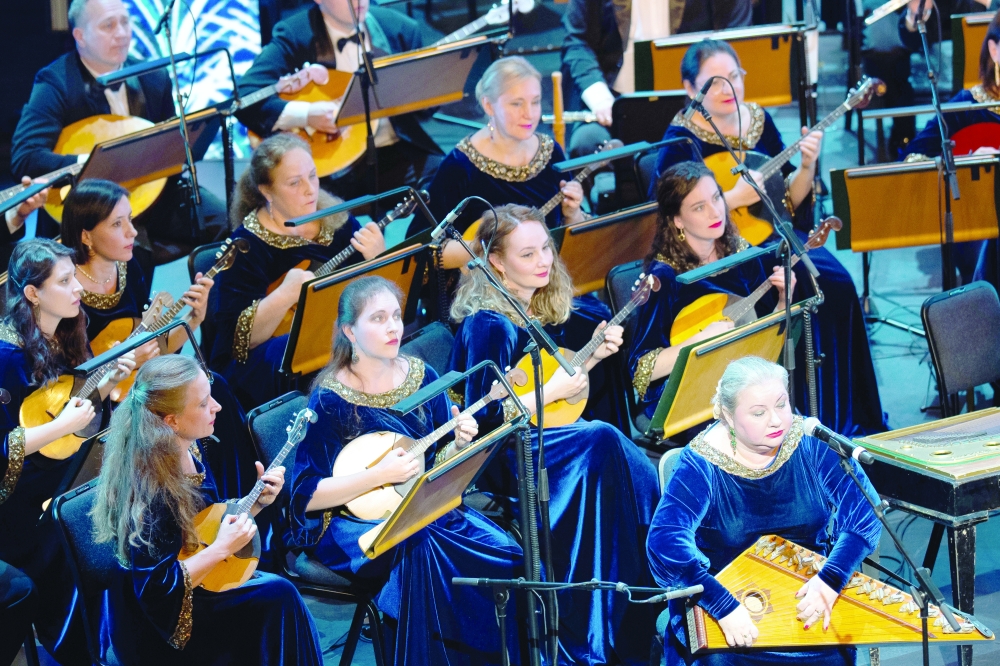
Everyone worldwide enjoys a good waltz, and the romantic 20th century dance by Saidashev was no exception, featuring wooden flutes and recorder timbres in Tatar folksongs. A contemporary arrangement of “Travushka-Muravushka” gave sweeping glissandi to the Gusli, while the melody was plucked above on domras in a growing crescendo to the end.
The soloists just kept emerging, and next up was the Qurai Maestro, Arslan Umurzakov, in his Bashkortostan National costume. Qurai is a long wooden, nay-like instrument with a deep, breathy flute sound. It has a didgeridoo quality in its lowest register and could produce double tones - rude, raspy sounds when overblown. The audience was spellbound and fascinated by this instrument, evocative of conditions in the freezing southern Urals. In contrast, “In the Moonlight” for solo Gusli, Alla Dogadova stepped forward to pluck her harp-like zither in a tender, lyrical solo which was well amplified above the ensemble, who hummed a backing tune at one point.
“Meadow Duck” brought the young chromatic button accordion (Bayan) soloist, Nikolai Mironov, to the fore. He displayed his dazzling virtuoso technique and wide dynamic range over a syncopated rhythmic section, in an invigorating dance movement.

An impressive highlight of the evening came in the form of a Yakut Jaw Harp (Khomus) player, Albina Degtyareva in, “The World of Olonkho”. She appeared in the splendid, sparkling national dress of the Republic of Sakha (Yakutia, in the Far Eastern Arctic region) playing the Khomus between her teeth. Then she created birdcalls from her throat followed by both Khomus and throat sounds! She produced high-pitched screams and buzzing effects using incredible techniques while moving her arms in a dreamy gesture. The orchestra joined with an ethno-Ayarhaan composition in a distinctive, almost avant-garde performance.
Another lady in black was 31 year old, Sofia Onopchenko from the south of Russia. She sang Ponomorenko’s, “I’m flying over Russia” to a stunning backdrop of green trees surrounding a lake, spied through a window. She possessed a beautiful, rich vocal quality like a Fado singer, delivered in a deep passionate and warm minor key.
Now, here’s the one you didn’t know you knew: Gorodovskaya’s, 20th century “Variations on a Russian Theme” for orchestra was the Cossack story of Stenka Razin. The slow waltz-lament was made famous in the 60s in the West by the Seekers’ “When the Carnival is over”! Each variation exploited a different rhythm or section, such as oboe themes with countermelodies in the Balalaikas, the accordion – and all musicians clearly enjoying themselves.

“Beautiful Oman” arranged for the orchestra by Hamdan al Shueili, introduced five Omani musicians into the folklorique mix. The theme was taken by Bayan, oboe and balalaika tremolo, or plucking the melody before Oud player, Abdullah al Qasmi took the solo, along with Shaikha al Abri on Qanoon dressed in lush deep burgundy. The final section with three Omani percussionists earned an audience clap-along approval leading to a highly rhythmic tutti climax and thunderous applause.
The folkdance, “Smolensk Gander” was slow, played tremolo to a backdrop of snowflakes falling in a medieval Russian winter. It returned our accordionist wunderkind with five soloists: balalaika, Gusli glissandi, fast domras melodies building up to a tutti frenzy and sudden stop. Khachaturian’s, “Lezghinka” starred a virtuoso Xylophone solo and clever, syncopated finale for all.
“The Bell Sings Under the Arch” brought Sofia Onopchenko back on stage to perform in her deliciously seductive, defiant style in a strident 2/4 before the Finale: Vera Gorodovskaya’s Variations on that iconic Russian folksong, “Kalinka”. The verse sections were impossibly lyrical in the plucked strings, alternating with a chorus accelerating to very fast with the audience clapping, trying to keep up! After an hour and twenty minutes of sheer exuberance, everyone left the auditorium with a smile on their faces.
Photos credit: Khalid Al Busaidi
Oman Observer is now on the WhatsApp channel. Click here