




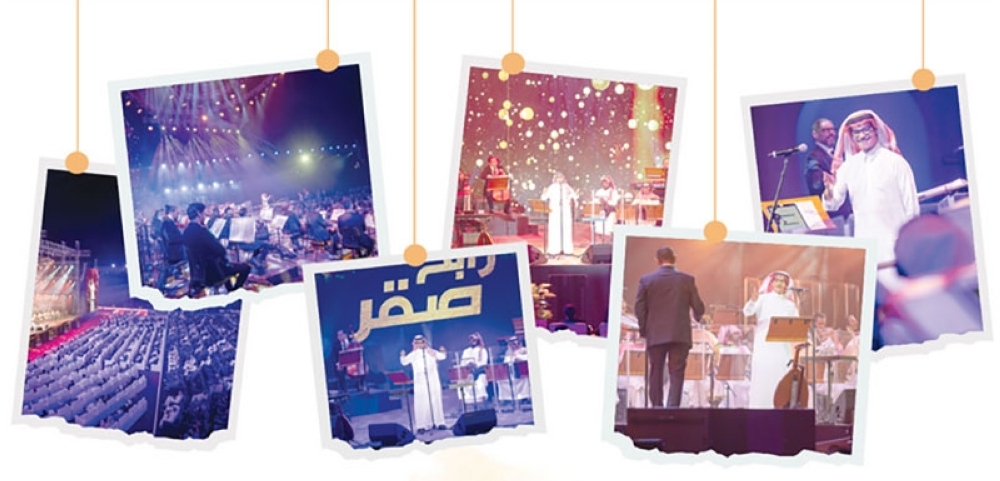
On Thursday evening the Maidan of the Royal Opera House Muscat was transformed into a huge open-air arena, rivalling the amphitheatre in Verona for size and grandeur. The occasion was a one-off visit from Saudi superstar, Rabeh Saqer and tickets were at a premium despite the nearly one thousand seat capacity.
Re-purposing the scaffolding structure from last weekend’s Military Music tattoo, patrons sat in blocks of black and white 5-star luxurious seating, equal to any business-class airline.
A majestic eagle was projected onto a massive screen behind as the band took their places on stage. The many Saudi hand drummers were seated behind Perspex soundproofing to the right and inevitably created various cross-rhythms between them.
The Egyptian instrumentalists sat in front on the left, including solo Qanoon, Oud (Islam El Qasabgi) Nay, electric cello, guitar and Korg organ, with fiddles and Saudi backing choir behind.
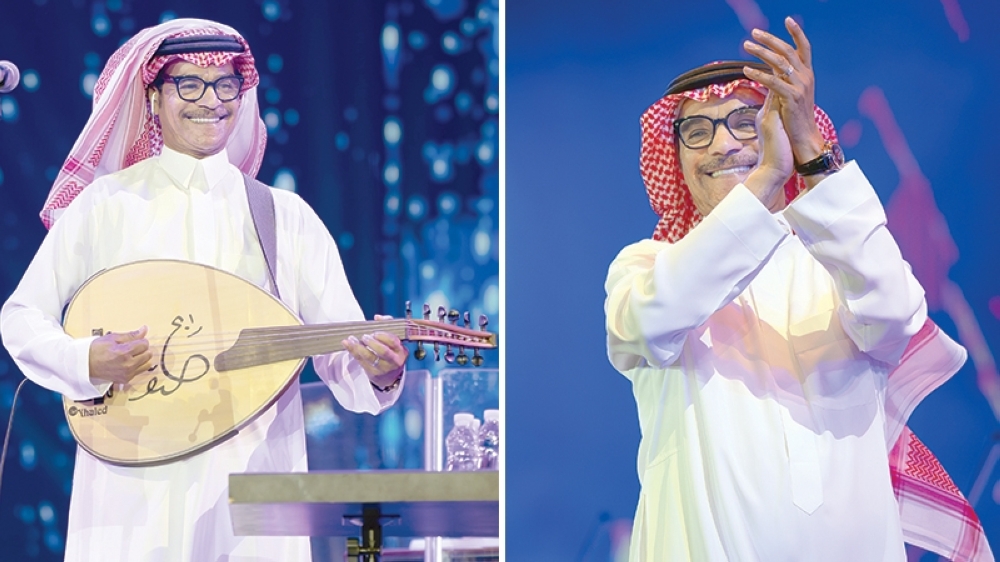
Taking his place on the podium, the conductor for this combined Arabic orchestra was esteemed Egyptian composer-arranger, Hany Farahat. After a brief orchestral introduction, Saudi singer, Rabeh Saqer came directly centre stage to open with the popular, 'Ain Al Shams'.
The entire performance was projected onto two side screens by CCTV. Rabeh greeted the audience to say what an honour it was to be performing in Muscat, exuding joy and happiness from his warm, sunny personality.
'Ghurbat Zaman' and 'Afhamak' were lyrical ballads, performed with a passion and met with some good natured heckling from the back!'Sa’ab' was a dreamy, filmic love song featuring Yahia Mahdi with a slow, sad electric cello solo, dripping with heartfelt pathos. It was sung pleadingly by Rabeh and the backing choir, with snatches of Nay themes from Ahmed Khairy.
In contrast, 'Al Bishara' was a famous popular number, illustrated with projections of stars in the Milky Way behind. It featured rising modulations and memorable, singable melodies enjoyed by the cheering fans.
'Gharam Atfal' provided more lively accompaniment in the cello and synthesiser (Hamada El Naggar) with backing singers followed by a louder rhythmic, 'Al Abat Al Rahifa' delivered by an animated Rabeh Saqer.
The next song was a highlight: The rousing, 'Khalas' included an electric guitar introduction from Mostafa Aslan and Qanoon solo from Sherif Kamel. White baubles exploded behind in a firework display, along with the sheer joy and exuberance of the extended sung chorus.
In a similar vein the fast and lively folksong, 'Laa Laa' featured some strong, rhythmic bass guitar lines (Mohamed Soliman). While listeners reclined outdoors in their sofa chairs, a light breath of air in this Arabian Night became a cool breeze, shared in communal song as a big projected yellow sun rose from backstage.
It seems that many instrumental solos, such as saxophone, accordion or mizmār were taken by synthesised sound of the Korg organ. It was sometimes difficult to know who was playing the melody as the camera did not always focus on soloists.
'Asharat Astrya' — unusual in waltz time, began with solo voice and electric cello and unfolded into a clever narrative of tender story telling in staccato repeated couplets. 'Saqa Allah' had a jazzy intro, based on a traditional Arabic scale and emphasised Rabeh Saqer’s agile, expressive vocal quality.
Furthermore, it was a tremendous feat of stamina to keep up that level of energy — for two full hours altogether and each song so different — for soloists and instrumentalists alike.
Into the encore section Rabeh (an accomplished Oud player) surprised the unknowing by picking up an amplified Oud and playing a long and complex solo, accompanying himself singing.
The finale turned the cameras onto the audience, projected for all to see much to their embarrassment! It was in call-and-response form with the orchestra and singers — dedicated to the Sultanate of Oman and the warm engagement Rabeh Saqer received.
Let’s welcome him back again soon to ROHM’s delightful open-air arena — the heart of Muscat's music scene.
Oman Observer is now on the WhatsApp channel. Click here