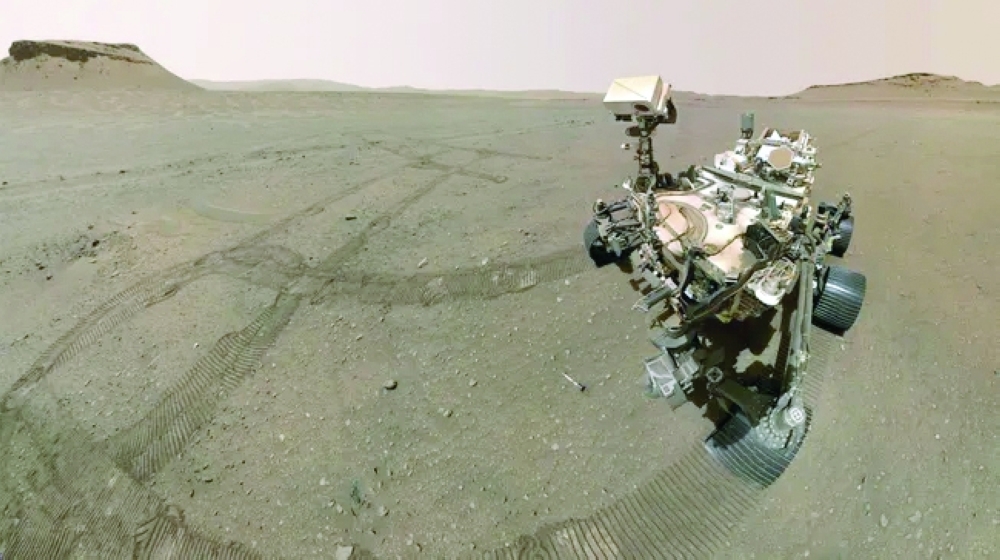





WASHINGTON: Nasa's robotic Perseverance rover has now driven farther than any other vehicle on the surface of any world other than Earth, racking up 28.1 miles (45.2 km) since arriving on Mars in 2021, the US space agency said.
The car-sized, six-wheeled rover reached the milestone 5-1/2 years into its mission to explore if conditions conducive to microbial life ever existed on Earth's neighbour. In doing so, it is visiting some of the most ancient terrain ever encountered in the solar system.
"Perseverance's engineering hardware and instruments are in excellent shape with all redundant systems still available," Steven Lee of Nasa's Jet Propulsion Laboratory in California, said.
"A recent assessment of all systems concluded that they are capable of operating well into the 2030s, likely beyond," added Lee, the project manager for Nasa's two Mars rovers, Perseverance and Curiosity.
Perseverance has exceeded the previous figure of 28.06 miles (45 km) driven on the Martian surface by Nasa's Opportunity rover from 2004 to 2018. Both also exceeded the driving distances of any lunar rover.
Perseverance, with its suite of scientific instruments, has focused on the Jezero Crater, a region in the northern hemisphere of Mars believed to have been flooded with water and home to a lake basin billions of years ago.
The rover set the milestone in a journey toward an area called Idubi, through the region off the crater's western rim nicknamed Lac de Charmes. Its companion rover, Curiosity, rolls along in the Gale Crater near the Martian equator.
Perseverance is showing no signs of slowing down, Lee added.
Its mobility system mechanisms are being tested to show it can drive 100 km (62 miles) or more, he said, with the hardware to be tested to the equivalent of 150 km to 300 km (93 miles to 186 miles) in the effort.
Nasa attributed a major role in Perseverance's success to its self-driving capability, an autonomous navigation system called AutoNav. Lee said 90 per cent of its drives are done autonomously, with no human intervention.
"Perseverance takes stereo images of the terrain ahead, generates a 3D software map, and selects the safest path towards a drive goal," he said.
Another key component is the Vision Compute Element, a fast co-processor computer that allows the rover to process images and run its self-driving software very quickly, almost continuously during drives, Lee added.
That contrasts with previous rovers, which needed to pause to "think" before each drive segment, he said. — Reuters
Oman Observer is now on the WhatsApp channel. Click here