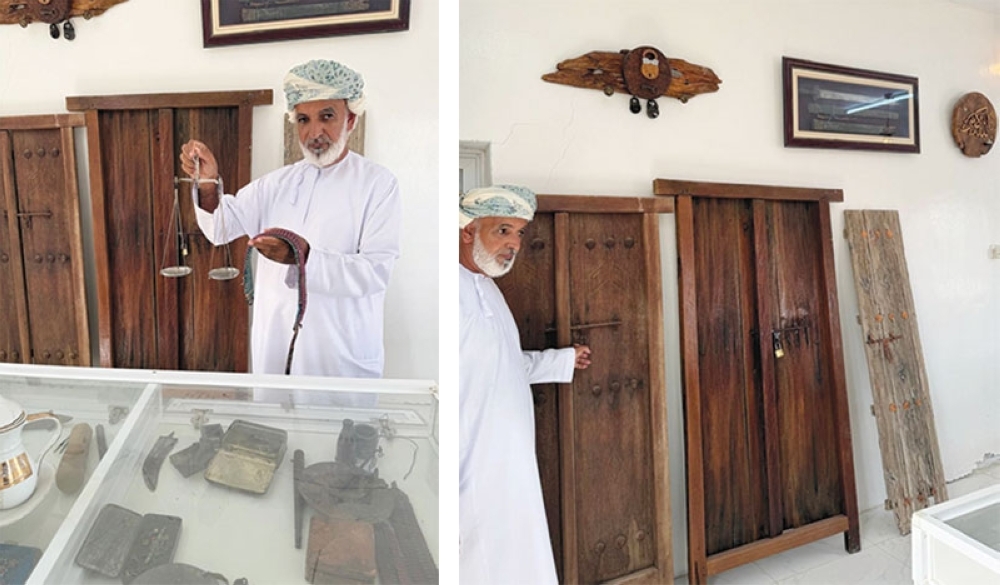





Between a wooden box crafted decades ago, an antique sword from a bygone era and coins that have crossed vanished empires and states, Humaid bin Abdulla al Hinaee stands in two rooms attached to his house in Dubaishi village, Wilayat of Ibri, as though he were the custodian of a memory he refuses to let fade. What a visitor may see as antiques, he sees as pages of history, each piece telling a story.
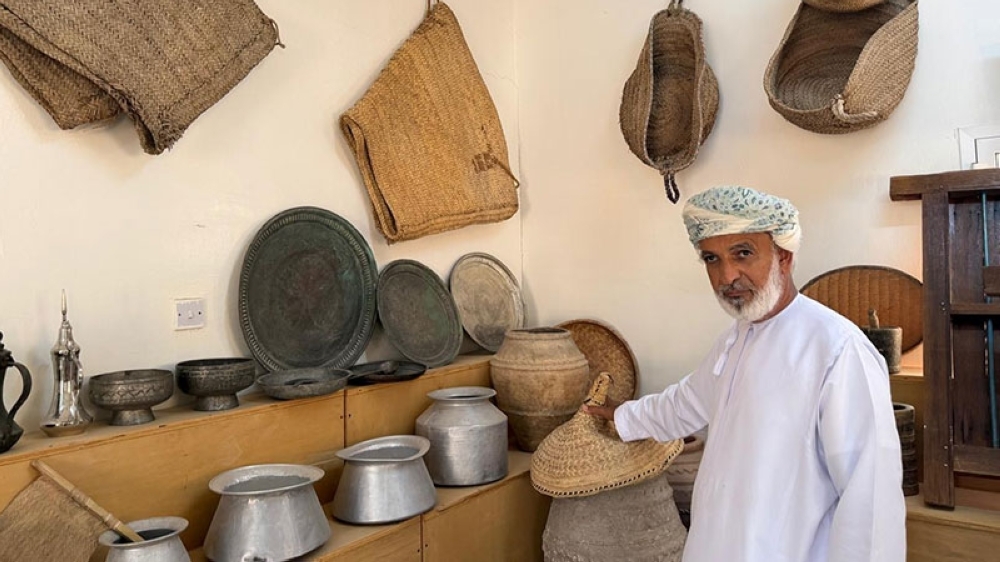
His journey began as a childhood hobby in the early 1970s, when he collected paper and metal currency, much as other children collected stamps and telephone cards. Over the years, however, currencies were no longer his sole focus. His family began gathering inherited antiques in one place, before the collection expanded to include pieces from outside the family. Gradually, the space became a gallery, offering a glimpse into Omani life before the Renaissance through household items, traditional craft tools, historical documents and rare artefacts.
The pieces are not arranged according to monetary value, but according to their stories. For Humaid, currencies are miniature historical documents rather than means of payment whose role has ended.
His collection includes the first paper issue of Omani currency during the reign of Sultan Said bin Taimur in the early 1970s, followed by subsequent paper issues up to the present. It also includes currencies from the Ottoman Empire, Tsarist Russia, the Soviet Union, the Russian Federation, Yugoslavia before its division and other countries whose political systems or borders have since changed.
He explains that currencies reveal more than economic history, reflecting political and social transformations. Yemeni currency, for example, documents periods from British colonial rule to independence and unification, while Egyptian currency reflects the transition from monarchy to successive republics.
For Humaid, collecting requires knowing the history behind each piece, the circumstances of its issuance and the geographical and political background of the country it represents. Visitors, he says, are often interested not simply in the currency, but in the story behind it.
His heritage collection is equally personal. He describes it as an effort to preserve the memory of his family and village before objects were neglected or lost. Among his most treasured possessions are the old goldsmithing and silversmithing tools once used by his father, whose craft provided the family’s livelihood. Their greatest value, he says, lies in the memories they carry.
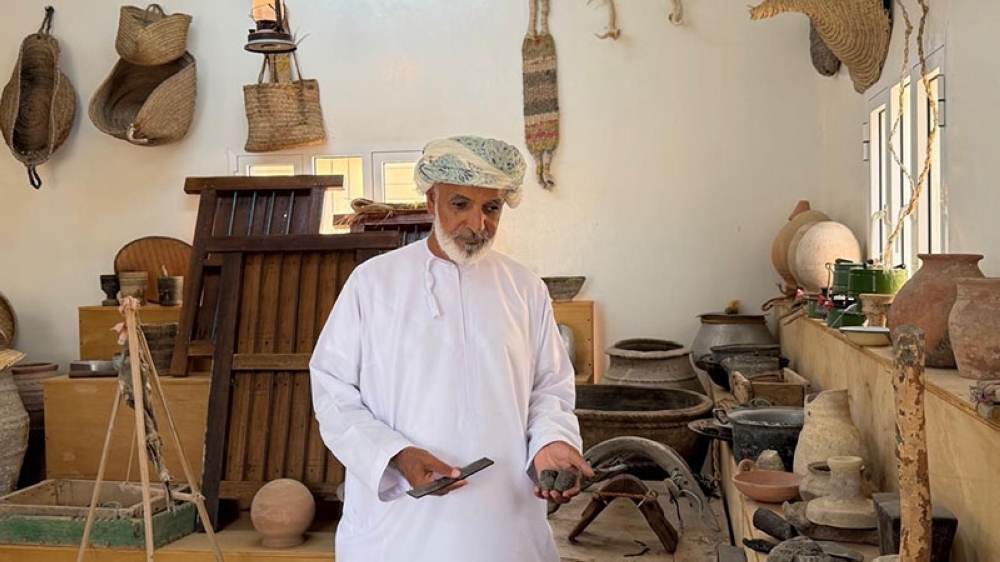
The collection also includes an old Yemeni sword, a large pottery vessel known as “al-Khabiya”, once used to extract indigo for dyeing clothes and later for storing dates, and wooden chests, or mandoos, used to store clothing and other belongings.
Rare documents add another layer to the collection, including a property sale document from Dubaishi dating to 1301 AH, a travel document to Zanzibar from the 1950s and a passport bearing the number 48, issued during the reign of Sultan Said bin Taimur.
Among his most distinctive possessions are four “Timnat”, poems praising Prophet Mohammed, which were recited during celebrations for children completing the memorisation of the Holy Quran. The procession would begin at the school and end at the student’s home, where the family welcomed the teacher and students.
The collection continues to grow through purchases from specialised forums in Oman and abroad, exchanges with fellow enthusiasts and gifts from travellers. Humaid would often ask those travelling abroad for just one souvenir: a currency from the country they visited.
Ultimately, what Humaid collects is more than currency, wooden boxes or old documents. He collects fragments of time, preserving memories that might otherwise disappear, and demonstrating how a small piece of metal or a yellowed sheet of paper can hold the story of an entire nation.
Oman Observer is now on the WhatsApp channel. Click here