




SALALAH: A marine-pilot training model being implemented at the Port of Salalah could be replicated at other Omani ports if it proves successful, according to the Ministry of Transport, Communications and Information Technology, potentially giving the programme significance beyond Salalah itself.
Eng Muhannad al Harthi of the ministry told the Oman Observer that similar programmes could be applied elsewhere following evaluation and the necessary approvals. Any expansion would be phased rather than immediate, he said.
Steven Yoogalingam, Chief Executive Officer of the Port of Salalah, said the specialist maritime skills being developed mattered both to the port and to the wider national economy.
“Looking ahead, the next stage of our growth has to be increasingly driven by Omani capability,” Yoogalingam said in remarks to participants.
The port plans to qualify 12 Omani marine pilots in two groups of six, the first of which is under way, Mohammed Salem al Ajili, Harbour Master at the Port of Salalah, told the Observer. Preparations for the second group are expected to begin towards the end of next year, he said.
The pathway combines theoretical instruction, simulation, work aboard harbour tugs and commercial vessels and supervised pilotage before candidates face the competency assessment required for licencing.
Marine pilotage has already reached full Omanisation at Al Fahal, Qalhat and Port Sultan Qaboos, Al Harthi said, while Salalah, Sohar and Duqm continue to develop Omani capability in the profession.
Al Harthi said developing the Salalah framework took around a year of technical discussion before a structured pathway was established.
He said participants are existing Port of Salalah employees being moved into pilotage roles. After qualifying, progression from smaller to larger vessels would depend on competence and accumulated experience.
Al Harthi said the conventional route to marine pilotage can take around 4 to 8 years through maritime education, professional certification and operational experience.
Marine pilotage is a regulated profession. Under MTCIT standards effective from April 16, 2026, training required for a marine-pilot licence must be accredited by the Directorate General of Maritime Affairs, with licensing subject to prescribed training, maritime service and competency assessment.
Completing the Salalah training period therefore does not by itself result in a marine-pilot licence.
Al Ajili said the pathway begins with around 12 months of theoretical and practical preparation.
During that period, candidates train aboard harbour tugs and commercial vessels and work alongside serving marine pilots.
They then move into roughly six months of supervised pilotage, although Al Ajili said the period could be longer or shorter depending on individual performance and readiness.
Once the port considers a candidate ready, the ministry is informed and the required assessment is arranged.
Candidates are tested individually on operational vessel movements, including entry, departure, manoeuvring and berthing.
Ammar al Zadjali, Marine Pilot Adviser with the programme, said at a programme briefing in Salalah that the specialist pilot-training component comprises six modules and associated short courses delivered over around nine weeks within the wider pathway.
The curriculum covers ship handling and manoeuvring, port approaches and departures, berthing and unberthing, passage planning, bridge resource management, human factors and contingency planning.
Training moves from classroom learning into simulation, practical application and assessment.
A parallel tug-engineering component runs for around 11 weeks across eight modules, covering engine-room operations, machinery and propulsion, hydraulic and electrical systems, maintenance and emergency response.
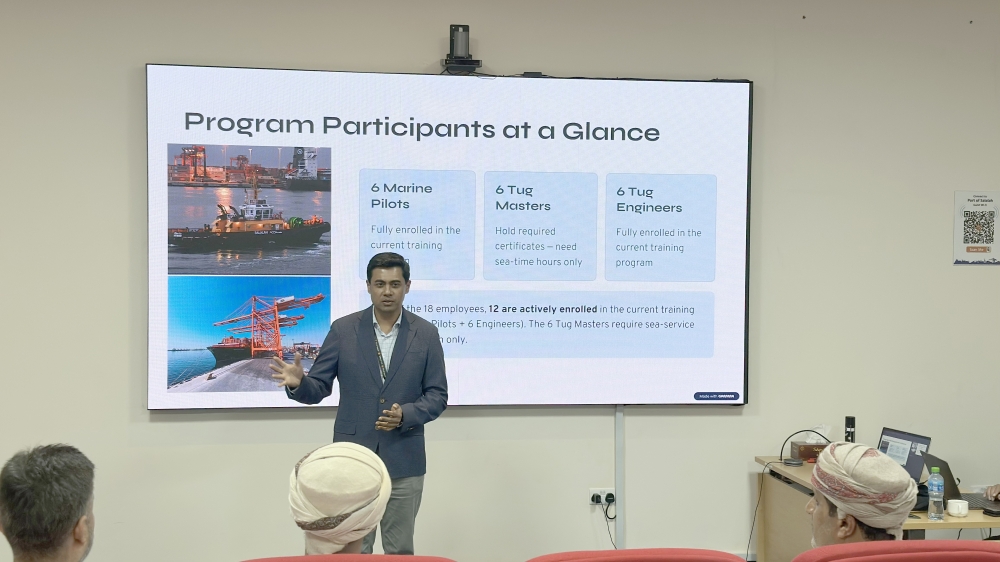
The wider marine programme covers 18 Omani employees across marine pilotage, tug-master operations and marine engineering, at a training and qualification cost of around RO 250,000, Salem Masoud Bait Said, Senior Human Resources Manager at the Port of Salalah and supervisor of the programme, told the Observer.
Bait Said said a second cohort of similar size is planned, which would take the overall number to around 36, as the port works towards full Omanisation of the three functions within two to three years.
Al Harthi said moving existing employees into higher-skilled roles could also open positions further down the employment chain for Omani graduates.
Asked whether Salalah was already coordinating with Sohar or Duqm on the programme, Al Ajili said no arrangements were currently in place, although the possibility could be considered later.
Salalah has developed Omani marine pilots before. Al Ajili said he was himself among employees trained between 2007 and 2009.
The current programme will ultimately be judged by how many candidates complete the pathway, meet DGMA’s competency requirements and obtain licences to undertake marine-pilot duties — and whether the framework subsequently provides a model that can be used elsewhere in Oman.
Oman Observer is now on the WhatsApp channel. Click here