




SALALAH, AUGUST 31
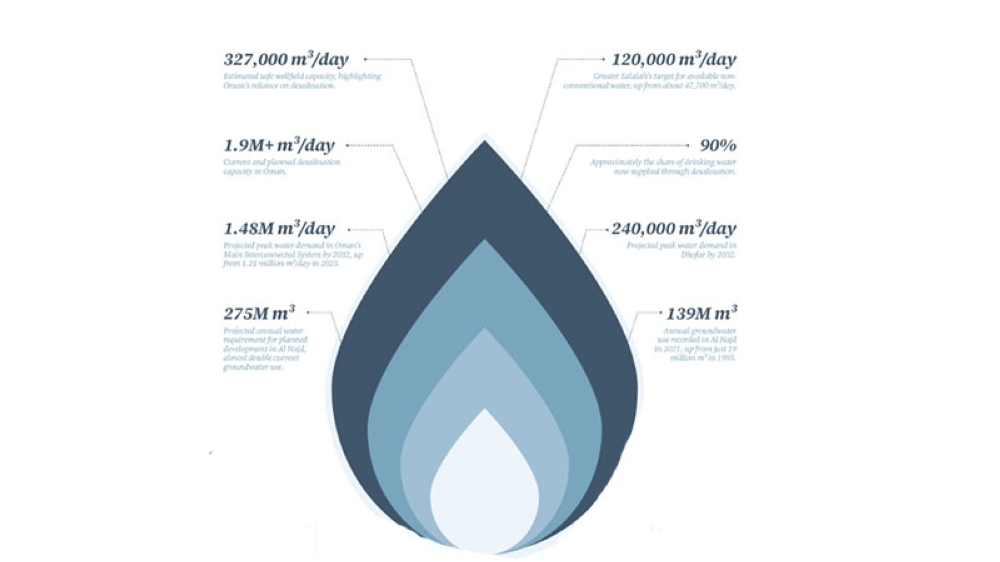
In Al Najd, future water requirements linked to planned development could reach around 275 million cubic metres a year — nearly twice the 139 million cubic metres of annual groundwater use recorded for 2021.
That figure captures a business question Oman will face increasingly often as it expands agriculture, cities, tourism and industry: should development determine water demand, or should water availability help determine where development goes?
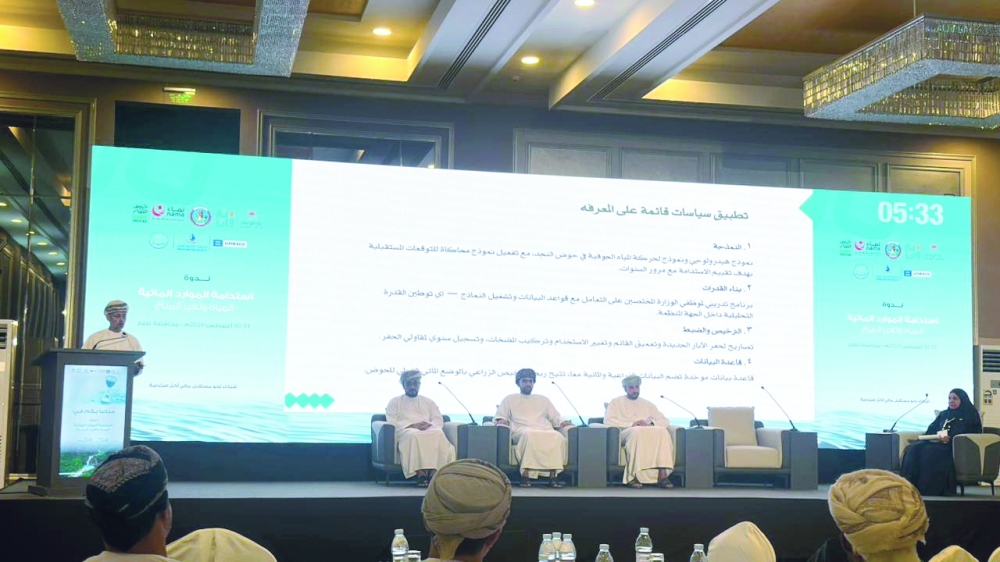
Data presented at the Water Resources Sustainability: Water and Climate Change symposium in Salalah show groundwater use in Al Najd rising from about 19 million cubic metres a year in 1995 to around 139 million cubic metres in 2021, while further projects could push requirements much higher.
The issue extends beyond Dhofar.
Nama Power and Water Procurement’s latest seven-year outlook projects peak demand in the Main Interconnected System, which serves Muscat and much of northern Oman, to rise from around 1.21 million cubic metres a day in 2025 to about 1.48 million by 2032. In Dhofar, peak demand is forecast to reach 240,000 cubic metres a day by 2032.
Meeting that growth will require investment in desalination, transmission, storage and wastewater networks. Water is therefore moving from the background of development planning towards the investment equation itself.
Al Najd demonstrates the tension clearly.
The agricultural zone north of the Dhofar mountains is important to plans to increase domestic food production, but it depends heavily on groundwater.
A presentation by Dr Khalid bin Salim Al Mashikhi, Assistant Director-General for Dams Affairs, said abstraction from the Umm Al Raduma aquifer system is exceeding recharge as agricultural expansion continues.
Isotope evidence cited in the presentation indicates groundwater in the wider Najd system ranges in age from modern recharge to more than 60,000 years. Economically, that means part of the resource behaves less like an annually replenished supply and more like a strategic stock.
Authorities are developing modelling and database systems intended to link agricultural licensing more closely to the condition of the resource.
For investors, land, finance and market demand may justify a project, but water availability can still determine whether it remains viable over decades.
It also raises a productivity question. The relevant measure is not only output per hectare but the economic and food-security value generated from each cubic metre.
Oman has reduced pressure on groundwater for drinking-water supply through large-scale desalination.
A capacity-planning presentation at the symposium said current and planned desalination capacity exceeds 1.9 million cubic metres a day, compared with safe wellfield capacity of around 327,000 cubic metres a day. It said roughly nine out of every 10 cubic metres supplied for drinking-water purposes now comes from desalination.
That represents a major gain in security, but it changes rather than eliminates the cost of scarcity.
Desalination requires capital, electricity and coastal infrastructure. As supply expands, water security becomes more closely linked to energy availability, operating costs and plant resilience.
The commercial question is therefore not simply whether another cubic metre can be produced, but what it costs to produce, move and store it — and whether efficiency and reuse could avoid some of that investment.
Greater Salalah is beginning to reflect that logic in spatial planning.
The regional structural strategy includes a target to increase available non-conventional water from about 47,700 cubic metres a day to 120,000 cubic metres a day, while raising reuse of treated wastewater from around 65 per cent to 100 per cent for suitable applications.
It also links groundwater monitoring, aquifer management and flood-risk mapping with urban planning.
Dhofar’s natural water system remains highly variable. A Ministry presentation showed groundwater levels near the foothills in the Wadi Jarziz catchment falling by around four metres between 2008 and 2011 before recovering after wetter years.
The lesson is that investment decisions must account for cycles that can look comfortable in wet years and much tighter after repeated dry periods.
Treated wastewater offers one of the clearest opportunities to reduce that pressure.
A Nama dataset covering 58 treatment plants recorded about 92.9 million cubic metres of treated effluent produced, of which around 48.8 million cubic metres was utilised. About 37 million cubic metres was discharged.
Not all of that unused volume can simply be redirected. Customers must be close enough to networks, water quality must suit the application, and distribution infrastructure requires investment.
But the gap points to a business opportunity: creating markets for water Oman is already producing. Potential uses include agriculture, ready-mix concrete, road works, cooling systems, vehicle washing and landscaping.
Water economics also appears on the opposite side of the equation: flood risk.
A Muscat Municipality presentation showed that one earlier approach to protecting major wadi corridors involved reopening natural channels, improving crossings and removing buildings and planned plots from vulnerable areas. Estimated compensation costs exceeded RO 2 billion.
The scale of that potential bill helped shift attention towards upstream flood-protection systems and dams that could reduce exposure while limiting the need for compensation.
The example carries a wider lesson. Protecting a drainage corridor before development has one cost; recovering it after land values rise and buildings occupy the floodplain can have another entirely.
The same principle applies to groundwater. Improving irrigation efficiency, controlling abstraction or extending a treated-water network requires capital today, but depletion and salinity can create larger economic costs later.
Oman’s water challenge, therefore, is not simply about finding more supply.
The harder task is allocating water to uses that create the greatest value while preserving resilience.
Which activities should use groundwater? Which can shift to treated water? How much agricultural expansion can an aquifer support? And should water availability become a more explicit factor in deciding where new industrial, tourism and urban projects are located?
For Oman’s next phase of diversification, those are business questions.
Water is becoming comparable with electricity, logistics and land: a factor that can shape location, cost and ultimately investment viability.
Instead of treating water as infrastructure that follows development, Oman is increasingly confronting a different proposition — that development itself may need to follow the water.
Oman Observer is now on the WhatsApp channel. Click here