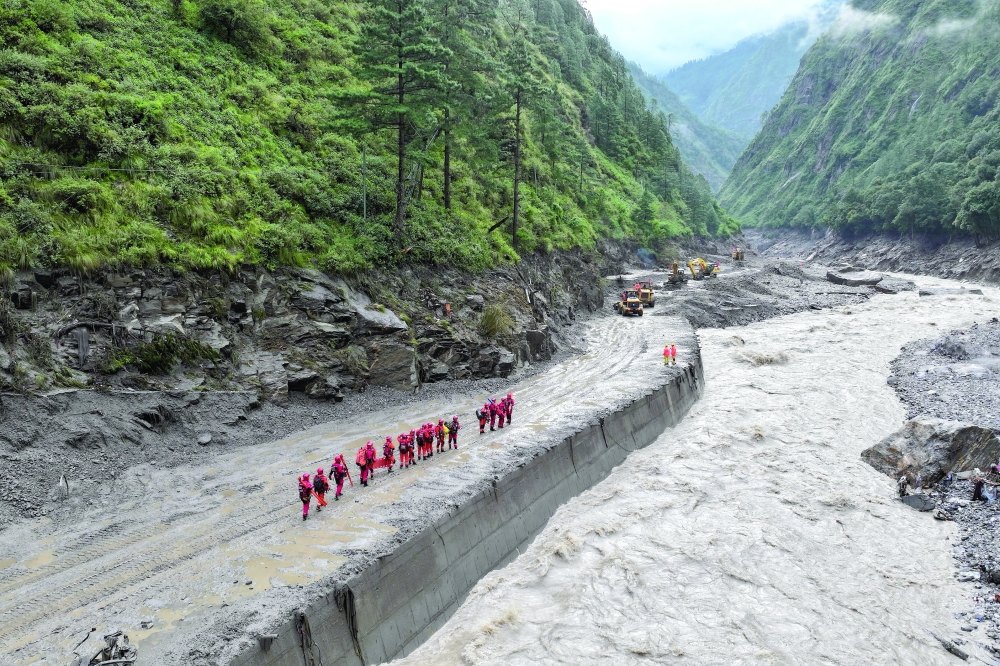





NUWAKOT: The number of people missing in Nepal and China leaped to more than 2,400 on Friday, underscoring the scale of the disaster days after a tsunami-like wall of water and debris swept away villages and killed hundreds.
Rescuers were battling through mud even as the threat of new floods loomed, with emergency teams recovering 584 bodies so far — and some of the dead swept downstream as far away as India.
The new figures came as Nepal's disaster authority added 933 hydropower workers to a missing list already including trekkers and pilgrims to Tibet's sacred Mount Kailash.
Relatives have crowded hospitals in Nepal's capital in a painful hunt for their loved ones, with posters on the walls bearing photos and names of the missing, AFP journalists saw.
"Today is the third day and we don't know anything. Hopefully he (my brother) is in a safe place," Samjhana Thing, 27, said. "We lost everything; he is our everything."
The US Geological Survey said the disaster — the deadliest for Nepal since a 2015 earthquake — was caused by a glacial collapse that triggered a vast flow of icy debris.
The deluge of ice and mud also caused huge lakes to form, with one of these formations becoming a direct threat to emergency workers scouring the region for survivors.
Nepali police urged all rescuers to "immediately move to a safe location", saying it had received information that "a water dam has burst again on the Tibetan side".
Separately in Tibet, China had earlier on Friday paused its rescue operation at the hardest-hit area of Gyirong over the risk of renewed flooding, before later saying the threat had eased.
State broadcaster CCTV reported that a lake formed by immense piles of debris began overflowing toward where rescue teams were headed, but later said the water level of the pool was dropping, so "the risk is gradually decreasing".
Rescue operations were therefore "proceeding in an orderly manner", it added.
Chinese President Xi Jinping, who chaired a meeting on rescue efforts on Friday, offered Beijing's help to Nepal's emergency operations.
Emergency teams had been racing to retrieve survivors from affected zones, where the widespread devastation meant food and water supplies were running out.
The Nepali military had meanwhile located people trapped in the tunnel of the Trishuli 3A hydropower project, where they were working to find a way in to extract the survivors.
"Two helicopters have been dispatched, but it is challenging because it is tough to even locate the entry points of the tunnel," army spokesman Raja Ram Basnet said.
Some 350 workers and residents have been brought to safety from the site, he added, but efforts were ongoing to rescue more than 100 people trapped in the same area.
Workers rescued from other dam projects along the Trishuli valley described a disaster that unfolded with terrifying speed.
Buddha Tamang said he survived only because he was inside a tunnel at the dam where he worked when the flood struck.
"I survived as I was in the tunnel," said Tamang, who was airlifted on Thursday after being marooned for more than 24 hours.
"The senior officers working on the other side, they were all swept away," he said. — AFP
Oman Observer is now on the WhatsApp channel. Click here