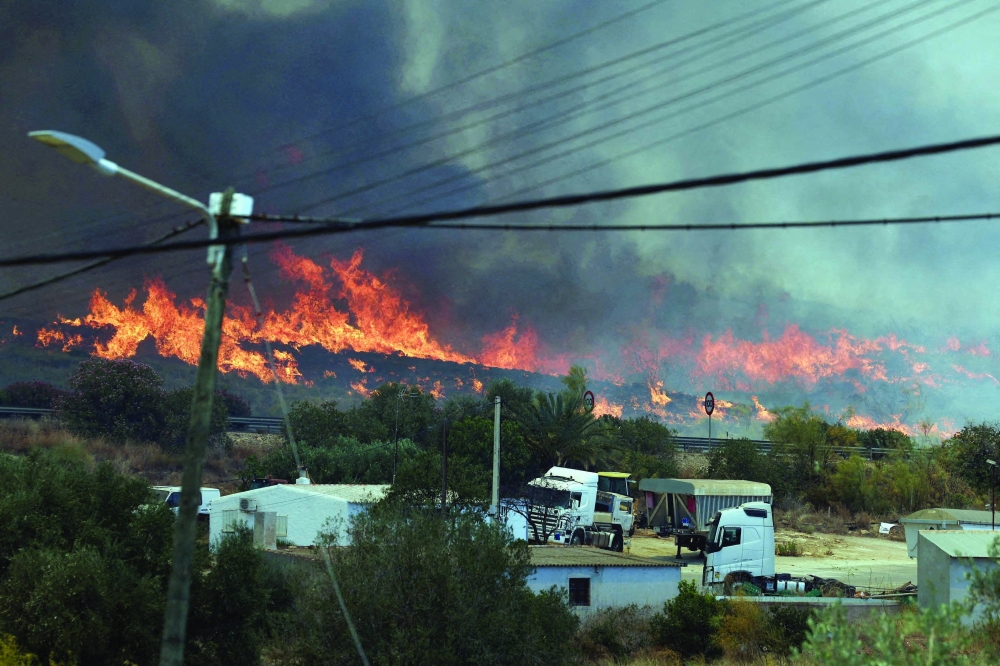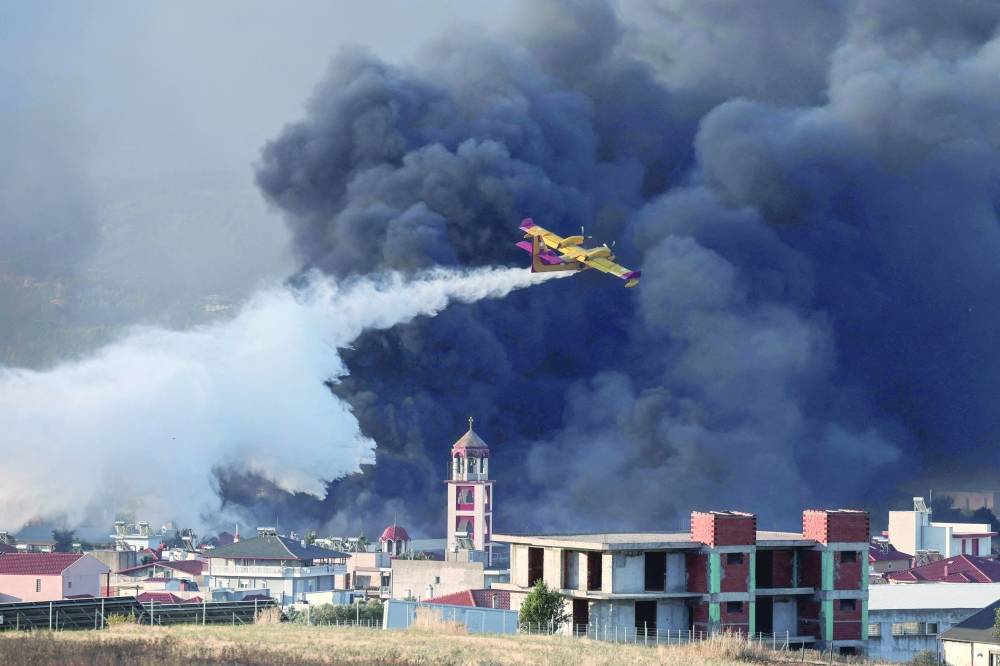





BARCELONA: Hundreds of firefighters battled forest infernos in France, Spain and Portugal on Sunday as temperatures rose again in heatwave-scarred Europe. The latest wildfires have already devastated more than 17,000 hectares of land across the three countries where temperatures in some places were predicted to touch 40°C on Sunday. Authorities registered thousands of excess deaths during one of Europe's worst heatwaves in June, and with more extreme weather on the way, France's Interior Minister Laurent Nunez has already expressed concern that the annual summer wildfire season had started a month early.
A fire near Spain's northeastern Costa Brava coast burned more than 2,200 hectares in two days and firefighters said their operation on Sunday would be "complicated" by rising temperatures and the many "smoking hotspots" within the fire's perimeter. Firefighters "worked tirelessly throughout the night to consolidate the perimeter of the La Bisbal d'Empordà forest fire, which is now stabilised," said a Catalunya fire service statement.
Catalunya regional government president Salvador Illa said that a man had been detained in connection with the fire which has badly hit the Gavarres protected natural area between Barcelona and the French border. Nearly 600 French firefighters have been mobilised to contain a wildfire that has burned more than 1,000 hectares on a mountainside at Trevillach, about 36 kilometres east of Perpignan.
Roads in the region have been closed and the authorities have ordered mayors to open emergency shelters for people who could be forced to flee their homes. Another 300 French firefighters battled another forest fire in a mountainous district of the southeastern Drome department.
In Portugal, emergency services said they had controlled "80 per cent" of a wildfire that has devastated some 13,000 hectares of forest and scrub land in the north of the country. A senior civil protection officer Jose Costa said that the fire had spread 35km since it started on Thursday and that 1,200 firefighters had been involved in the battle.
Spain and Italy sent reinforcements and water carrying planes after Portugal appealed for help to fight the inferno that has left nine people injured by burns. Several regions across Portugal, Spain and southern France stepped up heat alerts on Sunday as temperatures rose again. On Monday the latest heatwave was expected to move north. Forecasters say it could last until next weekend.
Western Europe has already seen heatwaves this year in May and June that would have been "virtually impossible" without climate change, the World Weather Attribution group of scientists said. Following a two-week surge in temperatures in June, France said there had been more than 2,000 extra deaths than usual in just one week, while Spain and Belgium each reported more than 1,000.
Authorities in several countries fear more summer trouble ahead. "Climate change is here, we are living the consequences and it is only the start of July," said French fire service Colonel Eric Belgioino as he made an appeal for people near the Pyrenees inferno to take precautions to avoid starting fires. "The season is going to be long for the soldiers fighting fires. You have to help us," he said.
Europe is still taking stock of a powerful heatwave in late June but experts are already confident it ranks among the worst ever recorded -- even rivalling a freak 2003 episode. Temperature records were rewritten across Europe as hundreds of millions of people withered under extreme heat that closed schools, shut down transport and cost untold lives. A heat dome trapped hot air from North Africa over the Iberian Peninsula in late June before spreading as far as the United Kingdom, eventually weakening over central and eastern parts of Europe in early July.
World Weather Attribution, a network of climate scientists, said the heatwave was the "most severe ever recorded" based on a three-day forecast of average peak temperatures over the region studied. Such a heatwave would have been "virtually impossible" without the influence of climate change, they said. A similar event in June 2003 would have been about 2°C cooler. In a preliminary assessment, Germany's weather service said the heatwave "can without a doubt be described as historic". "Since weather records began, there has never before been such a long and intense heatwave so early in the summer, in Germany or in many other parts of Europe," it said. — AFP
Oman Observer is now on the WhatsApp channel. Click here