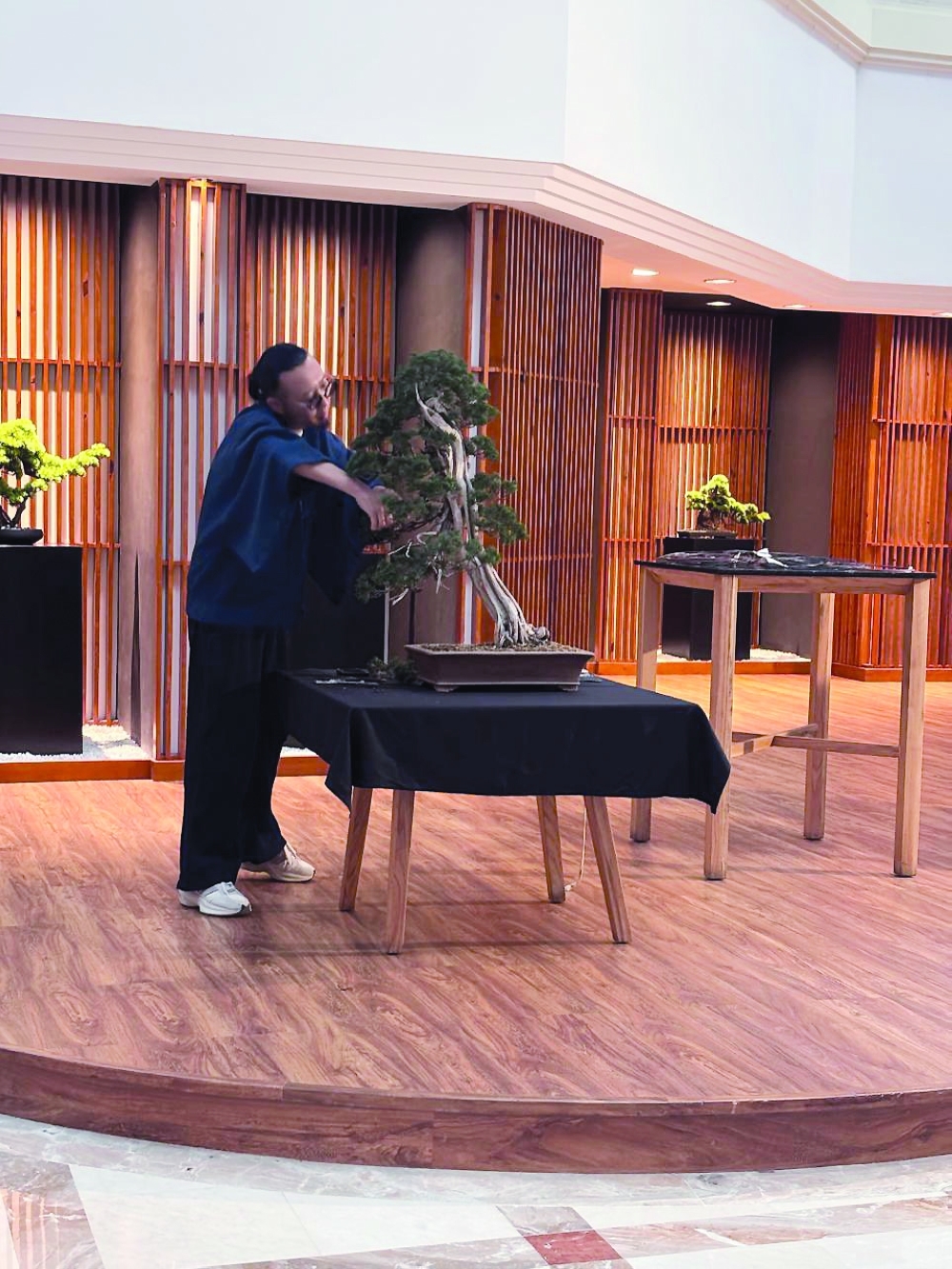





MUSCAT: Kanta Hirota, aka the ‘Bonsai Man’ as he is fondly called, who was in Muscat last week hosting live bonsai demonstrations on Bonsai, amused the audience with his hands that created Bonsai with quick moves and clockwise precision.
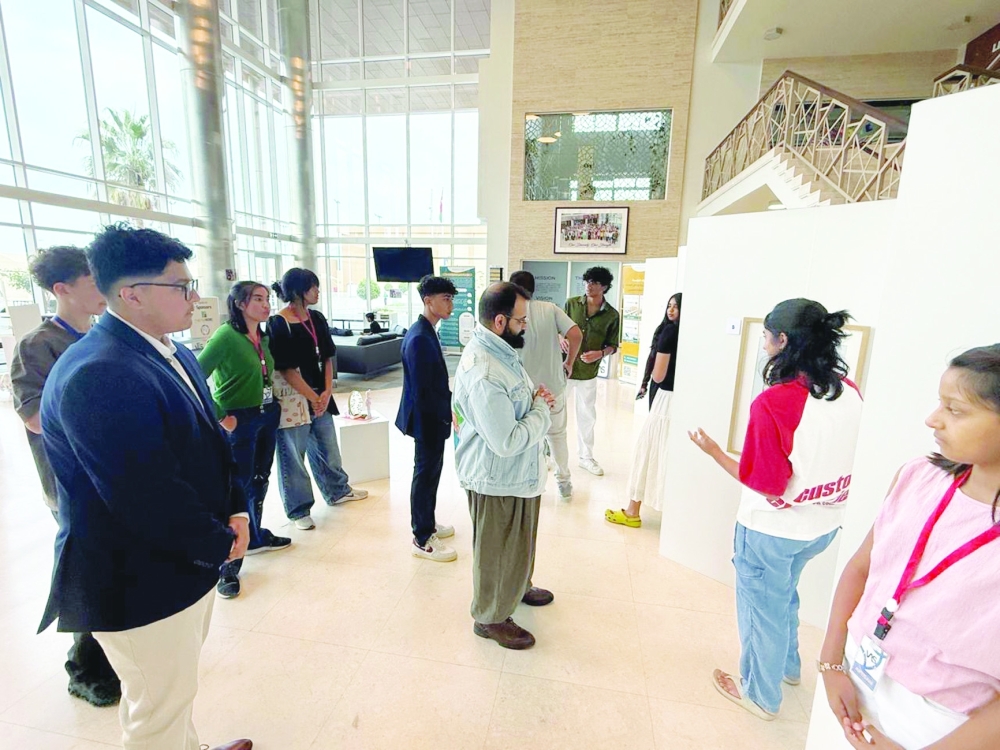
The live bonsai demonstrations that he held across Muscat in collaboration with the Embassy of Japan and the National Museum of Oman at venues including the National Museum and Takara Restaurant, was an attempt to promote bonsai as "living art" and a medium for cross-cultural connection.
He also explored Japan’s oldest art which found new roots in Oman’s soil during his few days in Muscat. He was so impressed by the resilience of local junipers in Al Jabal Al Akhdhar, that he is planning to return to study how Japanese techniques can adapt to Oman's climate and apply them to local trees.
“Bonsai is living art. If you want to touch it, first refine yourself. Pass on good energy with your hands,” he advocates. “This little tree stands still with centuries of stories to unfold and its twisted trunk speaks of storms weathered, its delicate branches of patient hands that have shaped them over generations. Every curve is intentional, every leaf a testament to discipline, artistry and time.”
He’s right. A bonsai is not a stunted tree. It is a landscape compressed and a juniper twisted by imagined storms. Branches shaped by hands that will never meet the next pair of hands. According to him, unlike a painting, it is never finished. Summer in Oman means it needs to be watered three times a day. “If you forget once, and centuries of care can end” he emphasised.
The most telling moment of his trip wasn’t on stage, but was in Al Jabal Al Akhdhar. “There are wild junipers there,” Hirota says. “Some look a thousand years old. Surviving on almost no water.” That changed something. “When I saw those trees on a harsh mountain, I became convinced Bonsai has great potential in Oman.” Now he speaks of frankincense, Oman’s iconic tree, shaped by Japanese hands. A cultural bridge in a pot. The climate is hard, he admits. “Oman’s heat needs study.” He will keep coming back to learn it.
Visitors to the three venues where he held a live demo asked if bonsai is like ikebana, Japan’s flower art. Hirota shakes his head. “In ikebana, when you cut the flower, its life ends. The arrangement is complete.” Bonsai is the opposite. “We prune so it can live longer, become healthier. Every stage is complete for that moment. Then it grows again.”
Hirota, the master artist from Japan’s historic Toju-en Garden in Omiya Bonsai Village, Saitama, entered the art of Bonsai accidentally. Hirota’s own story doesn’t start in a garden. It starts in a fashion high school. “My relative used to run a bonsai nursery. He was going to close it. Somehow, he took me in and my next task was to make it more appealing and make profit,” he recalls.
Within a few months, there were people crowding the shop again as he approached it with the belief that bonsai is not about stunting a tree unlike ordinary gardening. It is about creating harmony between nature and human imagination, good and bad, past and present, capturing the essence of a full-grown landscape within a single pot.
At Toju-en, founded in 1931 after Omiya Bonsai Village began, bonsai is treated as time itself. Wind, cold, years. A dialogue, not control. Third-generation owner Hirota now carries it forward — selling trees, yes, but mostly passing on spirit. In 1966, Toju-en opened the first public bonsai classes in Japan. Today it still does, for beginners and collectors alike. It also leases trees to hotels and cultural venues. Living art, maintained. He still feels: “A bonsai is never just a tree. It is patience you can see, respect you can hold, and perseverance in miniature.”
Oman Observer is now on the WhatsApp channel. Click here