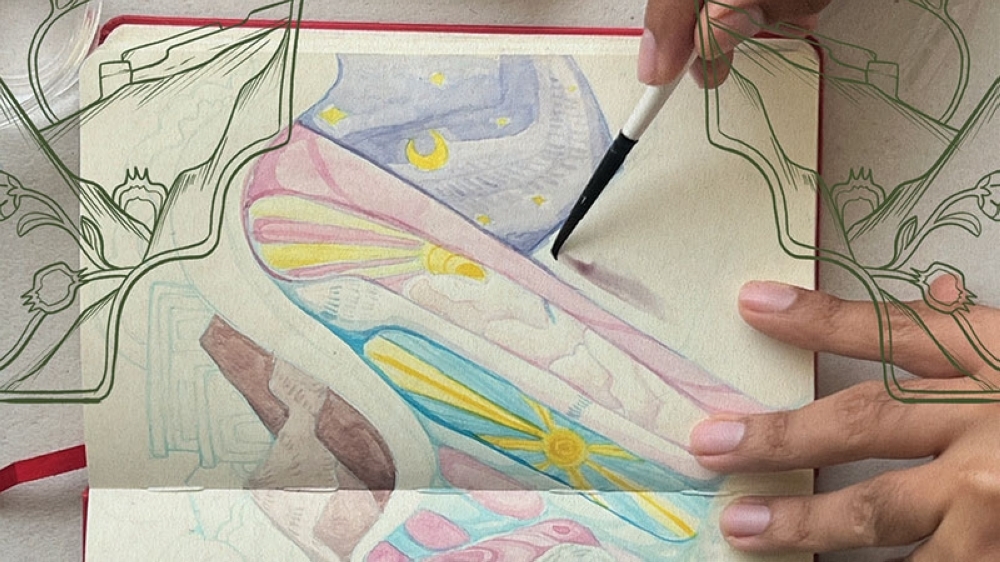





Some children are content with watching cartoons, while others try to draw their favourite characters. As a child, Mohammed al Attar was preoccupied with a different question: where do these worlds come from, and how can a screen contain entire cities, characters and stories? That curiosity inspired him to imagine worlds of his own, complete with names, houses and roads.
As he grew older, so did his dreams. Today, Mohammed writes and paints with the imagination of the child who once believed fish could fly, birds could dive into the sea, and the impossible was simply a word invented by adults. “My imagination is fertile because my relationship with my inner child is strong,” he said. “My artwork reminds us that each of us has a child within who deserves wings to break boundaries and reach the impossible.”
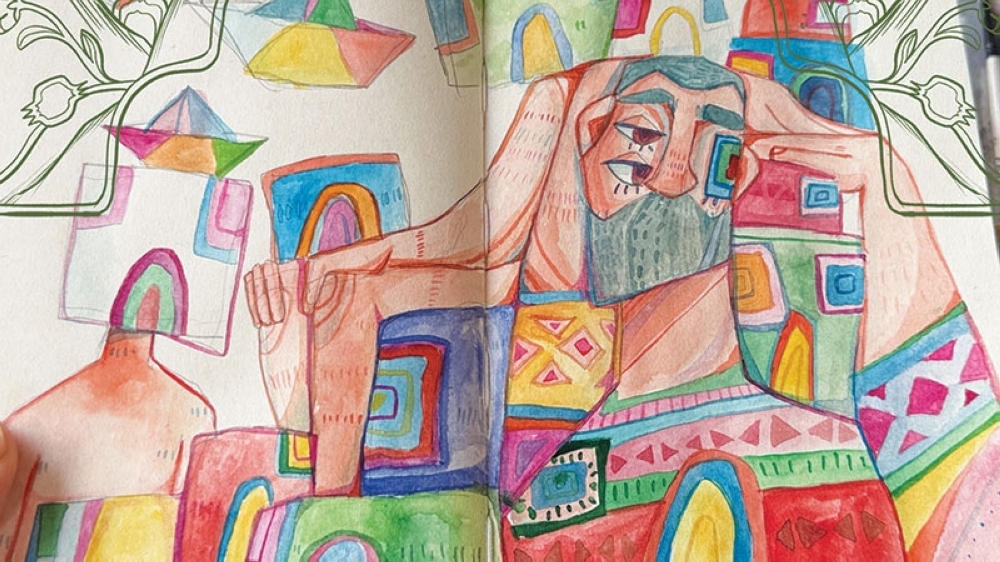
His works exist somewhere between reality and dream. They are neither fully surreal nor strictly realistic, but occupy a space where emotions take visual form. Mohammed does not paint simply to create beautiful images. Instead, he believes that emotions left unexpressed become burdens. “I believe repression is the enemy, and expression is salvation,” he explained.
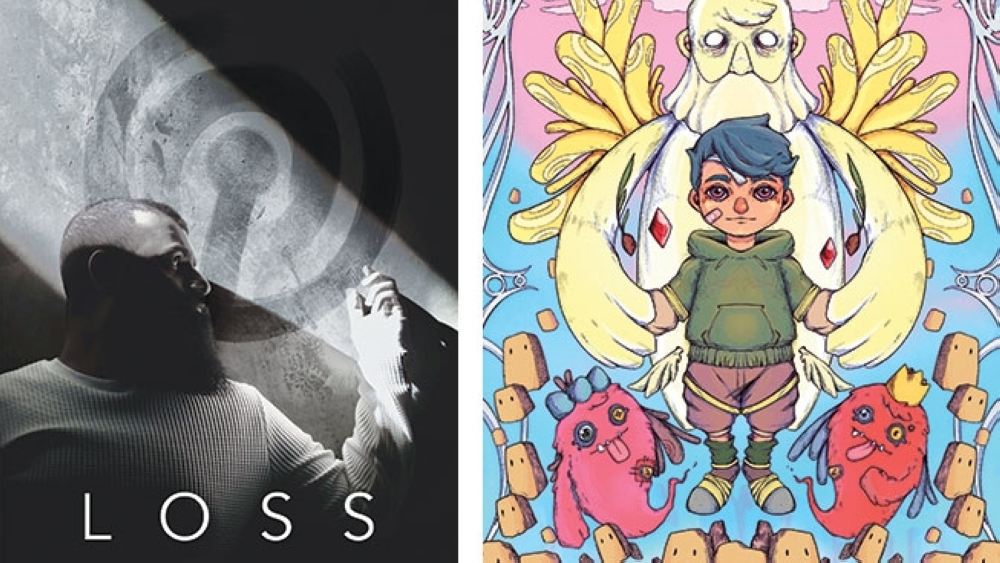
This philosophy is reflected in recurring motifs such as glowing hearts, closed eyes, repeated faces and children embracing themselves. For Mohammed, art and writing are psychological tools that help him confront emotions, analyse behaviour and better understand both himself and others. He describes his creative practice not as a painting journey, but as a healing journey. “We find peace when we allow ourselves to confront and contain our feelings, accepting both the dark and bright aspects of them,” he said.
His work resonates with audiences because of its emotional honesty. Rather than avoiding difficult feelings, he transforms them into colourful, symbolic compositions. Through people’s responses, he discovered that art creates a safe space where viewers realise they are not alone in their struggles.
Faces also dominate his compositions, often with multiple expressions contained within a single figure. To Mohammed, people do not possess one fixed identity but many selves that question, struggle and grow together. Likewise, the symmetry found throughout his work began as an artistic challenge before evolving into a reflection of his own journey of self-exploration.
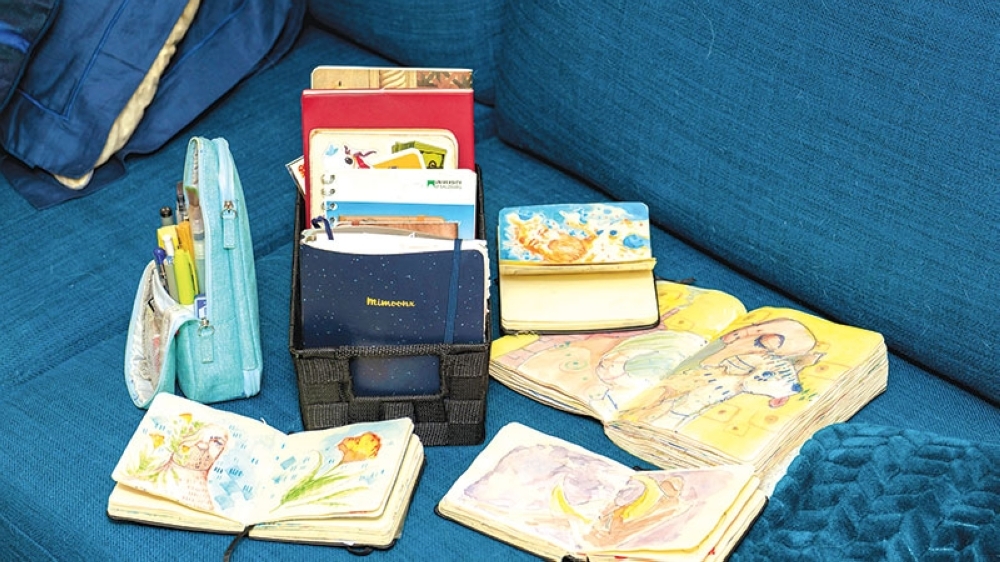
At the heart of Mohammed’s artistic world is childhood, not as a stage of life, but as a permanent part of the human spirit that continues to wonder, dream and hope regardless of age. His childlike figures stand facing the world with open hearts, reminding viewers of the innocence often lost in adulthood.
Among his most emotional works are those dedicated to Palestine. While acknowledging that no painting can fully express its story, he sought to capture both pain and hope through symbols of traditional dress, olive trees and homeland. “These works were not merely a political stance, but an extension of my belief that art should be a space where people feel they are not alone,” he said.
Mohammed’s creativity extends beyond gallery walls into books, clothing, furniture and everyday objects. He dreams of making art part of daily life, believing stories can live on a coffee cup, notebook or piece of fabric. Rather than fearing artistic block, he continually shifts between painting, writing and digital media, describing constant renewal as “immunity against artistic block”.
He describes his philosophy as “simple yet profound”, but behind those words lies a world of children who never stopped dreaming, hearts learning to heal, and imagination that remains open to everyone.
Oman Observer is now on the WhatsApp channel. Click here