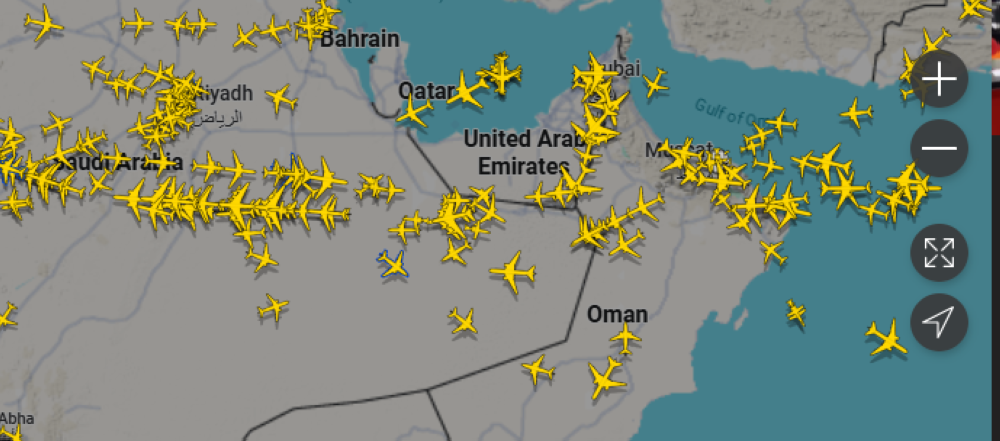





Muscat: Oman's air traffic controllers have been praised by aviation industry leaders for their exceptional handling of increased flight movements during the early stages of the recent Middle East conflict, ensuring smooth operations despite a significant surge in air traffic.
Kamil al Awadhi, Regional Vice President for Africa and the Middle East at the International Air Transport Association, described Oman's management of the situation as highly impressive.
"It was incredible to see how well Oman's air traffic controllers handled the situation, with almost no obstacles. It is impressive that Oman managed to accommodate that airspace and the volume of traffic it received," he said.
Al Awadhi noted that within weeks of the conflict escalating, most airline fleets across the GCC were grounded, resulting in a sharp decline in regional air traffic.
"The traffic dropped to almost zero. In fact, the only airlines operating were those flying in and out of Saudi Arabia through Oman, in addition to Oman's national carriers. They did an amazing job," he added.
Meanwhile, aviation analytics firm Cirium said its schedules data indicates that passenger capacity in the Middle East is expected to recover to 2025 levels by September, with approximately 5.6 million seats available across 27,300 flights. This would match the number of services operated during the same period last year, while representing a 1.3 per cent increase in seat capacity.
According to Cirium, seat capacity during July and August is projected to remain around 2 to 3 per cent below last year's levels, while June recorded a nearly 18 per cent decline.
Omani airspace has continued to operate without interruption since the onset of the conflict, underscoring the resilience of the Sultanate's aviation infrastructure and operational capabilities.
The Sultanate's air traffic management system is supported by advanced technology and highly trained personnel, enabling it to effectively manage additional traffic arising from geopolitical developments.
Earlier, Saleh Abdullah al Harthy, Director General of Air Navigation at the Civil Aviation Authority, told the Observer that the post-pandemic recovery has contributed to increased utilisation of Oman's airspace.
"The post-COVID recovery has seen an increase in the number of flights using Oman's airspace, while geopolitical developments in the region have also played a major role in traffic growth. Oman is regarded as one of the safest corridors linking East and West," he said.
He added that airlines are increasingly choosing Oman's airspace because of the high-quality services supported by significant investments in communication, navigation and surveillance infrastructure.
Al Harthy stressed that Oman's airspace is managed by highly qualified and well-trained professionals capable of handling a wide range of operational scenarios, including unexpected surges in air traffic movements.
Oman Observer is now on the WhatsApp channel. Click here