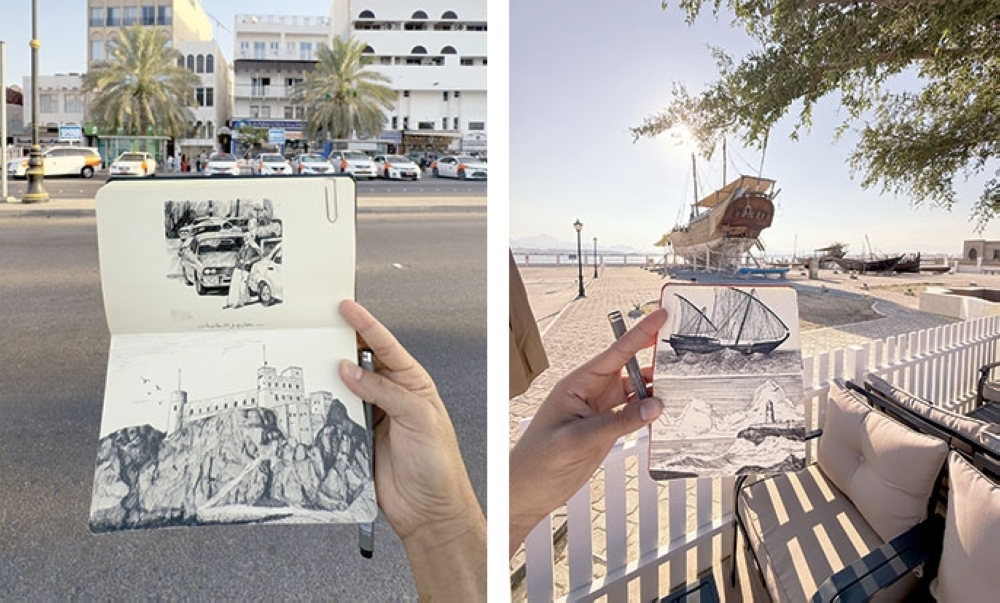





In the margins of a modest journal, worlds quietly unfold. Some pages hold buildings caught mid-light, others trace mountain lines, passing streets, or faces borrowed from film. For Issa bin Saif al Nairi, drawing is not an announcement, it is a habit of noticing. By profession, he works as an electrical technician, a role defined by structure and routine. But beyond his workday, he returns to pen and paper, where observation replaces urgency and the ordinary becomes worth keeping.
Issa’s relationship with drawing began without intention. There was no plan, no imagined audience and no pressure to produce something polished. His journal started as a personal space for release, a place to empty thoughts visually and make sense of what surrounded him. At first, it was simply a notebook filled with ideas and visual notes. Over time, it transformed into a living record of daily life, documenting whatever caught his attention, whether significant or fleeting.
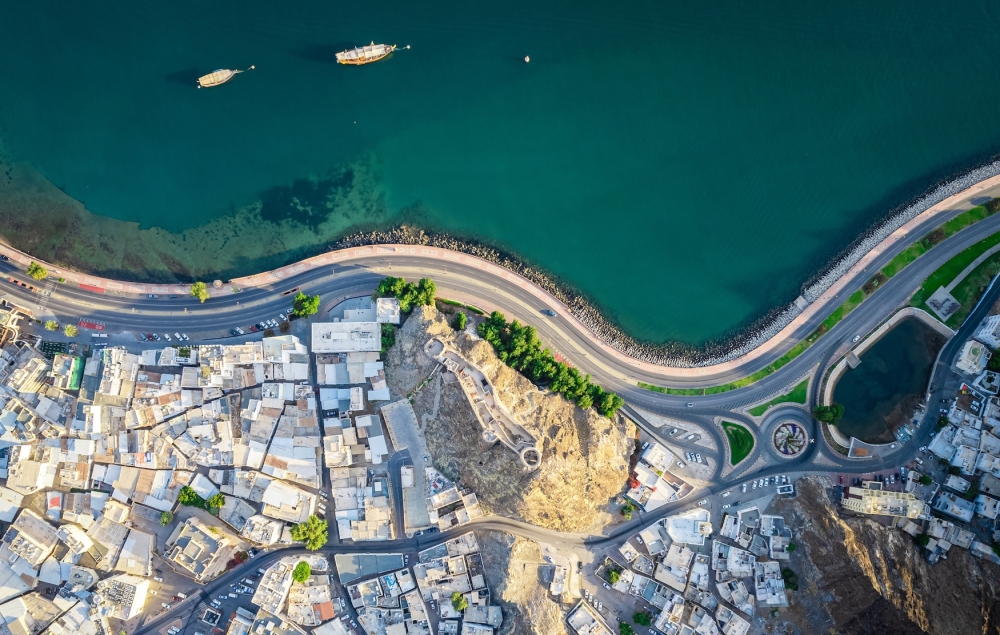
As the pages accumulated, places began to take shape more clearly. Issa found himself drawn to landmarks, not because they were famous, but because they carried quiet stories. Oman, as he sees it, is rich with details that are often overlooked, details that are calm, subtle and visually underused. Sketching these spaces became a way of preserving visual memory, especially historic areas such as Muttrah, where architecture, history and identity intersect. In his drawings, forts, streets and buildings are not presented as static icons, but as lived spaces shaped by time.
When Issa visits a new location, it is rarely a single object that prompts him to draw. The spark usually comes from the overall feeling of a place. Atmosphere leads, details follow. Sometimes it is nature that demands attention, sometimes it is a brief moment that might otherwise disappear. His sketches feel instinctive, guided by emotion rather than strict composition. The page becomes a response to being present, rather than an attempt to capture everything.
Alongside landscapes and landmarks, cinema plays a subtle but meaningful role in Issa’s work. Film is part of his artistic world, just like drawing. Certain characters or scenes leave an impression that stays with him and when that happens, he translates that feeling into a sketch. These drawings are not copies, but personal interpretations. They reflect what a scene stirred within him, allowing fictional characters to coexist with real places inside the same journal. Together, they form a layered portrait of his interests and inner life.
Issa describes his style as free documentation. It sits somewhere between realism and personal perspective, shaped by how he experiences life rather than how things are expected to look. His style was not something he set out to define. It emerged gradually through consistency and time. With every page, his lines became more confident, his compositions more mature, reflecting his own growing clarity and connection to his surroundings.
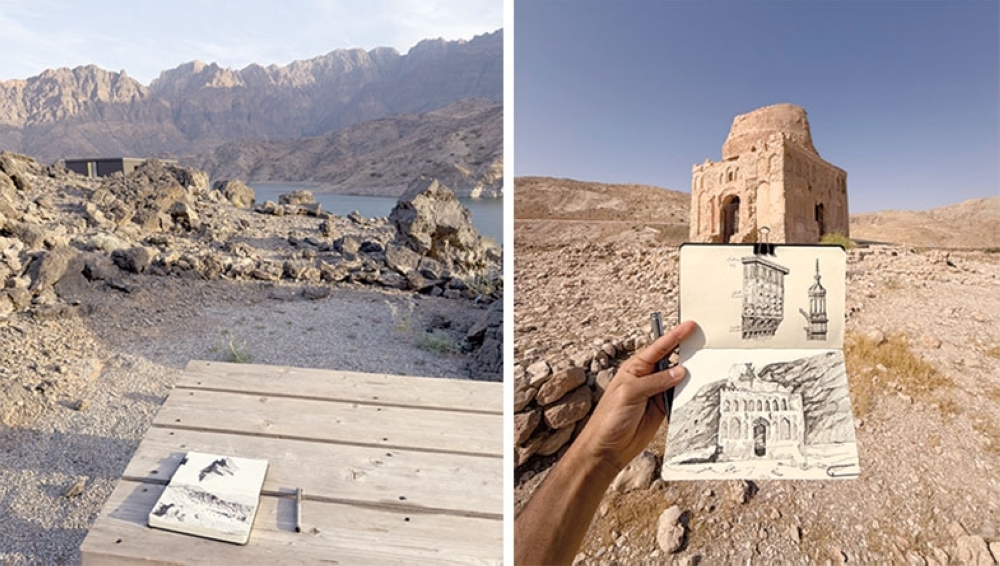
The journal itself plays a central role in his daily life. It is his constant companion, especially during travel. He returns to it whenever he wants, sometimes treating it as a second memory, one that stores places, feelings and moments that words cannot fully hold. Flipping through its pages reveals not just drawings, but a timeline of experiences, each one anchored in observation.
When Issa first began sharing his sketches publicly, he did so casually. His account functioned as a personal archive, a visual diary shared without expectation. Over time, people began to connect with the sketches. They felt honest and unfiltered; and viewers saw them as an extension of who he was. With continued sharing came growing support, even from companies. That encouragement led Issa to take a step forward, treating his art as professional work rather than a private hobby.
At the heart of his drawings is a desire to communicate the beauty of Oman in all its diversity. He speaks of its cultural, architectural and geological richness, of Islamic architecture that shifts from one wilayat to another, of forts in Muttrah, the vast stretch of the Al Hajar Mountains and the contrast between coastlines and inland terrain. Simply driving between regions, he believes, is enough to inspire, even for those who do not consider themselves artists. To him, Oman feels like a small continent, complete in its variety.
This belief eventually led to the creation of sketch’d, a brand born from a simple request by friends to turn a drawing of the Al Hajar Mountains into a printed design. What followed was not driven purely by profit, but by a desire to create a modern Omani brand with an authentic identity. Through sketch’d, Issa extends his drawings beyond the page, creating products for hikers, campers and those drawn to the outdoors, people who want to wear something that reflects who they are.
Looking ahead, he hopes sketch’d will become a leading name in hiking and camping products. His vision goes beyond clothing, towards building a brand that belongs naturally in the landscape. For Issa, every sketch remains a quiet act of presence, a way of paying attention to the world and leaving behind a trace of how it once felt.
Oman Observer is now on the WhatsApp channel. Click here