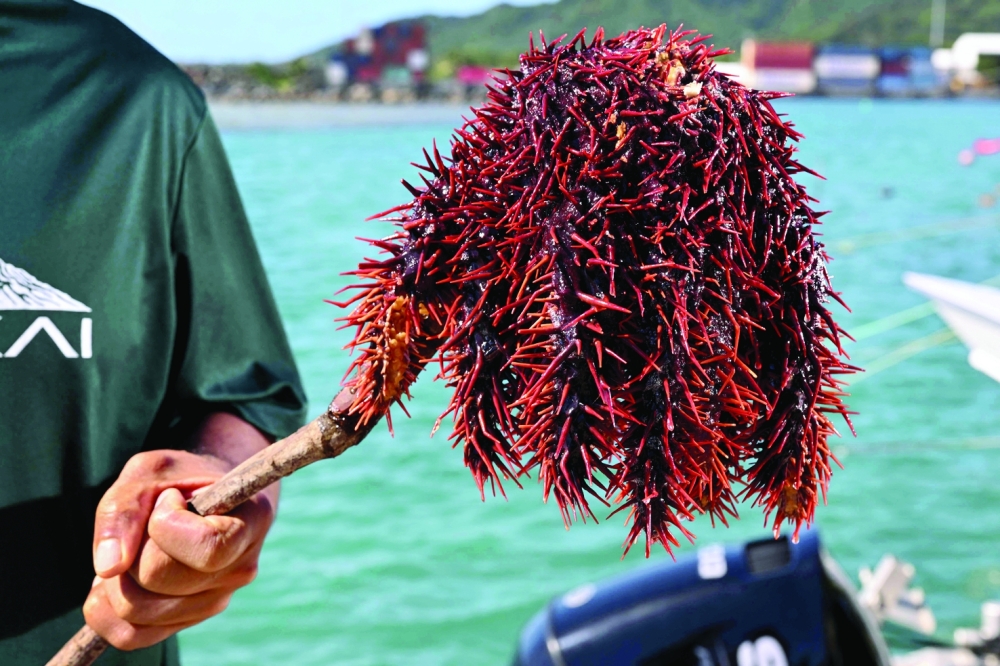





Divers clutch wooden spears as they plunge beneath the waves, hunting hordes of hungry starfish destroying the coral reefs around the Cook Islands.
These makeshift tools are their best weapons in the war against crown-of-thorns starfish, a coral-munching species eating through tropical reefs already weakened by climate change.
The Cook Islands, a South Pacific nation of about 17,000 people, is in the grips of a years-long outbreak, says marine biologist Teina Rongo.
“It can completely kill off the entire reef, right around the island”, said Rongo, who organises volunteers protecting the reefs fringing the isle of Rarotonga.
“I think there seems to be a Pacific-wide outbreak at the moment, because we’re hearing other countries are facing similar challenges”.
A single crown-of-thorns adult can eat more than 10 square metres of reef each year, squeezing its stomach through its mouth to coat coral in digestive juices.
They pose a major threat to Australia’s Great Barrier Reef, where scientists have developed robots that hunt down the prickly invertebrates and inject them with poison.
“At the moment, you basically kill them by injection”, said researcher Sven Uthicke, from the Australian Institute of Marine Science. “It could be vinegar, it could be lime juice or ox bile.
“Others are building chemical attraction traps. It’s all very promising — but it’s in the development stage”.
Rongo finds it quickest to pry the feasting starfish loose using a wooden stick cut from the dense timber of the Pacific Ironwood tree.
“Basically, we use a stick with a hook at the end”, he said. “We’ve made some modifications over time because we were getting pricked by these starfish. It’s painful”.
Named for their hundreds of venomous spikes, crown-of-thorns starfish have as many as 21 fleshy arms and can grow larger than a car tyre.
‘Plague proportions’
They spawn in “plague proportions”, according to the Australian Institute of Marine Science and are a major driver of coral loss.
From the Red Sea to the Pacific Ocean, crown-of-thorns outbreaks appear to be becoming both more frequent and more severe.
“Some argue that the crown-of-thorns has become chronic in the last few decades”, said Rongo, talking about the reefs of the South Pacific.
Scientists suspect these outbreaks are triggered by a mix of factors, including nutrients leached into the sea from agriculture and fluctuations in natural predators.
But the damage they can cause is getting worse as reefs are weakened by climate change-fuelled coral bleaching and ocean acidification.
“This is why it’s important for us to help the reef”, says Rongo.
Scuba divers scour the Cook Islands’ reefs for hard-to-spot starfish wedged into dimly lit crevices.
The day’s haul is dumped into a plastic chest before the starfish are lugged ashore to be counted, measured and mulched for garden fertiliser.
They are known as “taramea” in Cook Islands Maori, which loosely translates to “spiky thing”.
The volunteer divers working with Rongo and his environmental group Korero O Te Orau — or Knowledge of the Land, Sky and Sea — remove thousands of starfish every year. “I was part of that eradication effort. “We were too late when we did decide to do something about it. It went on and ended up killing the reef”. — AFP
A single crown-of-thorns adult can
eat more than 10 square metres of
reef each year, squeezing its
stomach through its mouth to
coat coral in digestive juices
Oman Observer is now on the WhatsApp channel. Click here