




A photo of Christian Dior’s original salon stretched the width of the Invalides, the gold-domed palace where Napoleon is buried, offering a fish-eye view of the past to the throngs shrieking outside — and a sign of just where Dior believes it belongs in the pantheon of French power.
Inside, dove-gray velvet lined the walls of a temporary event space and displayed two rare 18th-century oils by Jean Siméon Chardin on loan from the National Galleries of Scotland and the Louvre. Robert Pattinson gossiped with Josh O’Connor. Donatella Versace schmoozed with Roger Federer. A pregnant Rihanna arrived with A$AP Rocky a mere 45 minutes after the official start time.
That’s how much anticipation there was for the Dior men’s show. Filmmaker Luca Guadagnino was even trailing around to document the moment.
It was Jonathan Anderson’s debut as the creative director/savior of the house, the first designer to be put in charge of both menswear and womenswear. And under all the buzz, a giant question mark hovered: Could the former Loewe wunderkind reignite excitement not just in the brand but in fashion?
Anderson made it look easy. Literally.
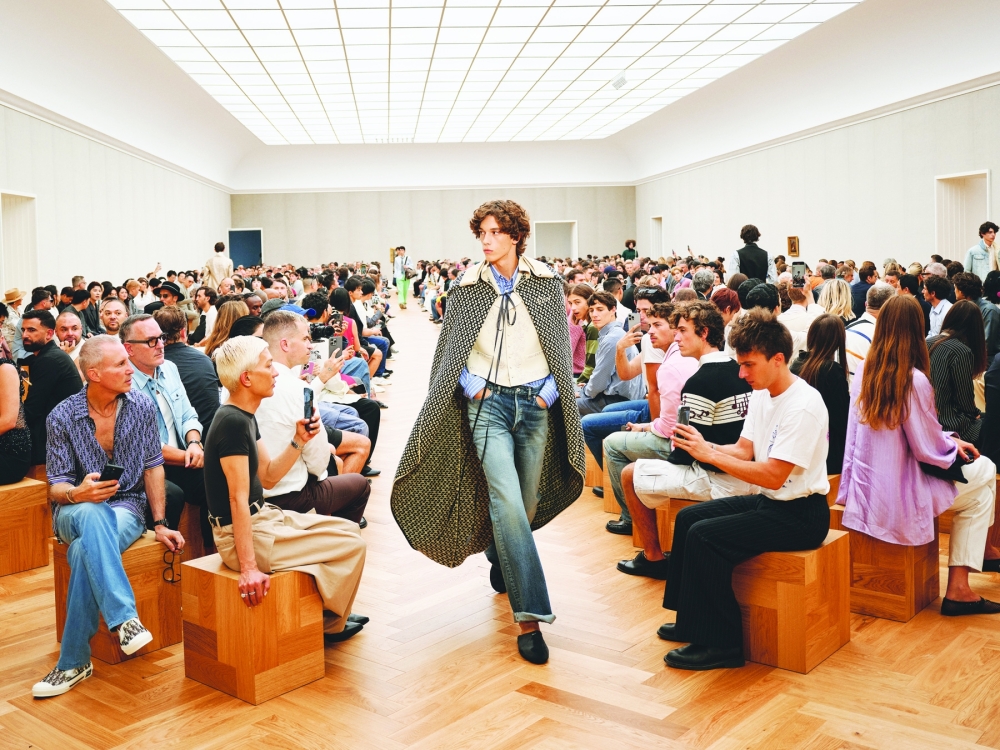
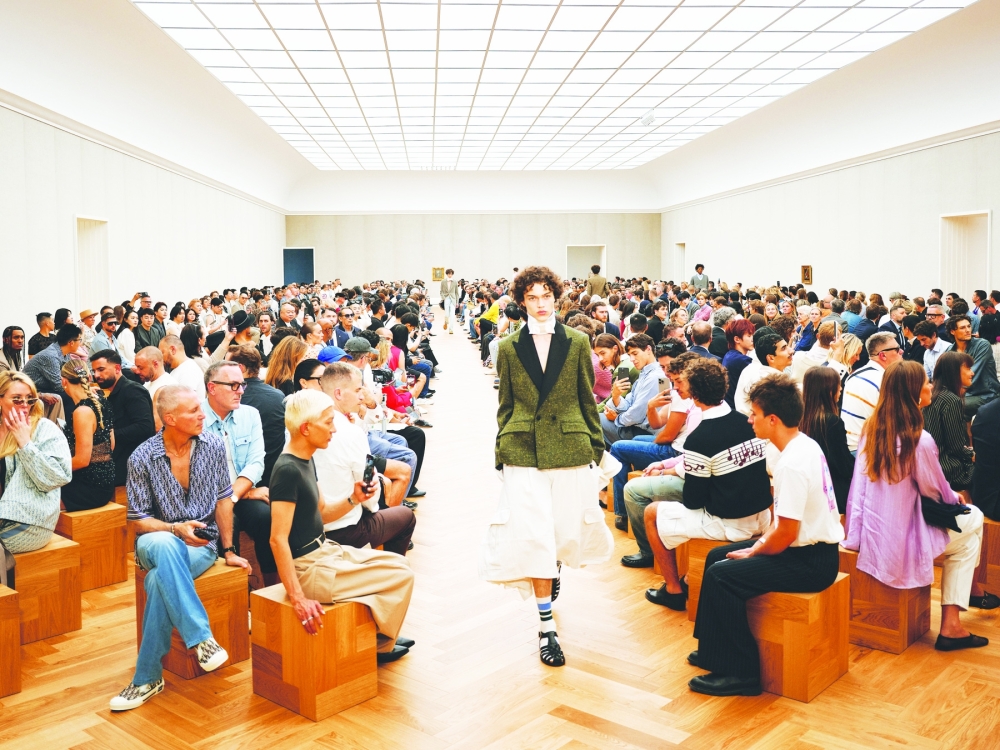
Beginning with his take on the Bar jacket, the most famous Dior womenswear shape — the one that prompted Harper’s Bazaar editor Carmel Snow to jump out of her seat shrieking, “It’s a New Look!” in 1947. It was reimagined in a Donegal tweed with a flat back and a whiff of the hourglass at the front, as if it retained a vague memory of what it once was.
With it, he paired not a shirt but a stiff white stock collar and a pair of oversize white cotton cargo shorts, each side sporting elaborate folds to create the plumped out silhouette of a goose, or a 1948 couture dress called the Delft. Go on, shake your tail feathers.
If little Lord Fauntleroy had spent a year at the University of Southern California and then returned for a pickup game of basketball at Versailles, this is how he might dress. It was not a capital N New Look. It wasn’t that radical, or shocking. But it was an awfully charming newish one.
And it was situated smack in the middle of the tension between formality and informality, menswear and womenswear, commerce and creativity (Anderson’s own work at Loewe and Uniqlo and what he inherited at Dior), which seems to define this particular moment.
No one is all one thing or another. Neither are their clothes. Neither are the totems of wealth. What Anderson proposed was a clear and convincing argument that contradictions can gracefully coexist. Most of all, he put forward the belief that fashion and wearability are not irreconcilable ideas — that you either have to look bizarro or look boring.
For every highfalutin garment there was an equal and opposite this-old-thing, usually worn together. Velvet frock coats were paired with faded jeans in Japanese denim. Olive green puffer coats and down vests were cut with trapeze backs. The exact pattern of another classic Dior dress, the Caprice, with its elaborately swathed peplum skirt, was applied to a pair of loose khakis, giving one leg the fillip of a drape. An 18th-century frock coat was exactingly reproduced — in moleskin.
There were shamrocks on tennis shoes and high-tops with driving shoe soles; cable knits under elaborate waist coats. There was a lot of neck action. Book totes borrowed, again, from the women’s line, with actual book titles on them from Baudelaire and Françoise Sagan.
Anderson had clearly done his homework.
Easter eggs to early Dior were everywhere. Even the labels inside the clothes were in the designer’s preferred silk faille. He was never going to toss everything out the window and start again. He couldn’t. Dior is a multibillion-dollar business, after all, and some of his predecessors (Raf Simons, Hedi Slimane, John Galliano) were his idols.
Once upon a time, a designer might have had the arrogance to wipe the slate clean, but this is a new age. The industry is in crisis, and the creative tectonic plates are shifting. It is why Anderson invited seemingly every other designer in Paris to join him at the show.
It is also why he picked the Chardin oils and why he seeded his Instagram with Warhol Polaroids of Lee Radziwill and Jean-Michel Basquiat. Chardin, he said in a preview, “kind of loosened up the still life”; Warhol made pop culture high art. Both crystallized an inflection point in culture. Anderson clearly wants his Dior to do the same.
His show invitation came borne on a china plate with three china eggs on top, as if a reminder that the menswear was just the beginning (and maybe to acknowledge that some shells may get broken along the way). Fair enough. The result may not knock you sideways, but it’s likely to make you sit up and buy.
Not to mention whetting the appetite for his first womenswear collection, come September.
Oman Observer is now on the WhatsApp channel. Click here