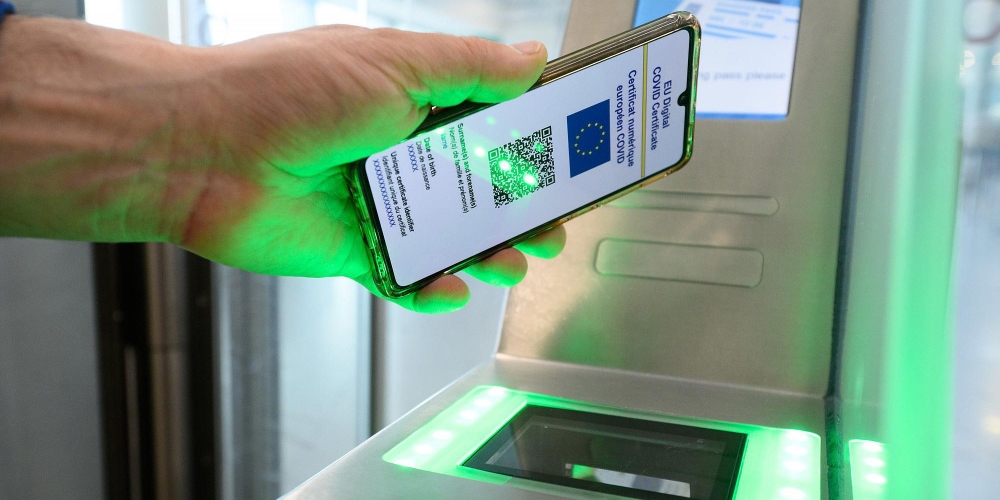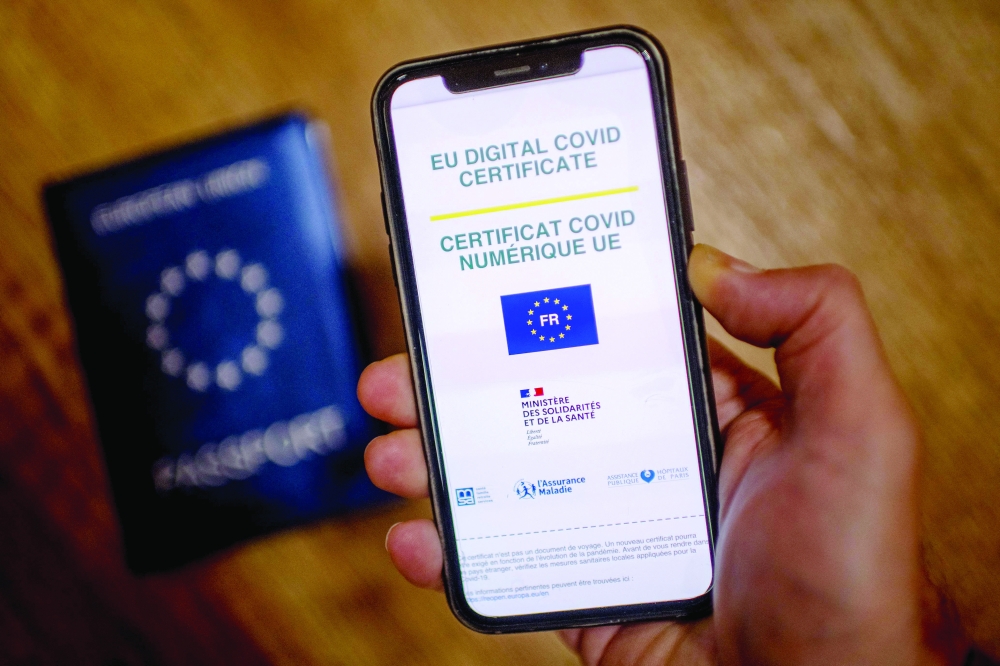





Brussels: The European Union's digital Covid-19 travel certificate officially went live on Thursday, with more than 200 million documents already generated following a soft launch last month, according to the bloc's executive branch.
Twenty-one EU countries had already started handing out the certificates in June, with five more joining their ranks on July 1, a press release from the European Commission said. Non-EU members Norway, Iceland and Liechtenstein are already handing them out too.
Only Ireland is yet to hand out any documents, according to information shared by the commission.
The document, available digitally or on paper, allows EU residents to show whether they have been vaccinated, tested negative, or recently recovered from an infection with the coronavirus.
It is deemed a vital lifeline for European tourism, and a central pillar of the plan to restore free movement in the EU more fully.
The member states still have the final say in whether to impose entry requirements like additional testing or quarantine on travellers within the bloc, but in principle certificate holders should not be subject to such restrictions.
While the 27 EU states have significantly opened up to one another in recent weeks, Germany has come under fire for advising travellers to avoid popular holiday destination Portugal due to the prevalence of the Delta virus variant there.
The EU digital Covid certificate, which can be on a smartphone or printed out, takes the form of a QR-code, which indicates if a traveller has received been fully vaccinated against Covid-19, has received a recent negative test result or has immunity due to recent recovery from a Covid-19 infection.
It is designed to be free of charge, issued and valid in all EU countries and set out in the national language and in English.
The system also extends to non-EU countries of the border-free Schengen zone - Iceland, Liechtenstein, Norway and Switzerland.
The certificate system cleared the approval process in mid-June, but EU countries still had to decide how they should be used.
They agreed that people who have been fully vaccinated for 14 days should be able to travel freely from one EU country to another. About 40 per cent of EU adults are fully vaccinated.
Restrictions for other travellers should be based on the degree to which the country they are coming from has COVID-19 infections under control, based on a colour coding sit by the European Centre for Disease Prevention and Control.
For travel from a green zone, there should be no restrictions, from orange - potential for a test; for red - a possible quarantine; and non-essential travel discouraged for "dark red".
Children aged 12 or more could be tested, but would only quarantine if an adult accompanying also had to.
Border policy as a whole, though, is a matter for individual EU countries, so they can still set their own rules.
Several EU countries have run trials before July 1. However, it is not clear whether police or those controlling borders have the equipment and manpower to check travellers.
Airlines have warned of chaos and hours-long queues unless countries coordinate the roll-out better.
EU member states will also be able to hit an "emergency brake" to bar travellers from a region showing a spike in more infectious variants of the disease.
The European Commission said it had learned from Berlin that Germany was invoking a form of such a brake in its declaration that Portugal is a "virus-variant zone". It means a mandatory two-week quarantine even if travellers are fully vaccinated or test negative.
The Commission has warned Berlin that the restrictions "do not seem fully aligned" with the EU-wide recommendations. -- Agencies
Oman Observer is now on the WhatsApp channel. Click here