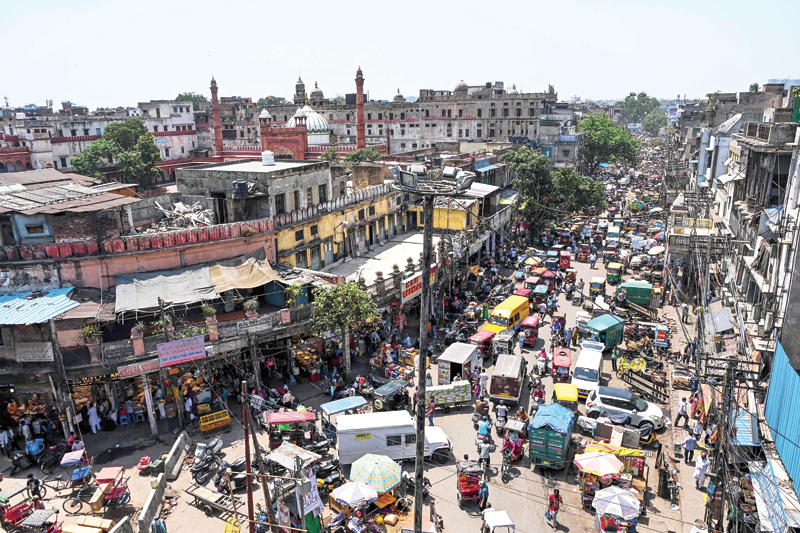





NEW DELHI: India’s capital New Delhi will impose a week-long lockdown from Monday night, officials said, as the megacity struggles to contain a huge surge in Covid-19 cases with hospitals running out of beds and oxygen supplies low.
The nation of 1.3 billion people reported a record-high of 273,810 infections on Monday — the fifth consecutive day of more than 200,000 cases — to take the total to just over 15 million.
In Delhi — the worst-hit city in India — 25,500 fresh cases were reported on Sunday, with almost one-third of those tested returning positive coronavirus results.
“Delhi’s health system is at a tipping point. The Covid-19 situation is pretty critical,” Delhi Chief Minister Arvind Kejriwal said in a televised address.
“If we don’t impose a lockdown now, we will be looking at a bigger disaster. From tonight there will be a lockdown until next Monday.”
He said businesses would be shut and movement around the northern city of 20 million limited to essential services, from 10 pm on Monday to 5 am the following Monday.
“The lockdown doesn’t end the pandemic but just slows it. We will use this week-long lockdown to improve our healthcare,” he said, adding that the healthcare system was “under severe strain” and had “reached its limit”.
Following the announcement, long queues formed outside Delhi’s shops in scenes reminiscent of the rush ahead of last year’s nationwide lockdown.
Kejriwal tried to address fears that the lockdown would be extended, appealing to migrant workers not to leave Delhi.
Last year’s harsh restrictions put millions of poor daily-wagers out of work, with many fleeing cities for their villages — often on foot with some dying along the way.
Delhi’s restrictions followed other measures in other states, including Maharashtra, home to financial capital Mumbai, and Tamil Nadu.
The national government has said it will address state pleas for more oxygen and drugs.
In the last seven days, India has recorded more than 1.4 million cases — an increase of 64 per cent on the previous week, according to data compiled.
Experts blame complacency about the virus, with the massive spike coming after daily
cases fell below 9,000 in early February.
There is also growing concern that virus variants, including a “double mutant”, are fuelling infections.
“The guard was let down too early... people went back to pre-pandemic behaviour and no one cautioned them,” virologist T Jacob John said. — AFP
“The second wave’s... spreading much faster than the first.”
Experts warned that religious festivals, including the Kumbh Mela attended by millions of pilgrims, and packed state election rallies had become “super-spreader” events.
Following a call from Prime Minister Narendra Modi for its rituals to be observed symbolically, officials at the Kumbh Mela in the northern city of Haridwar said the “site is nearly empty”. Nearly 3,900 people have tested positive in the past week in Haridwar, according to local authorities.
“The main sects have withdrawn from the festival,” event official Harbeer Singh said.
On social media, families pleaded for beds, oxygen and drugs. Local media reported long queues at crematoriums. In Modi’s home state Gujarat, crematoriums said bodies were being brought in in numbers far higher than local Covid-19 death tolls.
“Two of our furnaces are not operational as the frames are melting and gas burners are getting clogged as the furnaces are constantly in use,” said Prashant Kabrawala, the manager of Gujarat city Surat’s biggest crematorium. — AFP
Oman Observer is now on the WhatsApp channel. Click here