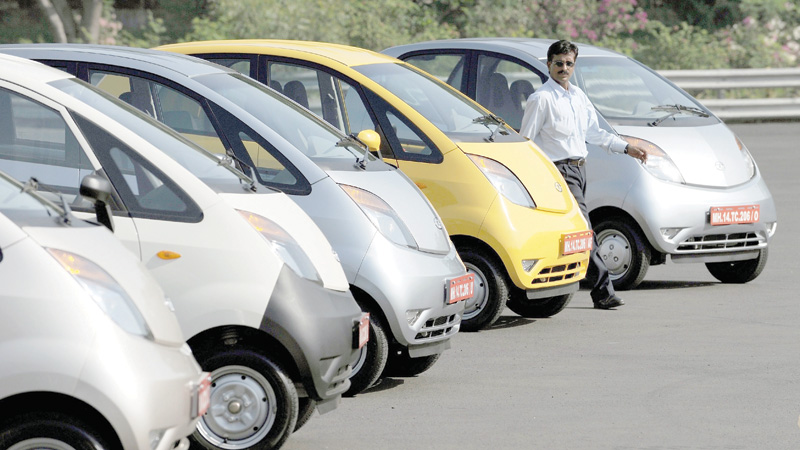





Mumbai: It was billed as the world’s cheapest car and shaped like a jelly bean — but after a bumpy 10-year ride India’s Tata Nano is nearing the end of the road.
Tata Motors, India’s top automaker, said on Thursday that it could stop manufacturing and selling the vehicle from April next year due to new safety and emissions rules that would require major investment.
“We may not invest in upgrading all the products and Nano is one of them,” Mayank Pareek, president of passenger vehicles at Tata, told reporters in Hyderabad. Tata launched the Nano, a compact four or five-door hatchback, with great fanfare in 2009 when its first edition went on the market for around $2,200.
It was the brainchild of the former boss of the tea-to-steel Tata Group conglomerate Ratan Tata, who wanted a budget car for the masses. Tata, now 81, was sure that aspirational lower-class Indian families would trade in their two-wheel motorcycles for the prestige, and comfort, of owning a car.
Analysts were similarly convinced, believing the Nano would transform how millions of Indians travelled, and it quickly became known around the globe as “the world’s cheapest car”.
The car was also plagued by safety concerns after a number of high-profile cases of engines bursting into flames. Tata, which owns Jaguar Land Rover, had initially hoped to sell 25,000 units a month but within a couple of years they were shifting just a few hundred.
In 2013 Tata Motors unveiled a new version in a bid to reverse the sales slump but the following year the Nano and several other small models from India failed independent crash tests.
A spokesperson for Tata Motors said on Friday that a final decision on whether to upgrade the Nano so that it meets the new regulations coming into force next year, or kill it off, had yet to be taken.
But Indian media said Pareek’s comments, carried by the Press Trust of India news agency, sounded the death knell for the Nano. “The end of a dream,” ran a headline in Mint, a business daily. — AFP
Oman Observer is now on the WhatsApp channel. Click here