




MUSCAT: An international scientific study, with the participation of Omani researchers, revealed that the availability of fresh water and suitable rocks for the manufacture of stone tools together formed a decisive factor in the spread of ancient humans and their settlement in the desert environments of the Arabian Peninsula during the past hundreds of thousands of years.
This study was featured on the cover of the latest issue of the international journal Nature under the title 'Stone and Water: The Rules of Ancient Human Settlement in the Desert'. It was prepared by Dr Ali bin Hamoud al Mahrouqi, a researcher in the Department of Archaeological Surveys and Excavations at the Ministry of Heritage and Tourism, and Dr Mohammed bin Hilal al Kindi, a geologist and CEO of the Earth Sciences Consulting Center, as part of an international scientific team comprising ten researchers from six countries in cooperation with a number of international research institutions and universities.
The study is the result of more than two decades of archaeological surveys and research in the Sultanate of Oman, carried out under the supervision of the Ministry of Heritage and Tourism, and has contributed in documenting hundreds of archaeological sites dating back to the Middle Stone Age, including sites in the Dhofar Governorate and the western slopes of Al Hajar Mountains.
The study said that the presence of fresh water alone was not enough for ancient humans to settle in desert areas, contrary to what previous scientific models had assumed. Rather, the availability of rocks suitable for making stone tools, especially flint, was a key factor in determining areas of human settlement. The results showed that about 57 per cent of the lands near ancient river courses in the Arabian Peninsula are located above geological formations that do not provide those rocks.
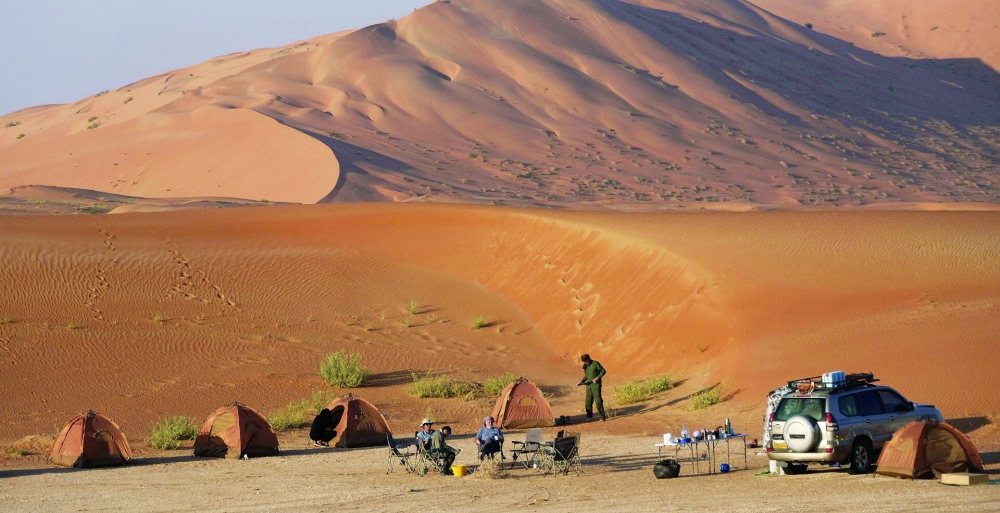
The researchers reached these conclusions following an expedition across the Empty Quarter desert in late 2023 that extended for a distance of approximately 1,500 km, and included a study of 125 sites, in 55 of which environmental and geological evidence was found indicating the presence of ancient freshwater lakes, without finding any stone tools due to the absence of suitable rock materials for their manufacture.
The Sultanate of Oman represented a pivotal model in the study, as the research team tested the new scientific model based on data from 301 archaeological sites dating back to the Middle Stone Age, which were documented during 44 field survey campaigns since 2002. The results showed a clear correlation between the distribution of archaeological sites and areas with the availability of water and suitable rocks, especially in the Najd Plateau in the Dhofar Governorate and the western slopes of Al Hajar Mountains.
Dr Ali bin Hamoud al Mahrouqi affirmed that the Sultanate of Oman’s participation in this achievement reflects the Ministry of Heritage and Tourism’s interest in supporting archaeological research and promoting international cooperation, noting that the database that has been available for more than 20 years has enabled researchers to reach these results, and will contribute to developing scientific tools to identify, protect and sustainably manage undiscovered archaeological sites.
For his part, Dr Mohammed bin Hilal al Kindi said that geology contributed directly to determining the locations of ancient human settlements; indicating that the Najd plateau in the Dhofar Governorate is characterised by the spread of limestone rocks rich in flint nodules, in addition to the availability of water during rainy periods, while the flint-bearing rocks in large parts of the Empty Quarter are buried under thick layers of sand and sediments, making it difficult to reach them.
The study highlights major climatic shifts in what is scientifically known as the concept of the 'Green Arabian Peninsula,' confirming that areas of human settlement were concentrated in specific locations that combined water and rock resources, resembling scattered islands within a vast desert environment.
The study involved researchers from the University of the Algarve in Portugal, led by Dr Jeffrey Rose, the University of Vienna and the Natural History Museum in Austria, where researcher Rudolf Delmore served as the lead researcher, along with the Czech Academy of Sciences, Kent State University and the Cleveland Museum of Natural History in the United States, and the University of Cambridge in the United Kingdom. — ONA
Oman Observer is now on the WhatsApp channel. Click here