

MUSCAT: The Research and Innovation Authority launched on Thursday the Sultan Haitham Program to Support Research Chairs at Academic Institutions, and opened the submission of applications for participation in the current cycle of the programme.
The programme aims to support a research chair in the field of advanced technologies at Oman Institute for Energy in Innovation Park Muscat.
The launch ceremony was held under the auspices of Dr Saud bin Hamoud al Habsi, Minister of Agriculture, Fisheries and Water Resources, in the presence of a number of representatives of academic institutions, specialists in the scientific research and innovation sector, chairholders of research chairs in the Sultanate of Oman, and heads of some Unesco and ISESCO chairs.
The launch of the programme comes as a qualitative step to enable academic institutions to lead research in fields of national priority and develop advanced technical solutions, as research chairs constitute one of the core pillars in the scientific research and innovation ecosystem to support knowledge production, enhance research excellence, build national research capacities, and attract distinguished competencies.
The programme aims to address national challenges by developing innovative applied solutions, enhancing the quality of research output and maximising its knowledge and applied impact, and attracting distinguished scientific competencies.
The programme focuses on building strategic and funding partnerships with the private sector, making knowledge and research outputs available to decision-makers, and establishing a sustainable national model for research chairs based on governance and efficiency.
The programme is expected to contribute to building a knowledge economy and achieving the targets of Oman Vision 2040, particularly the priority of education, learning, and research, alongside enhancing research excellence, raising the international competitiveness of academic institutions, and contributing to improving the Sultanate of Oman's performance in relevant global indicators.
In his speech during the launch ceremony, Dr Saif bin Abdullah al Haddabi, Chairman of the Research and Innovation Authority, affirmed the importance of the programme in supporting the scientific research and innovation ecosystem and enabling academic institutions to develop specialised research programmes that respond to national priorities, contribute to building scientific capacities, and expand research partnerships.
Al Haddabi said that over the past years, the Sultanate of Oman has worked to build a national ecosystem for research and innovation, and the Research and Innovation Authority continues this path within the competences entrusted to it by developing research and academic institutions, launching programmes supporting researchers, strengthening scientific partnerships locally and internationally, and directing research efforts toward national priorities and needs.
He added that the importance of this approach is increasing amid rapid global transformations in which knowledge, advanced technologies, and innovation have become among the most important determinants of economic competitiveness. The Sultanate of Oman achieved 69th place globally in the Global Innovation Index for 2026 and 25th place in the IMD World Competitiveness Report for 2026. The gap between the Sultanate of Oman's ranking in innovation inputs and outputs indicates the importance of enhancing the conversion of investment in research and scientific capacities into products, solutions, and applications with economic and developmental value.
He affirmed that supporting research chairs represents one of the strategic tools to strengthen the scientific presence of countries, attract distinguished research competencies and expertise, develop specialised scientific fields, and build sustainable partnerships between academic institutions and economic and developmental sectors.
The Chairman of the Research and Innovation Authority pointed out that the Sultanate of Oman has important experience in this field through scientific and research chairs in higher education institutions within the country, such as the Research Chair programme in nanotechnology for water desalination at Sultan Qaboos University, UNESCO chairs, and other scientific chairs supported by the private and government sectors, alongside Sultan Qaboos scientific chairs at a number of international universities and academic institutions, which contributed to strengthening the scientific presence of the Sultanate of Oman and expanding its research and knowledge relations.
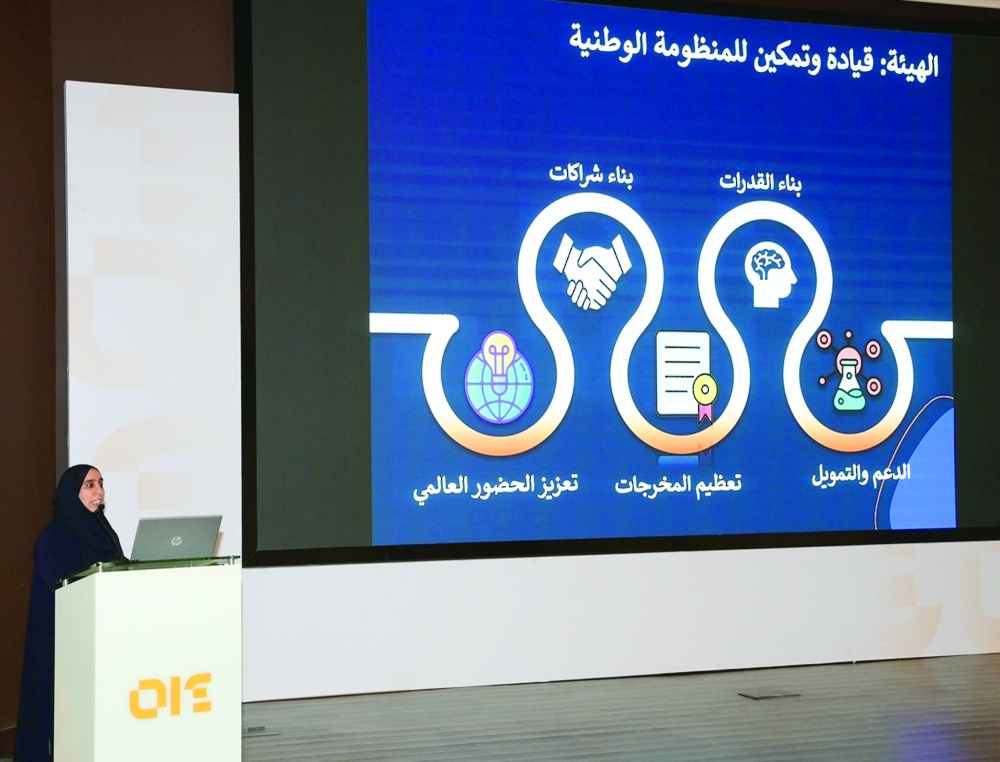
Balqis bint Saud al Hinai, Acting Director-General of Programmes and Capacity Building at the Research and Innovation Authority, reviewed the Authority's role in leading and enabling the national scientific research and innovation ecosystem, enhancing its global presence, providing support and funding for research and innovation projects and entities, alongside building strategic partnerships, maximising research outputs, and developing national capacities.
She explained that the Authority's orientations are based on targeted expansion in funding research projects and research and innovation entities, enabling institutions, and enhancing the readiness of the research ecosystem in a manner that contributes to developing a national environment capable of producing knowledge and converting it into outputs with economic and societal value.
Regarding the scope of support, she pointed out that the programme targets academic institutions by funding the establishment of the research chair for five years, with a funding ceiling of up to RO 1 million, under a participatory funding model that ensures the integration of contributions from the Authority, the host institution, and partners.
She explained that accrediting a research chair goes through three main steps, starting with the academic institution submitting its initial proposal for the research programme, followed by nominating the chairholder, and then conducting the final selection and accrediting the host institution according to specific evaluation criteria.
The first phase includes evaluating the initial proposal according to a set of criteria covering importance and expected impact, the chair's vision and objectives, the institution's readiness, partners and beneficiaries, and the required budget. This phase represents 40 per cent of the overall evaluation, and the top three institutions qualify, provided each obtains at least 75 points.
As for the second phase, it is dedicated to evaluating the chairholder and the initial conception of the research programme, with a weight of 60 per cent, and includes criteria of research excellence, administrative experience, and societal impact, provided the candidate holds the rank of associate professor or higher, along with submitting an initial letter of interest, clarifying research themes, projects, and targets, funding attraction opportunities, and the budget distribution mechanism. The institution qualifies for the final selection upon obtaining 75 points or more.
For his part, Prof Ghassan bin Adnan al Kindi, Assistant Vice-Chancellor for Research, Innovation and Graduate Studies at Sohar University, affirmed during his working paper titled "Investing in Research Chairs and Its Role in Supporting the National Economy and Knowledge Society" that investing in research chairs is no longer merely an academic initiative, but a strategic tool to support the national economy, build a knowledge society, and achieve the targets of "Oman Vision 2040." He said that a research chair is a long-term strategic research programme focusing on a field of national or international priority, led by a distinguished researcher with the participation of a team of experienced researchers, and aims to focus research efforts in a specific specialised field, attract competencies, direct scientific research toward developmental priorities and economic challenges, and contribute to building a knowledge society through partnerships, community service, and creating job opportunities in the knowledge economy.
He reviewed the state of research output in the Sultanate of Oman, noting that total research papers indexed in the Scopus database reached 51,657 papers up to mid-2026, at an average of about 21 research papers per day, and were cited more than 890,563 times, at an average of 17.2 citations per paper, while the national H-index stands at 269, placing the Sultanate of Oman fourth among Gulf countries in this field.
He touched upon models of research chairs in countries around the world, explaining that there are about 1,000 UNESCO chairs in 130 countries, that the Kingdom of Saudi Arabia holds the largest share in the region with more than 200 research chairs, while in the United Kingdom there are several thousand funded research chairs generating about $75 billion annually to support the economy against an investment of $12 billion annually, and that the Canada Research Chairs programme is among the best-known models globally.
He said that the Sultanate of Oman hosts 10 active Unesco and ISESCO chairs in its public and private universities, aligned with international standards and "Oman Vision 2040," alongside research chairs funded by the private sector and other funding entities, including the Oman Chamber of Commerce and Industry Chair for Economic Studies, the Shell Chair in Petroleum Geosciences, the Sohar International Chair for Financial Research, the Madayn Research Chair for Developing Industrial Cities and Free Zones, and the Omani-Indian Studies Chair.
He said that this initiative, bearing the name of His Majesty Sultan Haitham bin Tarik, comes to entrench a royal approach as a national research platform designed to confront challenges with a scientific methodology, support the march of innovation, and build a sustainable knowledge-based economy in line with the aspirations of "Oman Vision 2040," affirming that it is a promising initiative in achieving a tangible impact in supporting the economy and knowledge society through cooperation and integration with existing research chairs in the Sultanate of Oman.
Oman Observer is now on the WhatsApp channel. Click here