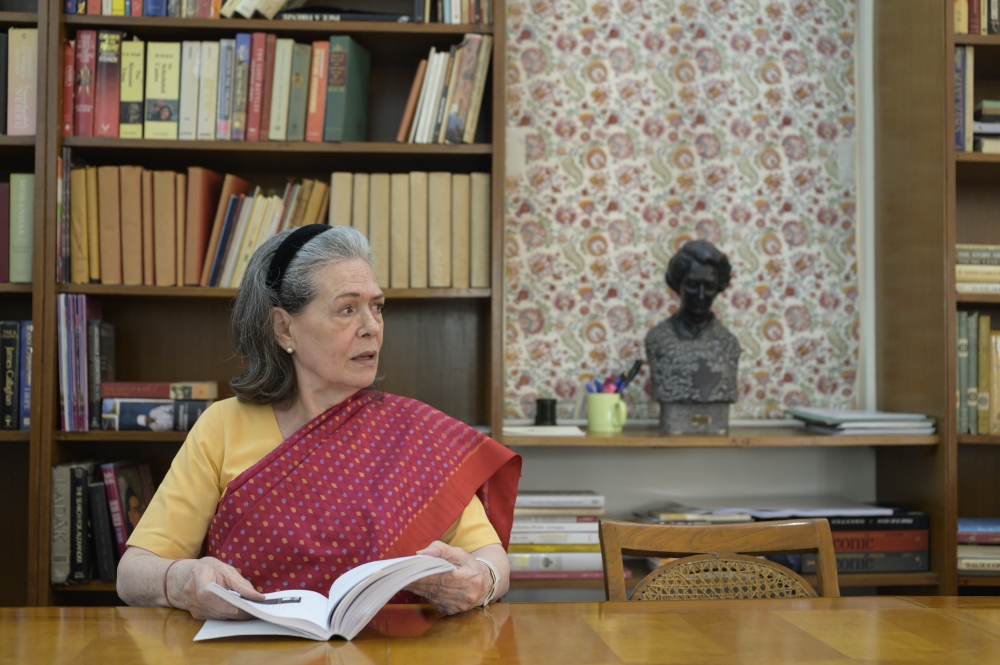


NEW DELHI — The astonishing story of Sonia Gandhi, the young woman from a middle-class Italian family who married into the Nehru-Gandhi dynasty, lived through unspeakable tragedy and nearly became prime minister of India, reached a crescendo in May 2004 in her heavily fortified home in New Delhi.
“It took place in this very room,” she said in an interview last week in her home office, once that of her late husband, Rajiv Gandhi.
His tricolor Congress Party shawl still hung over his desk chair in the corner, where it has been since his assassination in 1991, when he was campaigning to be prime minister a second time. On the wall was a photograph of Jawaharlal Nehru, Rajiv’s grandfather and India’s first prime minister, and another of Rajiv’s mother, Indira Gandhi, who was assassinated as prime minister less than seven years before her son.
On that day in 2004, party elders beseeched Sonia Gandhi, criticized by the opposition as a foreign-born interloper, to take her place as prime minister as the leader of the Congress Party, which had just won national elections. She initially said yes, horrifying her two children, Rahul and Priyanka, but recanted.
“My brother and I actually thought that she would get killed, too,” said Priyanka Gandhi, who sat next to her mother in the interview.
And yet today Rahul Gandhi, 56, the current leader of India’s largest opposition party, is putting himself at risk as he has risen from the political sidelines to stand with the massive youth protests against the Hindu nationalist government of Prime Minister Narendra Modi. “It does worry me,” said Sonia Gandhi, 79, who said she feared for the safety of her children, both now members of the lower house of India’s Parliament.
But she said she was never afraid that she herself might die in the years when she led the Congress Party after her husband’s death. “Maybe subconsciously, I really didn’t care if it happened,” she said.
Sonia Gandhi has just published a sprawling, highly personal and at times harrowing memoir, “Belonging: A Journey of Love,” that evokes a politics of martyrdom rather than ambition in her years leading the Congress Party. She is critical of Modi’s Bharatiya Janata Party, which she said in the interview has “destroyed” the secular Indian democracy that her family has long stood for, if not always practiced.
The deeply entrenched BJP has dismissed the book as political propaganda by a foreigner. “You cannot understand India with Italian glasses,” a senior party leader, Tarun Chugh, told the Indian television network NDTV this week.
Beyond the skirmishing, the memoir is remarkable as the journey of the shy young woman who was in the back seat of the car with her bloodied, dying mother-in-law as she was taken to the hospital, and whose life of love, hate, joy and tragedy mirrors the convulsive history of modern India.
‘He Was Very Good Looking’
Sonia Gandhi, now a member of the upper house of Parliament, has given very few interviews over nearly 30 years in politics. She was gracious but visibly nervous as she took her place on a sofa in her white-columned bungalow, built in the 1930s by British colonial rulers in the heart of New Delhi. She wore a pink silk sari, had her gray hair pulled back in a headband and spoke softly, and sometimes tentatively, in Italian-accented English. Her daughter, 54, was beside her for what her mother called moral support.
Her book, 12 years in the making, was to have been published by Penguin Random House India. But Manjulika Dubey, Sonia Gandhi’s closest friend, who worked with her on the memoir, said the publisher backed away because of the book’s criticism of the BJP and the far-right Hindu nationalist group Rashtriya Swayamsevak Sangh. Representatives for Penguin Random House said the decision not to move forward was mutual.
The book was published Tuesday in India and Britain by Harper Collins and in the United States by Knopf.
Sonia Gandhi said she wrote the memoir because her children and Dubey pestered her to do so. “She’s quite a private person,” Rahul Gandhi said in a telephone interview. “But my sister and I felt that there were things that she had gone through that were important for people to know.”
Yet Sonia Gandhi does not delve into her political life, which began with her joining the Congress Party in 1997, until nearly 400 pages in. Much of the memoir is about her experiences in the Gandhi household, her complicated relationship with her mother-in-law and her courtship and marriage with Rajiv.
“That’s the part that I love the most,” she said.
She met him in January 1965 when he was 20 and studying engineering at Trinity College, Cambridge. She was 19 and enrolled at an English language school nearby. She had noticed him in a Greek restaurant — “he was very good looking” she said — and he had noticed her, too. The attraction was so intense that six months later Rajiv insisted that she meet his formidable mother, then a minister in Nehru’s government, who was visiting London.
“I was terrified,” Sonia Gandhi said. When her future mother-in-law asked her about herself, she was so nervous that she burst into tears.
She was married in New Delhi in 1968, two years after Indira Gandhi became prime minister. The young bride moved into the official, bustling household, struggled to learn Hindi and to adjust to Indian food and customs. Rajiv Gandhi, who quit engineering studies to become an airline pilot, was away at flight school. Sometimes it would be just Sonia Gandhi and her mother-in-law at the dining table, where the prime minister would often read a newspaper and ignore her, Sonia Gandhi wrote.
By 1975, Indira Gandhi was facing attacks from the opposition and a conviction on two counts of electoral corruption — the use of the services of a government official and of a rostrum in an election campaign — leading her rivals to demand her resignation. She responded by declaring a state of emergency. She jailed her opponents, suspended India’s equivalent of the bill of rights, censored the press and arrested thousands.
“It was something that should not have been done,” Sonia Gandhi said, carefully.
Indira Gandhi called for elections in 1977, was trounced by the opposition and jailed for a week. Sonia Gandhi brought her food from home. “I was moved to tears seeing her tiny figure sitting on a metal chair in that bare, cold jail cell,” she wrote.
Indira Gandhi was reelected in January 1980. Five months later, after her younger son and presumed political heir, Sanjay, died in a stunt plane crash, she turned to her elder son to carry on the family name in politics. Sonia Gandhi begged her husband for a year to say no but ultimately, she wrote, “I broke.” Rajiv Gandhi won a seat in Parliament in 1981 and eventually his reluctant wife joined him on trips to his constituency in the Indian state of Uttar Pradesh.
The next years were violent. In June 1984, Indira Gandhi ordered an army assault on Sikh militants holed up in Punjab’s Golden Temple, the holiest shrine in Sikhism. Hundreds of militants, soldiers and civilians were killed, according to the government, but independent estimates have put the death toll as high as several thousand. Retaliation was swift.
On the morning of Oct. 31, 1984, Sonia Gandhi was about to start her bath when she heard a series of explosions. She ran outside to see that her mother-in-law had been gunned down by two of her Sikh bodyguards as she walked through the garden of her residence. The prime minister was rushed into the back seat of a car. Sonia Gandhi crouched on the floor beside her.
“Her large eyes are wide open; her face wears a surprised expression,” Sonia Gandhi wrote. “She doesn’t move. I attempt to speak to her, to call out, ‘Mummy, Mummy,’ but no word comes out.”
Indira Gandhi was declared dead at 2 p.m. Rajiv Gandhi arrived at the hospital soon after with the news that he was to be sworn in as prime minister. “They will kill you too!” Sonia Gandhi burst out. Her husband replied, she wrote, “They will kill me anyway.”
As the young prime minister embarked on an ambitious modernization program, his wife became a virtual recluse. “I sort of went into myself,” Sonia Gandhi said. “I think I had some sort of depression.’’
“She was a ghost,” interjected Priyanka Gandhi, who was 12 at the time. “She became paranoid about my father’s security.”
Sonia Gandhi said she remembers few details about the 1991 assassination of her husband, then 46, who was killed in South India by a suicide bomber from the Tamil Tigers militant group. “If I fell asleep, heavily sedated, it was to wake up from a nightmare, drenched in perspiration, my heart in my throat, frightened and lost,” she wrote. He had asked her to come on the trip, but she said she was too tired. It has haunted her ever since.
Entering the Family Business
Six and a half years later, Sonia Gandhi laid a wreath at the site of her husband’s assassination and delivered her maiden political speech at an open-air rally. She presented herself as essentially Indian — “I became part of India 30 years back, when I became Indira Gandhi’s eldest son’s bride” — then kicked off a 34-day tour aimed at pulling the Congress Party out of steep decline.
Such vast crowds gathered for her 140 campaign appearances that India Today, the country’s largest newsmagazine, called it “unparalleled in electoral history.”
Women “cry unabashedly when she talks of her lonely existence,” the magazine reported, while “others gawk at the ‘white woman’ speaking Hindi.”
She had decided to go into the family business, Sonia Gandhi said in the interview, out of the sense of duty she felt when staring at the photos of her husband and mother-in-law on her office wall. “I used to feel cowardly,” she said. “How can I just sit?”
The party finished second in 1998, Sonia Gandhi became Congress Party president and in a 2004 campaign she traversed the country once again. The BJP threatened to take to the streets if the foreign woman became prime minister. She nominated economist Manmohan Singh in her stead.
The BJP, she said, “would have used this ‘foreigner prime minister’ to further divide the country.”
Sometimes, she thinks of what her life would have been if her husband had remained a pilot. “In my dream we would have grown old together,” she wrote, “enjoyed our grandchildren, traveled in India and abroad to places I longed to see.”
Would she do it all over again?
She did not hesitate. “Absolutely,” she said.
This article originally appeared in The New York Times.
Oman Observer is now on the WhatsApp channel. Click here