If asked today what Oman truly needs to sharpen its competitive edge in the regional race for foreign direct investment (FDI), my answer would not be laws, incentives, or infrastructure. These elements are undeniably vital, and Oman has made monumental strides in developing them over the past few years. Instead, our next evolutionary leap requires something far more profound: a potent, unified investment narrative that our own state institutions fully embody before it ever reaches the global market.
In the modern economic arena, traditional bait like tax holidays, specialised economic zones, and streamlined paperwork have become commoditised. They are no longer differentiators; they are merely the baseline entry requirements for any nation seeking to capture global capital. Today’s ultimate competitive advantage lies in a nation’s capacity to cultivate institutional trust and project a seamless, sophisticated economic story to global markets.
Sophisticated investors look beyond the fine print of statutory laws; they look for strategic predictability, long-term policy stability, and cross-institutional harmony. Consequently, the clarity and caliber of a state’s investment narrative have become just as vital to its core competitiveness as its deep-water ports or legislative frameworks.
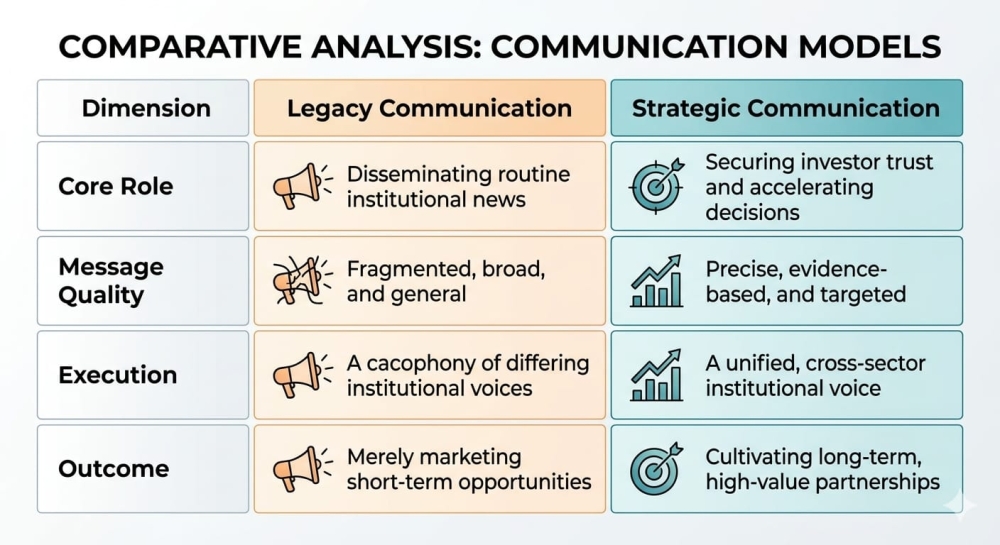
FROM MARKETING TO STRATEGIC ALIGNMENT
This shift from transactional promotion to strategic leadership can be mapped across four distinct operational dimensions:
Throughout my career in financial and business journalism, covering regional market dynamics and investment flows, I have consistently observed that capital gravitates toward nations that speak a coherent corporate language. The global race is no longer won simply by having the best assets, but by having the superior capability to articulate their value proposition.
Oman’s economic profile has already undergone a remarkable transformation. The sweeping fiscal and structural reforms enacted since 2020 have substantially elevated our standing in international benchmark reports. This was not just a victory of balance sheets, but a masterclass in signaling; it proved to global markets that Oman possesses both a clear economic vision and the political will to execute it.
The next phase demands a total transition from legacy marketing to integrated strategic communication. This does not mean amplifying PR noise or multiplying promotional campaigns. It means enforcing absolute alignment across every state entity that interacts with global capital.
Institutional contradiction is the ultimate repellent of capital. When an investor is greeted with an ambitious, forward-leaning vision by one ministry, only to face archaic bureaucracy or conflicting guidelines at a regulatory body, market trust evaporates instantly. Conversely, when institutions act as a singular unit, delivering identical datasets and moving toward shared macro-targets, they eliminate investor hesitation and de-risk the business environment.
At its core, investment is an exercise in trust long before it is a calculation of capital allocation. Investors seek out empowered public officials who possess deep sector expertise, executive clarity, and the ultimate authority to answer complex operational questions in real time. This direct human interaction dictates an investor's critical first impression far more than any sleek pitch deck ever could.
Oman holds undeniable macroeconomic advantages: an unassailable strategic location, rock-solid political stability, top-tier logistical infrastructure, and a globally respected, balanced foreign policy. Yet, the true return on these assets depends entirely on our ability to package and present them as a cohesive, friction-free ecosystem. In the modern global marketplace, achievements do not speak for themselves; they must be actively and flawlessly narrated. The more coherent and synchronised Oman’s voice becomes, the faster we will convert global interest into enduring, high-value economic partnerships.
Oman Observer is now on the WhatsApp channel. Click here