

The world economy has entered a new order, and it has a new first question. For thirty years, boardrooms asked where goods could be made and moved most cheaply. Since February they have asked where they can be made and moved with certainty. When the Strait of Hormuz closed, daily ship transits fell from about 130 to six within a month, according to UNCTAD, the United Nations body now expects global merchandise trade growth to slow from 4.7 per cent last year to between 1.5 and 2.5 per cent in 2026. In a world rationing certainty, Al Duqm has become one of its suppliers.
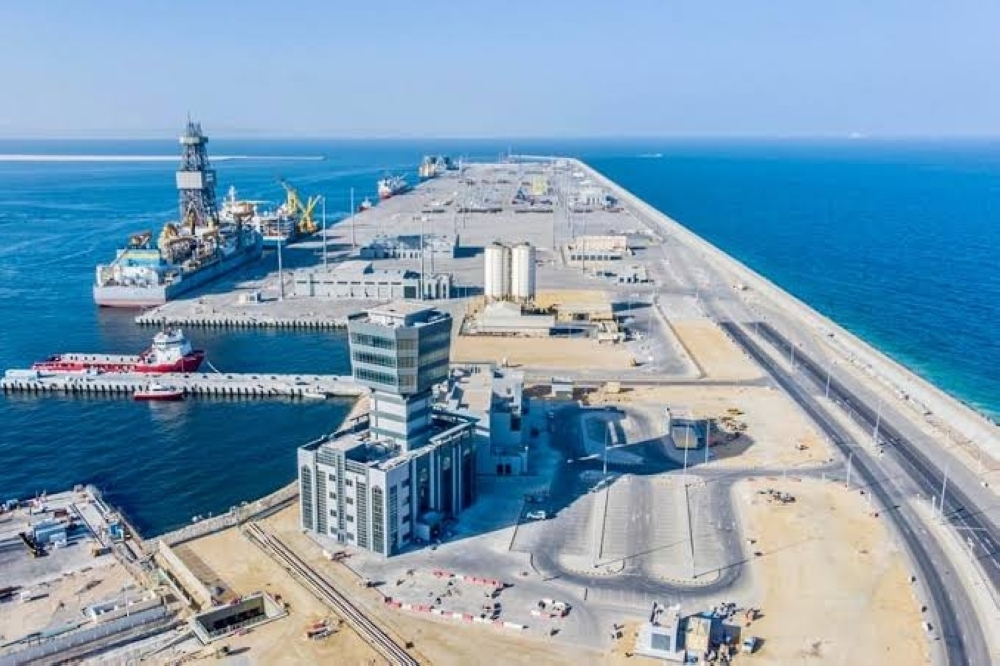
Geography explains part of that. Al Duqm faces the open Arabian Sea, outside every chokepoint in the region, with deep water, 2,000 square kilometres of zoned land and a stable, neutral state behind it. What changed is that fifteen years of patient national building matured exactly when the world needed them, in a country whose Salalah port ranks second worldwide on the World Bank's Container Port Performance Index, an index Al Duqm itself joined in 2023. Sea-Intelligence's analysis of UNCTAD's port connectivity index shows Al Duqm's liner connectivity up 213 per cent in the third quarter, the largest gain in the region. When His Majesty Sultan Haitham bin Tarik toured the zone and the port on September 23, he described Al Duqm as open to the world's seas and one of the pillars of Oman Vision 2040, and directed that it be developed into a leading economic and logistics hub. Few endorsements have been more clearly earned.
The capital has noticed. Committed investment in the Special Economic Zone at Duqm (SEZAD) reached RO 8.8 billion by the end of June, up 141 per cent since 2021, according to the Public Authority for Special Economic Zones and Free Zones. Ten agreements worth RO 2.9 billion were signed on a single day in June, and SEZAD's leadership reports a further RO 7 to 8 billion under negotiation in iron and aluminium. The national picture confirms it. UNCTAD's new GCC Investment Report finds that Oman's foreign investment inflows reached a new high, that the value of announced greenfield projects rose more than tenfold, and that Saudi Arabia–Oman became the Gulf's largest intra-regional greenfield corridor at about $9 billion. NCSI puts Oman's foreign direct investment stock at RO 32.2 billion at mid-year, up 6.4 per cent.
What makes Al Duqm compelling is that it offers a distinct proposition to every class of investor. For energy-transition industrialists, it is a place to make the products of the next economy: ACME's green ammonia plant, its output contracted to Norway's Yara, is nearing operation, and Vulcan Green Steel, backed by Jindal, is heading for first low-carbon steel in 2027 with Volkswagen among its European buyers. The International Energy Agency projects that Oman will be the world's sixth-largest hydrogen exporter and the largest in the Middle East by 2030, and Al Duqm is where much of that industry is taking physical form. For Gulf capital, it is a secure southern gateway: the OQ8 refinery, a partnership with Kuwait, has expanded to 255,000 barrels a day, and the road across the Empty Quarter has opened the Saudi interior. For Asian manufacturers, it is a platform for electric-vehicle battery materials and green aluminium. For institutional investors, it is infrastructure with contracted demand, as Investcorp's role in the $550 million port expansion shows. And for Omani entrepreneurs, it is a growing market: more than 500 small and medium enterprises are now active in the zone.
The results are reaching the national accounts. NCSI data show manufacturing output up 16.1 per cent in the first half of 2026, with refined products up 40 per cent, and non-oil exports up 10.7 per cent to RO 4.3 billion. This is diversification measured in tones and rials.
Above all, Al Duqm is becoming an engine of quality employment far from Muscat. More than 12,400 people work in the zone, and the number of Omanis employed more than doubled in a year, lifting Omanisation from 20 to 26 per cent. A wind turbine factory is set to create more than 1,000 jobs, and Duqm University College opens its first academic year this year. The Eleventh Five-Year Development Plan targets 7 per cent annual growth in transport and logistics and 5.9 per cent in manufacturing; Al Duqm is where both targets meet skilled Omani careers in Al Wusta.
Three steps would take Al Duqm to the next level. First, convert crisis volumes into long-term commitments: a Duqm Resilience Compact offering carriers, GCC cargo owners and governments guaranteed berth windows, bonded corridors and stable tariffs over ten years, so that those who came by necessity stay by contract.
Second, build capacity and connectivity ahead of demand: container handling, feeder links to India and East Africa, air cargo and a protected rail alignment. Third, make Al Duqm the world's reference address for green industry, with ready packages of renewable power, land, water and certification, and a published quarterly scorecard so every investor sees the performance carriers already experience.
Nations rarely get a second chance at a strategic location. Oman received its first from geography and its second from events. With His Majesty's backing and Vision 2040 as its compass, Al Duqm has moved beyond being Oman's port of the future. It is becoming the region's platform of the present, and the bar it is setting is the one others will now have to reach.
Oman Observer is now on the WhatsApp channel. Click here