

MUSCAT, NOV 4
In the science laboratory of the future, students will not simply read about great discoveries but experience the excitement of making them, according to an educational expert taking part in the Oman Science Festival 2026.
Dr Sofoklis Sotiriou, who represents Ellinogermaniki Agogi, a Greek school actively involved in educational innovation and scientific research, is presenting the school's vision for the science laboratory of the school of tomorrow at the festival.
Speaking to the Observer, he said the principle behind all the school's activities is simple: "Students learn science by doing science." The goal, he said, is to introduce students to scientific methodology and develop an academic mindset from an early age, so that they learn to ask questions, formulate hypotheses, conduct experiments, analyse authentic data and communicate their findings.
Achieving this, he added, requires a fundamental transformation in how science education is organised.
"School science must become more authentic, connecting classroom learning with real scientific challenges, modern research infrastructures, and the work of professional scientists," he said. It is an approach the school promotes through its educational research and teacher professional development programmes.
He envisions the school laboratory as an open gateway to scientific research, linking schools with universities, observatories and international scientific communities.
At the festival, the school has organised two workshops, "From Galileo to Modern Physics" and "Multimessenger Astronomy", which engage students and Omani science teachers with frontier scientific discoveries through hands-on activities, demonstrations and inquiry-based learning, and show how contemporary research in astronomy and fundamental physics can be brought into everyday classroom teaching.
Dr Abdullah al Nasri, a biology teacher at the Ministry of Education who attended one of the sessions, said the workshop on gravitational waves covered the concept and its applications before moving on to programmes and devices that simulate them.
The aim, he said, is to make use of these applications in real life and to bring scientific theories closer to learners by simplifying them in their curricula.
Describing the workshop as very useful in an exceptional event, he added: "I encourage everyone to visit the exhibition and attend the workshops and activities being held." The school's exhibition also offers three interactive experiences. "400 Years of Scientific Discovery" traces how scientific instruments, from Galileo's pioneering astronomical observations to the Cassini spacecraft, modern neutrino telescopes and gravitational-wave observatories such as Virgo, have transformed our understanding of the universe.
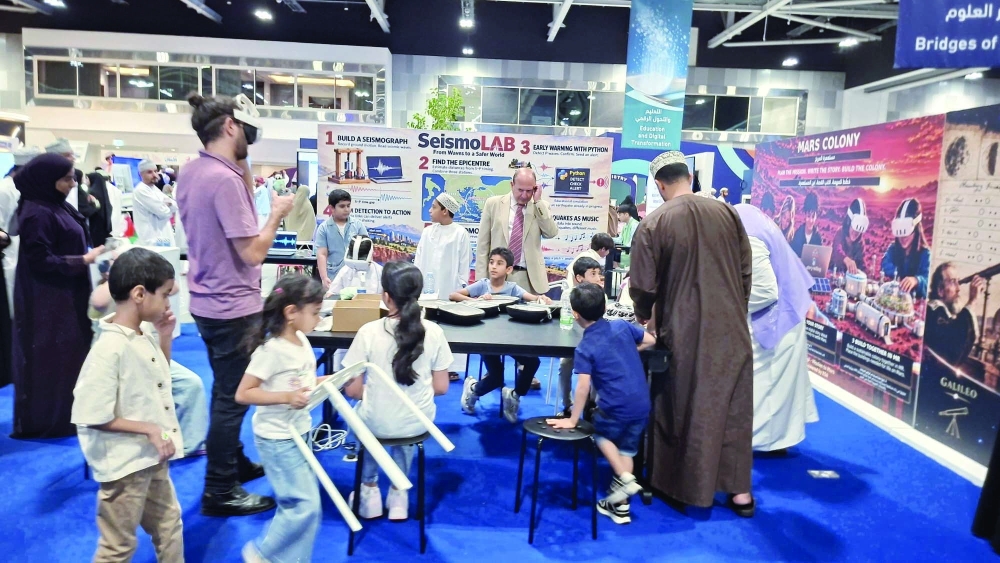
In "Educational Seismology", students build school seismographs, analyse earthquake data, locate epicentres, explore the Earth's interior through seismic tomography and use Python programming to develop educational early-warning systems, while "Mission to Mars" uses virtual reality, engineering design and digital storytelling to plan sustainable settlements on the red planet, addressing challenges such as energy, water and food production.
Dr Sotiriou said the school's participation is an opportunity to share its vision with Omani educators and students, inspiring new collaborations and more authentic approaches to science education.
"The school of tomorrow should inspire every student to think, investigate, and act as a young scientist," he said.
The festival, organised by the Ministry of Education, runs until November 11 at the Oman Convention and Exhibition Centre.
Oman Observer is now on the WhatsApp channel. Click here