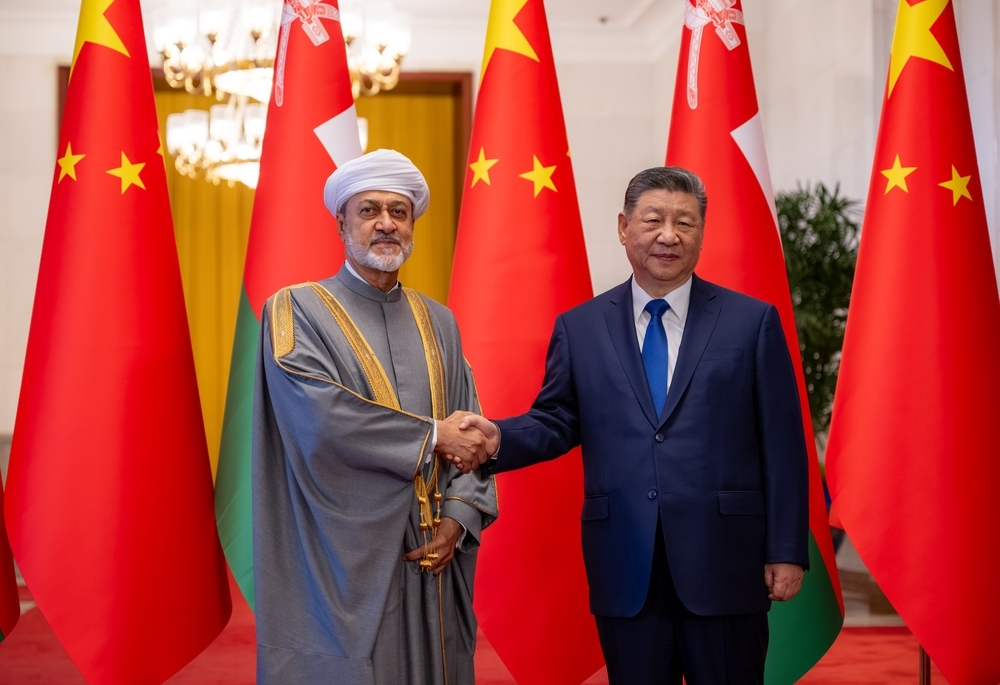
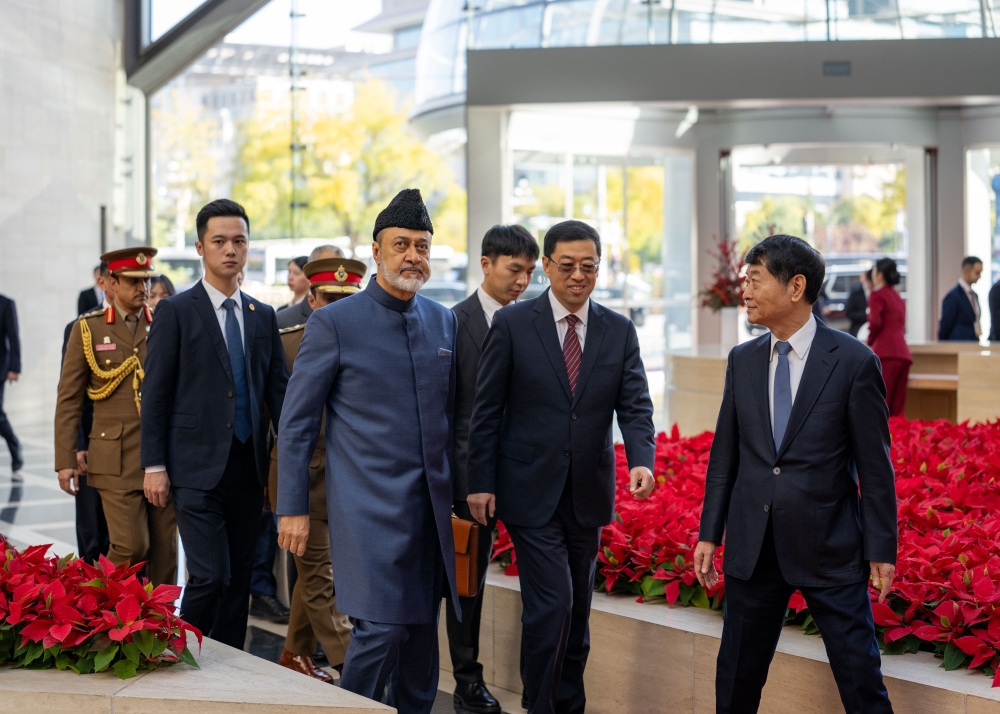


This week, His Majesty Sultan Haitham bin Tarik of Oman arrived in China for a historic two-day state visit — the first by an Omani head of state since the establishment of diplomatic relations in 1978. The timing is no coincidence. The visit comes as the threat of war continues to hang over the region like the sword of Damocles, while both countries seek to deepen an economic partnership that has yet to realise its full potential.
Politically, China and Oman share much common ground. Beijing has long maintained that the Middle East is not any country's backyard, but belongs to the people of the region. Muscat shares this perspective. Omani Foreign Minister Badr al Busaidi, for instance, recently called on the Gulf states, Iraq and Iran to conclude a comprehensive non-aggression pact. His proposal reflects Oman's longstanding belief that lasting security can only be achieved by maintaining constructive relations with all countries, rather than through exclusion or external dominance.
Building on this shared outlook, China and Oman have made sustained efforts to promote peace and stability in a region marked by recurring cycles of conflict. A notable example came in 2023, when China, with Oman's support, helped facilitate the historic rapprochement between Saudi Arabia and Iran, ending years of diplomatic estrangement between the two regional powers.
This breakthrough was made possible in part by Oman's longstanding role as a trusted intermediary between Saudi Arabia and Iran, including its efforts to host indirect talks during periods of strained relations. China, meanwhile, was able to leverage its considerable economic influence as a major trading partner of both countries to help bring them closer together.
With the region once again facing the risk of wider conflict, such cooperation is more important than ever. China and Oman are well positioned to encourage opposing parties to return to the negotiating table, helping to prevent further escalation and the spillover of instability across the region.
Economically, the two countries also have much to offer each other. China is Oman's largest trading partner, while Oman is China's fifth-largest supplier of crude oil. Yet Oman's strategic value to Beijing extends well beyond the volume of its exports.
With the Strait of Hormuz currently facing severe disruptions, Oman's geographical position outside the strait has acquired even greater strategic significance. Its oil exports, ports and energy infrastructure provide valuable alternatives that can help support supply-chain resilience and contribute to stability in global energy markets.
The partnership, however, extends far beyond oil. Oman Vision 2040 aims to diversify the country's economy and reduce its dependence on hydrocarbons. This is where China's expertise in renewable energy could play a transformative role.
China has developed the world's largest installed capacity of hydropower, solar and wind energy, accumulating extensive technological expertise and industrial capabilities in the process. Oman, meanwhile, possesses abundant sunshine, strong wind resources, vast expanses of land and significant investment potential, supported by a government committed to harnessing these advantages.
If renewable energy cooperation emerges as a second pillar of China-Oman economic relations, it could become a compelling example of mutually beneficial cooperation.
For China, Oman offers a gateway to the promising Gulf market and an opportunity for its renewable energy companies to establish a stronger regional presence. For Oman, Chinese investment and expertise could accelerate clean energy development, create employment opportunities, facilitate technology transfer and support its broader economic diversification ambitions.
In essence, each country possesses strengths that complement the other's needs.
For more than a millennium, the maritime Silk Road has connected China and Oman through trade, cultural exchange and maritime cooperation. Those historical links have continued to evolve, growing steadily stronger since the establishment of diplomatic relations in 1978. In 2018, bilateral ties were elevated to a strategic partnership, marking a significant milestone in their modern relationship.
His Majesty Sultan Haitham bin Tarik's state visit opens a new chapter in this longstanding partnership. At a time of heightened regional uncertainty and profound economic transformation, closer cooperation between Oman and China is not merely desirable — it is increasingly essential to the interests and aspirations of both nations.
Yang Xiaotong is a researcher at the Beijing-based think tank Horizon Insights Centre, where he focuses on China-MENA relations. He has lived in the Middle East for a decade, including seven years in Oman, and his work has appeared in Al Arabiya, Al Jazeera, and Al Majalla. -
Oman Observer is now on the WhatsApp channel. Click here