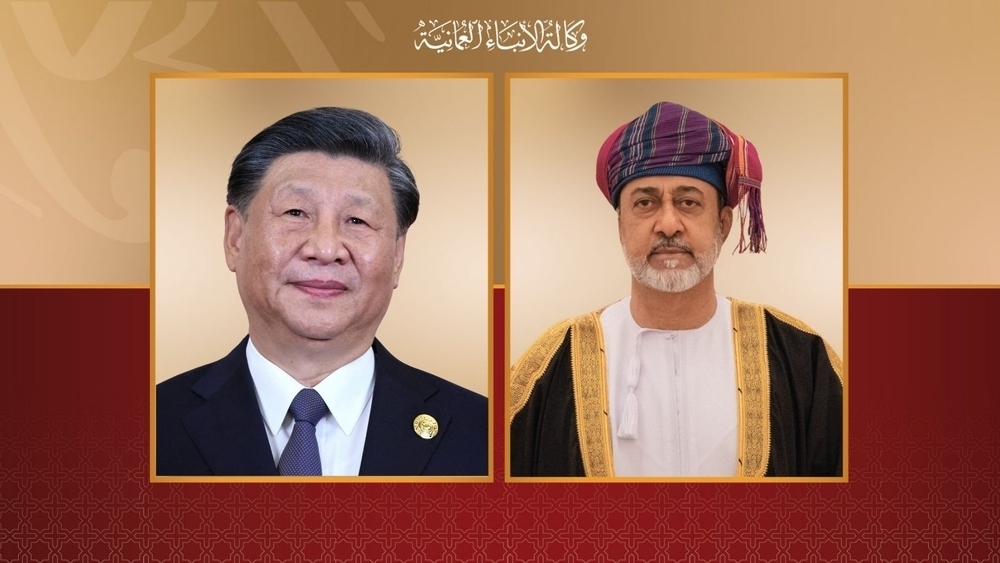
His Majesty Sultan Haitham bin Tarik’s state visit to Beijing is historic in more than protocol. As the first visit by an Omani head of state to China since diplomatic relations were established in 1978, it closes a chapter of steady, pragmatic friendship and opens one of strategic partnership.
The symbolism at the Great Hall of the People was clear, but the substance was clearer still.
In a single day, the two sides witnessed the signing of a central bank currency exchange agreement between the Central Bank of Oman and the People’s Bank of China, 14 memoranda of understanding, and cooperation protocols spanning artificial intelligence, green development, space, BeiDou navigation, central bank digital currencies, securities and futures regulation, and even the export of Omani dried dates.
Alongside it, the Oman Investment Authority signed 23 agreements, MoUs and strategic partnerships with Chinese institutions on the sidelines of the Oman-China Forum. This is not ceremonial diplomacy. It is economic architecture.
What the visit signals is a deliberate pivot from a trade in goods to a partnership of capabilities. His Majesty’s proposal for a preferential bilateral trade and investment agreement would move the relationship beyond spot crude sales into structured, long-term flows of capital, technology and manufacturing – precisely what Oman’s Eleventh Five-Year Plan and Oman Vision 2040 require.
President Xi Jinping described deepening ties as a ‘shared strategic choice’, pledging to lift the partnership to a higher level to contribute to peace, stability and prosperity.
In a world where the Gulf is too often viewed as an arena for great-power rivalry, Oman’s independent, balanced and development-focused approach offers a different model. As President Xi noted, the Middle East should not become a battleground for rivalry.
For investors, the message is equally important. This visit de-risks Oman for Chinese industry and, by extension, for global investors watching China’s footprint. It tells a manufacturer in Shenzhen that Al Duqm offers not only land and port access, but institutional backing at the highest level.
What makes this visit different is the depth of institutional alignment. The agreements are not just government-to-government but connect regulators, central banks, space agencies and private capital.
Cooperation on securities and futures, data governance, and competition rules signals that Oman and China are not just trading more, but learning to regulate together – a prerequisite for long-term investment in AI, fintech and advanced manufacturing.
Al Duqm is central to this vision. Once seen as a remote port, it is now being positioned as a green industrial hub where Chinese technology can produce renewable energy, green hydrogen and value-added minerals for export.
Combined with Sohar’s industrial base and Salalah’s logistics advantage, Oman offers what few partners can: an integrated, politically neutral platform linking the Belt and Road Initiative with the GCC and Africa.
For this momentum to hold, two things are essential: speed and talent. Joint investment funds, discussed by His Majesty with Premier Li Qiang and President Xi, must move quickly into bankable projects in renewable energy and digital infrastructure. Technology transfer will only succeed when Omani engineers, coders and entrepreneurs are part of the build.
His Majesty called this visit ‘a new starting point’. With four decades of trust as a foundation, Oman and China have the chance to build a partnership that is not just larger, but deeper – one that serves Oman’s diversification, China’s connectivity, and regional stability.
This visit will be remembered not as a visit about China, but as a visit about Oman’s future.
Oman Observer is now on the WhatsApp channel. Click here