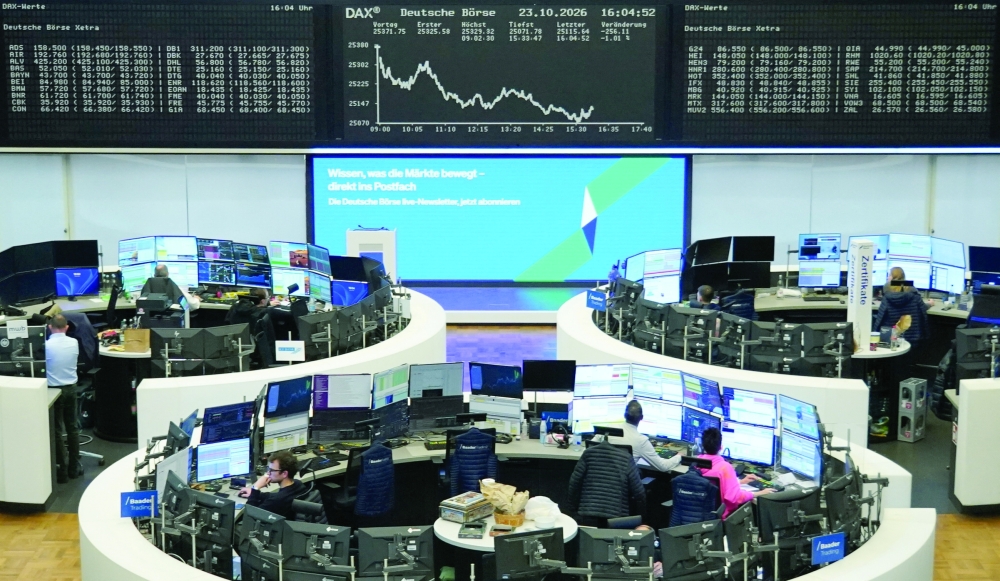


A selloff in global tech shares lost some steam in Asia on Friday, after concerns over the enormous funding needs of AI hammered Wall Street and led to the biggest daily rally in Treasuries in more than three years.
European bourses also look set for a steady start to trading, with pan-region stock futures little changed. Nasdaq futures were off 0.1 per cent, while S&P 500 futures slipped 0.2 per cent.
However, Brent crude added 0.9 per cent to hit a new five-month peak of $114.10 a barrel as fears grow that the conflict in the Middle East could escalate. Brent is set to end the week 3.9 per cent higher after Houthi attacks in Saudi Arabia stoked concerns of further disruption to energy supplies.
Treasuries held onto their overnight gains amid the flight to safety. Markets also sharply pared back bets on further policy tightening from the Federal Reserve, stripping out almost a full quarter-point rate hike for next year amid concerns a bursting AI bubble could derail the data-centre investment boom and hobble the US economy.
A December rate rise is no longer fully priced, with the implied probability falling to 85 per cent.
MSCI's broadest index of Asia-Pacific shares excluding Japan was last flat after earlier falling as much as 0.8 per cent as bargain hunting emerged following the steep selloff. Still, it was set for a weekly loss of 2.4 per cent, which would be a fourth straight week in the red.
Japan's Nikkei dropped 0.5 per cent and was down 4.1 per cent for the week. South Korea's KOSPI managed to eke out a 0.1 per cent gain after shedding 4 per cent earlier in the session.
Mainland China's blue-chips found support after hitting the lowest since July 2025, with the CSI300 up 0.8 per cent. Hong Kong's Hang Seng also rose 0.7 per cent after dropping 3 per cent on Thursday.
"It is hard to get too bearish on equities overall just yet, with earnings growth still positive and the hard economic data holding up well," said Diana Mousina, Deputy Chief Economist at AMP.
"All of this means that the AI trade isn’t necessarily over, but it is changing. It is no longer a case of 'buy everything'."
On Wall Street, the Nasdaq slumped more than 2 per cent, with Meta shares losing nearly 8 per cent after the Facebook parent posted its first cash outflow in more than a decade due to its AI-related expenditures. Meta also announced plans to issue non-voting shares in a two-for-one split to raise capital to spend on the technology. Tesla shares fell 3.1 per cent as the electric car maker cut its 2026 capital spending plans.
As tech stocks tumbled, money flowed into safe-haven US Treasuries, sending yields plunging across the curve overnight. The benchmark 10-year Treasury yield slid more than 19 basis points, the biggest drop since March 2023, before steadying at 4.9676 per cent on Friday, back below the closely watched 5 per cent level.
That was also due in part to the ongoing sell-off in French bonds, whose benchmark yield climbed 6 basis points overnight to 5.0601 per cent, the highest level since 2002.
"The US 10 yr yield gapped back below 5 per cent with some conviction. We're not convinced it keeps on going," said Padhraic Garvey, ING's regional head of research for the Americas.
"We're minded to expect it to snap back above (5 per cent), as we still have inflation/fiscal deficit/AI boom underpinnings to navigate. And we have the US midterm elections approaching as an excuse for trouble. But it will need some degree of calm in the risk space first."
The 2-year Treasury yield slumped nearly 19 bps overnight and was last flat at 4.6582 per cent.
Government bonds in Asia also rallied. The yield on 10-year Japanese government bonds fell 9 bps to 2.780 per cent, while Australia's 10-year yield dropped 8 bps to 5.178 per cent.
In currency markets, the dollar steadied at 156.91 yen on Friday, after slumping 0.9 per cent overnight. The dollar rose 0.2 per cent to 0.8219 Swiss franc, after an overnight fall of 0.5 per cent.
Oman Observer is now on the WhatsApp channel. Click here