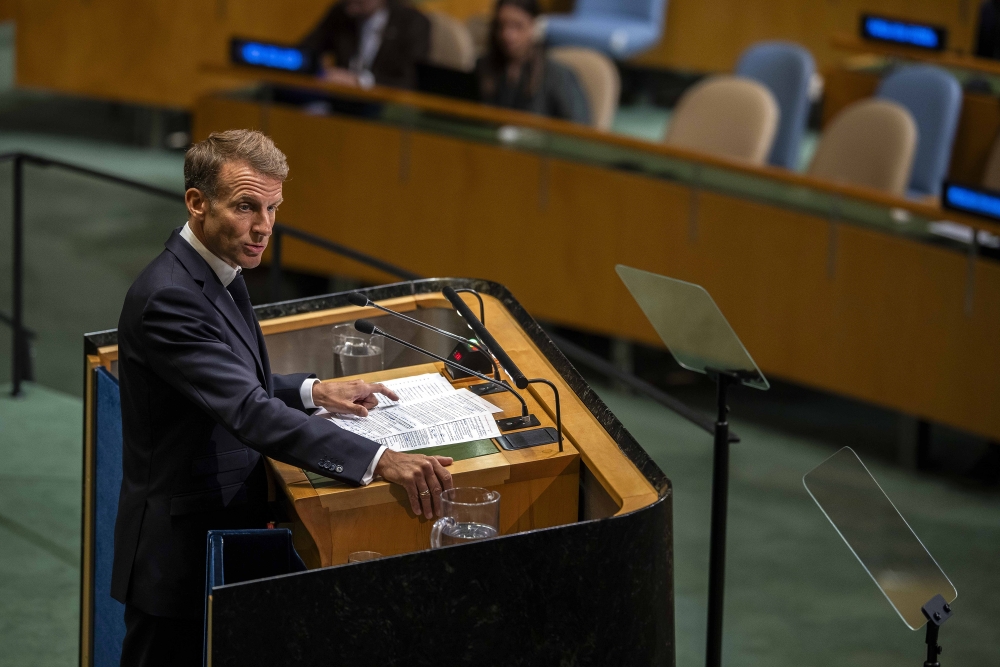





PARIS — As thousands of high school students took to the streets last week in a collective cry of youthful anger, French President Emmanuel Macron traveled to a navy ship off the coast of Brittany. From the deck, he watched the firing of a new ballistic missile from a French nuclear-powered submarine.
It was a telling display of Macron’s priorities in a country where the president, by tradition, rises above the messy scrum of domestic politics. Macron left it to his prime minister, Sébastien Lecornu, to try to reassure the French people that the government was handling the proliferating unrest.
It also reflected how Macron, after nearly a decade in power, has failed to solve the manifold problems afflicting France’s economy and welfare system — problems he promised to address when he was elected in 2017, at 39, as an ambitious reformer, and which have now coalesced into a systemic crisis.
“Remember, Macron published a book before the 2017 election, called ‘Révolution,’” said Jérôme Fourquet, a political analyst at the polling institute IFOP. “We told ourselves: He will relaunch the machine, he will lead a revolution.”
With just seven months before he leaves office, the president “hasn’t been able to bring about this revolution,” Fourquet said. Instead, the analyst said, he may be remembered as “the last captain of the boat.”
On Tuesday, thousands of students were set again to protest overcrowded classrooms, dilapidated school buildings and a shortage of teachers. The protests, now in their fourth week, added to the portrait of a country in disarray.
So dire are France’s fiscal problems that experts say the country may finally be forced to reckon with the foundering of its generous welfare state. Such a scenario could trigger painful cuts to benefits or even a default on France’s debt.
To be sure, many of these problems predated Macron. Some were exacerbated by events out of his control, like the coronavirus pandemic and wars in Iran and Ukraine, which fueled inflation and further busted the budget.
Still, critics say Macron failed to make a dent in France’s long-standing structural problems, either because of public blowback or his own political miscalculations. His legacy, then, is likely to be one of unfulfilled promise.
Macron’s office declined to comment.
A onetime investment banker who had served as economics minister, Macron came in promising to revitalize France’s economy by cutting taxes on businesses and high-income people, loosening labor laws and overhauling the pension system. This, he said, would nurture an entrepreneurial culture and make France attractive again to investors, which would reignite economic growth.
Macron accomplished the first two goals but not the third. He set off angry protests after pushing through an unpopular rise in France’s retirement age to 64 from 62, a move that economists say was critical to stemming the tide of red ink. After Macron lost his majority in the National Assembly, lawmakers bowed to popular sentiment, voting in 2025 to pause the change.
At the same time, Macron’s elimination of a tax on wealthy people earned him the unflattering sobriquet “president of the rich.” That became a political problem as rising prices created a cost-of-living squeeze. From 2018 to 2020, France was convulsed by the yellow vest protest movement, which began when people turned out to demonstrate against fuel prices and a litany of other grievances.
“We never had so many very rich people, and we have many people who can’t make ends meet,” said Jean-Yves Camus, a political scientist at the Jean Jaurès Foundation, a left-leaning think tank in Paris. “French society, which always aimed at being egalitarian, is going the American way.”
France, of course, remains starkly different to the United States when it comes to the size of the state. In 2025, public spending — on healthcare, pensions, education, culture and other benefits — amounted to 57.3% of France’s total economic output. That is the second highest percentage in the European Union, after Finland’s, and more than 20 points higher than in the United States.
Total public debt is now projected to reach 120% of gross domestic product in 2027, the third-highest ratio after those of Greece and Italy.
Russia’s invasion of Ukraine, and President Donald Trump’s return to power in 2024, compounded France’s costs because it has had to spend more on its military — to counter Russian threats and to rely less on the United States’ security umbrella.
Even critics credit Macron for leading calls for the continent to take on more responsibility for its security. His blueprint for “strategic autonomy” from the United States once seemed unrealistic, even grandiose. Given Trump’s disparagement of NATO, it now seems prescient.
“He has tried to build a global European vision,” said Gérard Araud, a former French ambassador to Washington, said of Macron, whom he has advised. “Whatever you think of it, he has been the voice of Europe.”
But Araud said that the qualities that had enabled Macron to stride the global stage have hurt him at home. His elite credentials and intellectual manner have made him seem out-of-touch in meat-and-potatoes France, he said.
“He’s the ultimate arugula president in a populist time,” said Araud, recalling an early episode in which former President Barack Obama, who some say shares a few of Macron’s high-handed traits, was tweaked for mentioning rarefied salad leaves in a meeting with farmers.
French voters have long since grown disillusioned with Macron. His approval rating stood at 15%, the lowest level since he took office, according to a poll last week by polling firm Ipsos.
Macron’s eroding popularity has coincided with a skein of electoral setbacks, some of them self-inflicted.
After his party was badly beaten in European Parliament elections in 2024, the president called snap elections within France. The decision, which surprised his advisers, backfired, leaving his party with fewer seats in the national parliament.
Macron found himself with little room for legislative maneuver as France’s fiscal situation continued to deteriorate. His push to overhaul the French state was by then a memory. The eruption of the Iran war drove up energy prices again, further clouding France’s economic picture.
Even in pushing for an end to the conflicts in Iran and Ukraine, Macron has found himself largely on the sidelines of negotiations dominated by the United States. One exception was when he recently negotiated a deal with Trump and other leaders to release 100 million barrels of stockpiled crude oil and diesel to ease prices that war has raised.
Macron has cycled through prime ministers as the government has labored to pass a budget. The seemingly unending drama over France’s finances has deepened the doubts of investors about the country’s creditworthiness.
With yields on France’s bonds briefly crossing the dangerous threshold of 5%, there are fears that the country could tumble into a full-blown financial crisis. Investors are also alarmed by the prospect that far-right leader Marine Le Pen has a plausible path to the presidency next spring.
Macron, who twice defeated Le Pen, has long presented himself as a bulwark against the far right. But his inability to turn his political movement into a self-sustaining centrist party, analysts said, has contributed to the withering of France’s political center, leaving the country vulnerable to a far-right takeover.
Alain Minc, a French businessperson who was a close adviser to Macron before falling out with him midway through his tenure, said the president’s legacy could be divided neatly into halves.
Macron’s first term, during which he pushed through some significant changes, was “more than decent.” His second, Minc said, was a “drama,” culminating in the current crisis, which has prompted some to question whether France will need to be bailed out by the European Central Bank.
“His legacy will be dramatic,” Minc said, and not in a good way. “For France to need the support of the ECB is the most humiliating position to be in.”
This article originally appeared in The New York Times.
Oman Observer is now on the WhatsApp channel. Click here