




MUSCAT, SEPT 21
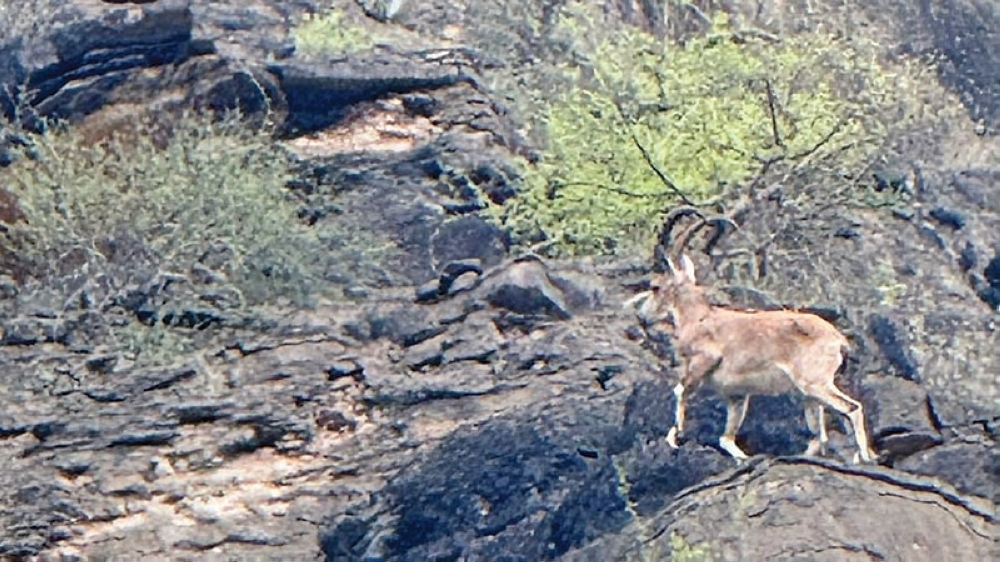
Wild enthusiasts and hikers in Dhofar spotted a wild goat Arabian Tahr (Arabitragus Jayakari) scaling rocky cliffs of Dhofar recently.
The Arabian Tahr, which is locally known as ‘Waal’, is an endangered and endemic to Oman and neighbouring UAE and lives in the Hajar Mountains. Wildlife experts say it is a very shy animal and sightings like this are becoming increasingly rare but also important as they usually live on steep rocky cliffs.
Since Arabian Tahr is a species at the verge of extinction, Oman is doing a lot to protect it - it's one of the symbols of Oman's wildlife conservation. The Anglo Omani Society says the Arabian Tahr was named in honour of Dr Atmaram Sadashiv Grandin Jayakar (ASG Jayakar, 1844–1911), a surgeon-lieutenant colonel in the Indian Medical Service and a dedicated naturalist who served as the British Agency Surgeon in Muscat in the late 19th century. Dr Jayakar first obtained and sent the initial specimens of the animal from Jebel Taw in Oman to zoologist Oldfield Thomas, who formally described and named the species in his honour in 1894.
"In honour of the Arabian Tahr, the ESO (Environment Society Oman), Oman's first NGO focused on conservation, has made it part of its logo together with a sea turtle because the two animals are its two flagship species, representing the full range of Oman's natural heritage that ESO works to protect," an ESO spokesperson said, adding, "The Tahr in particular was chosen because it's uniquely Omani, found almost only in Oman, it is a symbol of national pride and is listed as 'Endangered on the IUCN Red List', with fewer than 2,500 left in the wild due to habitat loss and poaching - exactly the type of species ESO was created to save. Its survival reflects the health of Oman's fragile mountain ecosystems, just as the turtle reflects the health of the marine ecosystem."
"To see a healthy, adult male in the open during daylight means this habitat is still intact and relatively undisturbed," said a conservationist. "These mountain goats are indicator species. If they are doing well, the whole mountain ecosystem is doing well."
Perfectly camouflaged, with its light brown coat blending into the rocks, the Tahr can climb near-vertical cliffs and survive for long periods without water, getting moisture from plants.
Local environmental authorities have stepped up anti-poaching patrols and camera-trap monitoring in recent years, and images from the public are now a vital part of tracking the population.
Siraj Zidan, the hiker who grabbed the rare photo from a distance said the goat watched for a moment before disappearing over the ridge in a few effortless bounds - leaving behind only this photograph, a sign of hope for mountain wildlife, and a reminder of the wild beauty still holding on in Dhofar’s mountains.
Oman Observer is now on the WhatsApp channel. Click here