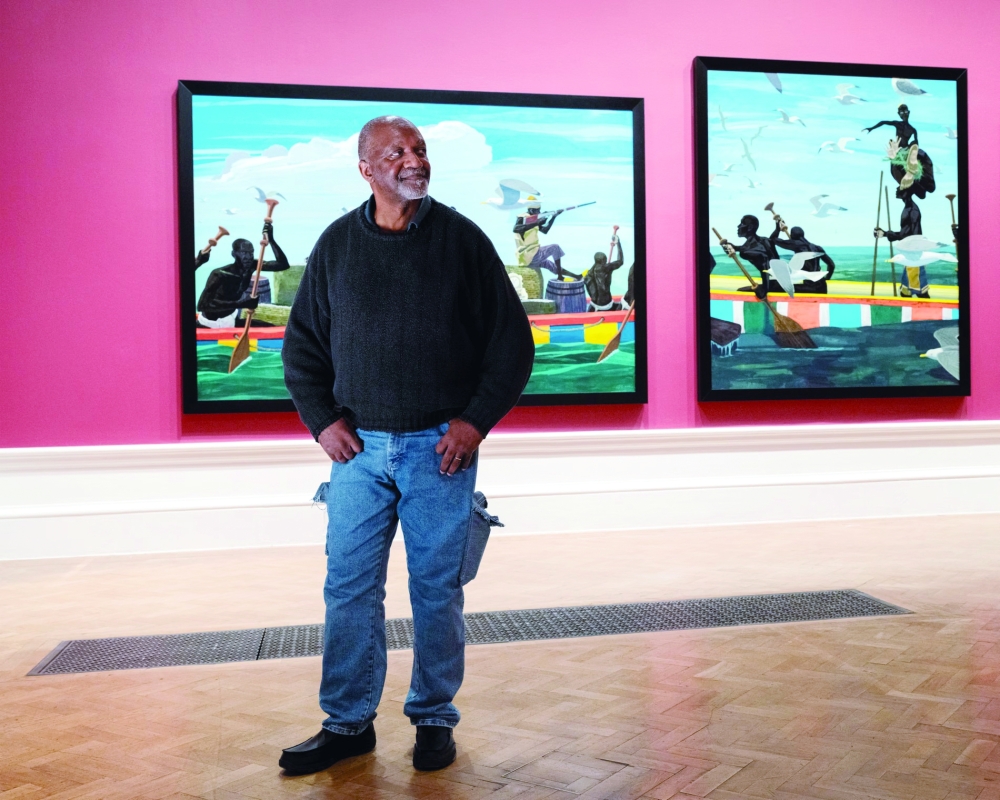





He has arguably done more than any living painter to bring black figures into Western galleries, but Kerry James Marshall remains uncomfortable with being seen as a trailblazer on the eve of another major retrospective of his work.
“It’s not a reasonable assumption to believe that there were no black people in pictures before I had some kind of revelation that they should be there,” the Alabama-born American told AFP in Paris.
He cites the work of his mentor Charles White (1918-1979), whom he compares with some of the greatest figurative painters, as well as portraits by 16th-century Dutch painter Hieronymus Bosch and statues of Ancient Greece.
Few contemporary artists, however, have done as much to mainstream black portraiture. Marshall counts stars including Sean Combs and Jay-Z among his collectors, holds the auction record for a living black artist and is now receiving unprecedented recognition outside the United States.
His travelling retrospective, “The Histories”, has received acclaim at London’s Royal Academy of Art and Zurich’s Kunsthaus before arriving at the Musee d’Art Moderne in Paris, where it opened on Friday.
The exhibition includes monumental works such as “De Style” (1993), depicting clients at an African American hair salon who stare towards the viewer beneath a calendar showing the date of Rodney King’s beating by Los Angeles police officers in 1991, an event that preceded race riots.
In “Black Painting” (2003), a barely discernible couple embrace in a dark bedroom, with a book by African American activist and former Black Panther Angela Davis on the bedside table.
“The first thing you see is that they’re black figures, but then you have to move on from that to everything else that’s happening in the picture,” Marshall said.
Much of his work carries a powerful message about representation, placing black people in ordinary settings such as beauty salons and parks, while echoing the conventions of classical European portraiture, where black subjects were often depicted as servants or slaves.
Marshall renders his figures’ skin in jet-black, describing “blackness” as “a rhetorical device” and an aesthetic framework that allows viewers to consider it as something complex and rich.
Marshall, now 70, grew up in segregated Birmingham, Alabama, before moving to Los Angeles with his family in the 1960s. Living in predominantly black and poor South Central, he witnessed gang violence and the 1965 Watts riots.
He emerged as a major figure relatively late, receiving his first major retrospective only a decade ago. The 2020 Black Lives Matter protests further increased interest in black American artists.
Asked about artistic freedom under President Donald Trump, Marshall said he remained unconcerned.
“I’m driven by what I think is necessary to do myself,” he said. “You can’t make me stop making pictures.” -AFP
Oman Observer is now on the WhatsApp channel. Click here