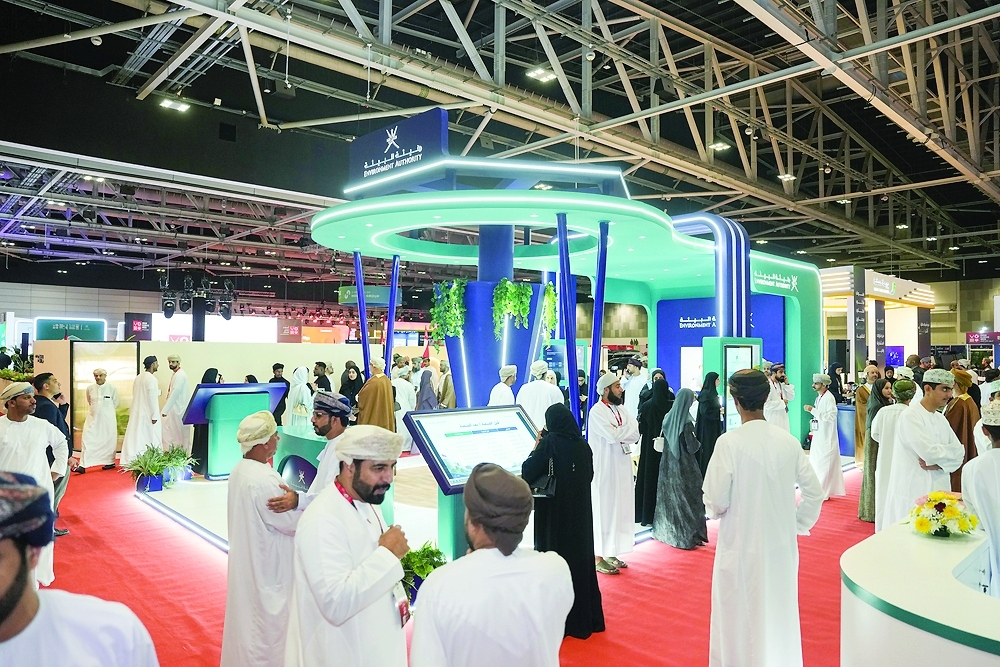





MUSCAT: Article 6.4 of the Paris Agreement was in focus on the second day of the Oman Climate Week held at the Oman Convention and Exhibition Centre as the momentum is growing globally, regionally, and nationally. In the global landscape the number of countries that have established Article 6 of the Paris Agreement is 129 out of 198 in the Paris Agreement.
Oman has total credits of nearly more than 800,000 from three main projects that are associated with gas recovery and landfill projects.
Mohammed al Shuaili, VP of Carbon Market and Green Certificate Oman Net-Zero Center, said, "We are really very lucky to have such a detailed rule book that covers all the requirements and all the foundational requirements or regulations associated with working and establishing transactions and agreements within the carbon markets. If we look into the global landscape, you can clearly notice that the number of countries that have established DNA-designated national focal points for Article Six is really growing." He noted that similarly in 6.2, the number of agreements between countries has grown significantly, with roughly 112 agreements so far, spanning 65 countries.
"Bilateral collaboration basically is generating around 28 million tonnes of mitigation outcomes, so it is quite a significant volume to help countries achieve their NDC commitments," said Al Shuaili.
He quoted the World Bank's 2025 annual report on the Carbon Market that stated almost one-third of global total emissions are covered by some sort of carbon crediting mechanism, either a carbon pricing or carbon crediting mechanism.
Oman has already launched the national carbon registry—Oman's national carbon market infrastructure is anchored by the Oman Net-Zero Centre (ONZC) under the Ministry of Energy and Minerals, which utilises the Meezan digital platform to serve as the national carbon registry and accounting system. It includes three main modules. One module is an integrated accounting platform for either companies or sectors within Oman; they can key in their emissions and get immediate analysis and reports.
The second module is a detailed database that includes all the emission reduction projects spanning all the key sectors within Oman.
This database includes projects from the oil and gas sector, the industrial sector, the agriculture and waste sector, the transportation sector, etc. The last module integrates with the carbon registry, which is moving forward and will be tied in or interconnected with the global carbon registry. It allows smoother movement of information and data between projects.
"The objective is to have a portfolio of projects. We do have over 200-plus projects. Emission reduction projects are being submitted, while some are at different stages of development; some are under development, some may be in the concept or selection stage, and so on." According to him, these projects include different types of activities such as renewable energy, solar and wind; some of them are associated with battery storage and energy efficiency across commercial, residential and government buildings." He pointed out that there are a number of gas recovery projects, either from landfills or from some of the oil and gas activities, as well as methane recovery projects.
Dr said al Sarmi, Senior Net-Zero Expert, and Oman Article 6 DNA, Oman Net-Zero Center, explained, "The recently updated and submitted nationally determined contribution of Oman has a target of 33 per cent—seven per cent is unconditional and 26 per cent is conditional on finance received, technology and capacity building. So the government should protect the NDC (NDC is the nationally determined contribution) and have the priority to achieve the mitigation target of Article Six. We have the vision to mobilise the finance and the technology needed to implement high-integrity projects that help Oman to achieve the target, especially the conditional target."
Oman Observer is now on the WhatsApp channel. Click here