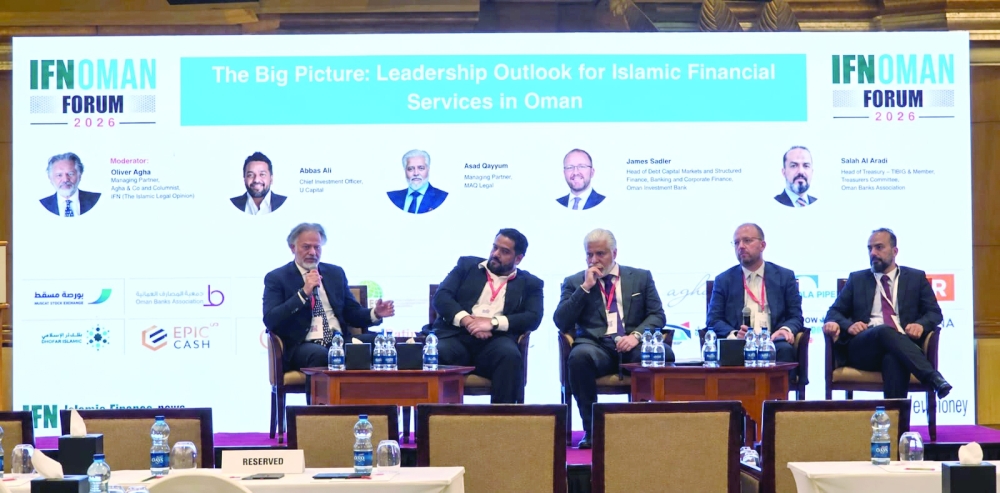





MUSCAT: Oman’s Islamic finance industry needs deeper capital markets, greater liquidity and a broader range of investment products to sustain its rapid expansion as the sector heads towards an estimated $45 billion in assets this year, industry executives said.
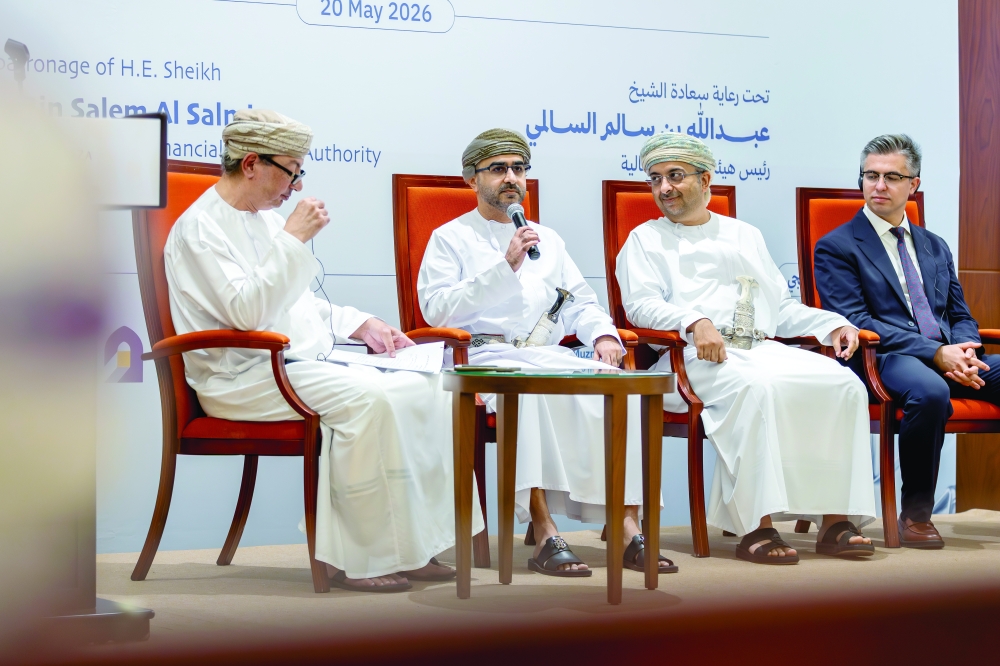
Speaking at the IFN Oman Forum 2026, senior bankers, asset managers and legal experts said the Sultanate of Oman had built considerable scale in Islamic banking and sukuk, but capital-market products, asset management and takaful remained relatively small.
Abbas Ali, Chief Investment Officer at U Capital, said the industry was worth about $35 billion last year, comprising roughly $25 billion in Islamic lending and $10 billion in outstanding sukuk.
Asset management and other capital-market products accounted for only about $1 billion, or 2.5 per cent of the industry, he said, while Islamic banking represents around 20 per cent of system-wide banking assets.
“The market has become bigger, it’s not become deeper, it’s not become broader,” Ali said.
He said Oman needed a fuller range of Sharia-compliant investment options that would allow individual and institutional investors to allocate savings across different asset classes.
A key requirement was more frequent sukuk issuance across different maturities, including short-term Islamic treasury instruments as well as medium- and long-term securities. Such instruments would help establish pricing benchmarks and improve liquidity for asset managers and investment banks.
Ali said the performance of Sharia-compliant assets showed that the issue was not necessarily investment returns. Sukuk had outperformed some conventional bond benchmarks over five- and 10-year periods, while Islamic equity strategies had also delivered competitive long-term returns.
Asad Qayyum, Managing Partner at MAQ Legal, said structural reforms under way in Oman could provide another catalyst for the industry.
Banks operating Islamic windows are expected to submit plans to the Central Bank of Oman by the end of this year as the sector moves towards standalone Islamic banking structures, with broader corporate governance reforms targeted by 2030.
Qayyum said Islamic banking assets currently account for about 65–66 per cent of Oman’s Islamic finance sector, with sukuk representing around 30 per cent. Takaful and asset management together make up only about 2–3 per cent.
“We need to see growth in that,” he said, adding that expansion was taking place but was not yet fast enough to make a significant impact on the industry's composition.
Legal certainty will also be important as Islamic financial products become more sophisticated, panellists said.
Qayyum said Oman already has the Central Bank of Oman’s Islamic Banking Regulatory Framework, which defines Islamic banking products, but questions remain over how some structures would ultimately be interpreted and enforced by courts.
Greater legislative clarity and judicial familiarity with Islamic finance could provide investors and issuers with greater certainty, particularly in complex transactions, he said.
James Sadler, Head of Debt Capital Markets and Structured Finance at Oman Investment Bank, said Oman and the wider region already possessed considerable capacity and supply of Islamic financial products.
The next stage required “greater liquidity, greater pricing transparency, and a broader base of participation,” he said.
For Oman, attracting more international investors into domestic sukuk markets over the medium term could broaden the investor base and strengthen secondary-market activity.
The discussion highlighted a shift in the industry’s priorities after years of rapid balance-sheet expansion. Rather than focusing principally on increasing the headline size of Islamic finance, executives said the next phase would depend on creating deeper markets, expanding non-bank Islamic financial products and improving the mechanisms through which securities are priced and traded.
For a sector approaching $45 billion, Ali said the priority was clear: “I’m not looking for more size, I’m looking for more depth, and I’m looking for more breadth.”
Oman Observer is now on the WhatsApp channel. Click here