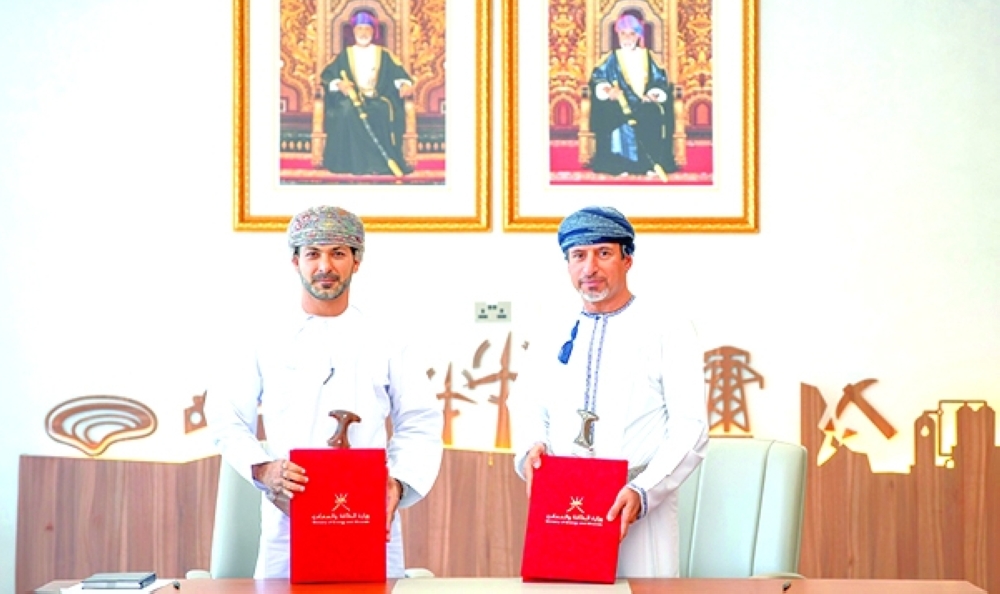
MUSCAT: The Ministry of Energy and Minerals signed two agreements in Muscat on September 10 to develop two mining concession areas covering a combined 1,687 square kilometres, with exploration investments estimated at around RO 6 million ($15.4 million).
The first agreement covers Concession Area 51-B, located across Al Dakhiliyah and Al Wusta governorates and extending over 1,050 sq km. Exploration investment is estimated at approximately $6.2 million.
The first phase of the exploration programme will run for two years and three months and include topographic, geophysical and remote-sensing surveys, geochemical and physical analyses, as well as exploratory drilling and trenching.
The second agreement covers Concession Area 25-E in South Al Sharqiyah Governorate, spanning approximately 637 sq km, with exploration investment estimated at around $9.2 million.
The work programme will include topographic, geophysical and remote-sensing surveys, geochemical and physical analyses, exploratory drilling and trenching aimed at improving geological knowledge and assessing the area's mineral potential.
The agreements were signed on behalf of the Ministry by Eng Salim bin Nasser Al Aufi, Minister of Energy and Minerals; Ahmed bin Khalid Al Shanfari, Managing Director of Emaar Mining Company, which will invest in Area 51-B; and Zhang Xiaolong, Chairman of Gulf Royal Minerals and Energy Company, which will invest in Area 25-E.
Al Aufi said the agreements represented a continuation of the Ministry's efforts to provide investment opportunities, expand mineral exploration and prospecting, and build a pipeline of projects capable of progressing into development and production.
He said the next phase would focus on accelerating the conversion of exploration results into productive projects and maximising the in-country value of mineral resources through manufacturing and associated processing industries.
The Minister said Oman's minerals sector had undergone a significant transformation in its investment and regulatory framework over the past five years. During this period, 28 mining concession areas have been awarded for the exploration and development of a diverse range of mineral resources, including copper, chromite, gypsum, limestone, dolomite, silica and salts, among other minerals.
These efforts have been accompanied by improvements to the legislative and regulatory framework, including the adoption of an occupational health and safety guide aimed at raising mining standards and operational efficiency.
The government has also established the Oman Mineral Trading Company to regulate the trading and marketing of mineral raw materials and improve their access to markets.
At the same time, transactions and services across the mining sector have been shifted from paper-based procedures to an integrated digital system. The platform provides a sector-wide database, streamlines the submission and tracking of applications, and makes investment opportunities available on the principles of transparency and equal opportunity.
Al Aufi said these reforms were beginning to be reflected in the sector's economic performance, with mineral-sector revenues rising around 39 per cent in 2025 compared with 2024, alongside an expansion in mining activity and the commencement of copper ore production.
He said the gradual progression of concession areas from exploration to development and production, together with new projects entering operation — notably the Mazoon copper mine, expected to commence production in 2027 — would support further revenue growth.
These developments are also expected to maximise the economic value of Oman's mineral resources, expand domestic value chains and local content, and strengthen the mining sector's contribution to economic diversification and the objectives of Oman Vision 2040. (ONA)
Oman Observer is now on the WhatsApp channel. Click here