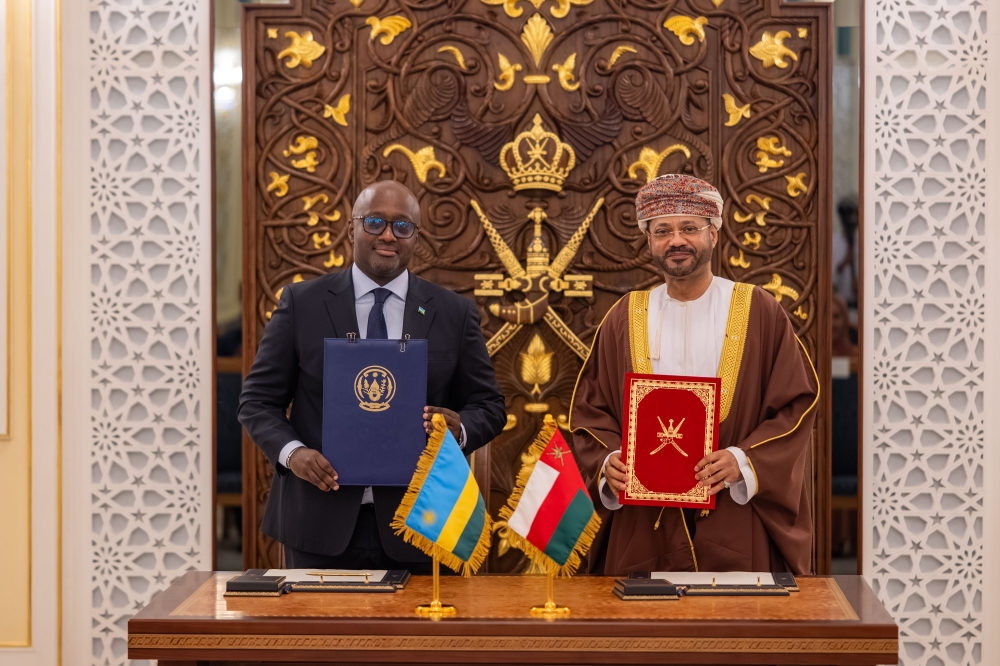
As Rwanda’s President Paul Kagame visits Oman, the moment carries more weight than a standard diplomatic exchange. It is a signal that two nations, separated by geography but united by ambition, are choosing to write the next chapter of cooperation.
For Oman, this visit is a natural extension of its foreign policy: balanced, pragmatic, and anchored in peace.
Under the leadership of His Majesty Sultan Haitham bin Tarik, Oman has consistently positioned itself as a bridge — between East and West, between tradition and innovation, between stability and growth. The country does not seek dominance. It seeks partnerships that deliver prosperity, dignity, and resilience.
For Rwanda, the visit reflects the same clarity of purpose. In just three decades, Rwanda has transformed itself from a nation recovering from tragedy into one of Africa’s most dynamic economies. It has prioritised good governance, digital transformation, clean energy, and a knowledge-based economy. It is a country that proves that vision, discipline, and investment in people can change a nation’s trajectory.
Oman and Rwanda do not have a long colonial history binding them. They have something better: shared values. Both countries believe in stability as the foundation for development. Both have prioritised youth, education, and technology as engines of the future. Both understand that in a volatile world, diversification is not a luxury — it is survival.
Oman brings to the table its expertise in logistics, maritime trade, renewable energy, tourism, and financial services. With ports like Suhar and Al Duqm, Oman sits at the crossroads of global shipping lanes. With Oman Vision 2040, it is investing heavily in green hydrogen, manufacturing, and a knowledge economy.
Rwanda brings a different but equally powerful set of assets: a reputation for efficiency, a young tech-savvy population, leadership in conservation and sustainable development, and a strategic position as a gateway to the East African Community and the African Continental Free Trade Area. Kigali has become a hub for innovation, drone delivery, and digital government — proof that scale is not a prerequisite for impact.
Put together, the complementarity is clear.
Oman can help Rwanda access Gulf and Asian markets, invest in infrastructure, and develop tourism that respects culture and environment. Rwanda can offer Oman a foothold in Africa’s fastest-growing region, opportunities in agri-tech, fintech, and smart cities, and lessons in how to deliver public services with speed and integrity.
There are immediate areas for collaboration. In renewable energy, Oman’s green hydrogen ambitions and Rwanda’s investments in methane gas and solar can create knowledge exchange.
In agriculture and food security, Rwanda’s expertise in high-value crops and Oman’s logistics capabilities can build resilient supply chains. In tourism, both nations offer authentic, sustainable experiences — from Oman’s mountains and coasts to Rwanda’s gorillas and lakes — and can market themselves to each other’s travellers.
Education and human capital must also be central. Exchange programmes, vocational training, and partnerships between Omani and Rwandan universities can ensure this relationship is carried forward by the next generation.
At a time when the world is fragmenting into blocs, Oman-Rwanda relations offer a different model. It is not about charity. It is not about dependence. It is about two sovereign nations choosing each other because it makes strategic sense.
This partnership also reflects a broader shift. Africa and the Gulf are no longer talking across each other. They are talking with each other.
Oman, with its history of maritime trade with East Africa dating back centuries, is uniquely placed to lead this reconnection.
For Rwanda, Oman represents a gateway to the Gulf, to Asia, and to stable capital. For Oman, Rwanda represents proof that reform works, that Africa’s future will be built by Africans, and that opportunity exists beyond traditional partners.
The presidential visit should therefore be more than ceremonial. It should lock in mechanisms: a joint commission, regular business forums, direct air connectivity discussions, and investment promotion desks in Muscat and Kigali.
Most importantly, it should be guided by patience and mutual respect. Real partnerships are not built in a day. They are built by showing up, delivering on promises, and solving problems together.
Oman and Rwanda may be 4,000 kilometres apart, but they are close in spirit. Both are small in population, big in ambition. Both believe that the future belongs to nations that invest in people, protect the environment, and stay true to their identity while engaging the world.
As President Kagame meets with His Majesty’s government in the Wilayat of Salalah, Dhofar Governorate, the message should be simple: this is not just a visit. It is the beginning of a long-term alliance — one rooted in vision, built on trust, and designed to deliver for the people of both nations.
In a world searching for stable partnerships, Oman and Rwanda can show what is possible when two countries choose to grow together.
Oman Observer is now on the WhatsApp channel. Click here