




Muscat: El Niño and global warming are often mentioned together, particularly when global temperatures reach record levels, but they are fundamentally different phenomena.
While global warming refers to the long-term rise in Earth’s average temperature, driven primarily by increasing concentrations of greenhouse gases from human activities, El Niño is a naturally occurring climate pattern that develops periodically in the tropical Pacific Ocean.
The two, however, are closely linked in their influence on global temperatures and weather patterns. El Niño can temporarily raise global temperatures, adding to the long-term warming trend caused by climate change.
A long-term trend versus a temporary cycle
Global warming is part of the broader process of climate change and occurs over decades and longer periods. The burning of fossil fuels, deforestation and other human activities have increased the concentration of heat-trapping greenhouse gases in the atmosphere, causing the planet to warm.
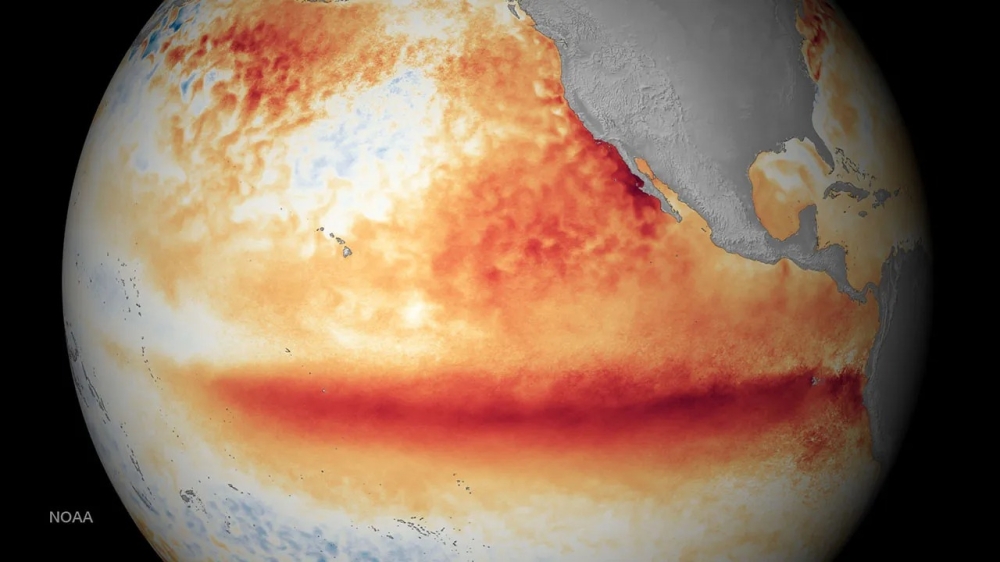
El Niño, by contrast, is one phase of the El Niño-Southern Oscillation (ENSO), a naturally occurring climate pattern involving changes in sea-surface temperatures and atmospheric circulation over the tropical Pacific.
During El Niño, sea-surface temperatures in the central and eastern equatorial Pacific become unusually warm, while the prevailing easterly trade winds weaken. La Niña represents the opposite phase, when ocean temperatures in the region become unusually cool and the trade winds strengthen.
In simple terms, global warming changes the planet’s long-term temperature baseline, while El Niño causes temporary fluctuations around that baseline.
Why does El Niño raise global temperatures?
The tropical Pacific Ocean stores enormous amounts of heat. During normal conditions, strong trade winds push warm surface waters towards the western Pacific. During El Niño, these winds weaken, allowing warm water to move eastwards and increasing the release of heat into the atmosphere.
This additional heat can temporarily increase global average surface temperatures.
As a result, a strong El Niño occurring in an already warming world can produce exceptionally high temperatures. This does not mean that El Niño is responsible for the underlying global warming. Instead, it acts as a temporary boost on top of the longer-term warming trend.
This distinction is particularly important when assessing individual years. A year influenced by a strong El Niño may be considerably warmer than the years immediately before it, while a La Niña event can have the opposite temporary effect by helping to moderate global average temperatures.
Is global warming making El Niño stronger?
Scientists continue to study how a warming climate is affecting ENSO. Global warming does not simply turn El Niño on or off, and the relationship between climate change and ENSO is complex.
Researchers have found evidence that climate change can alter the background conditions in which El Niño and La Niña develop. However, determining precisely how global warming will change the frequency, duration and intensity of individual ENSO events remains an area of active scientific research.
What is clearer is that the impacts of El Niño are occurring against a warmer global background. This means that an El Niño event today can produce extreme heat on top of temperatures that are already higher than they were in previous decades.
Why the combination matters
The distinction between the two phenomena becomes especially important when looking at extreme weather.
El Niño can influence rainfall, drought, storms and temperatures across different parts of the world. The effects vary depending on the strength and duration of the event, the season in which it develops and its interaction with other climate patterns, including the Indian Ocean Dipole.
Global warming, meanwhile, is changing the overall climate baseline and increasing the likelihood and severity of certain types of extreme heat and other climate-related impacts.
When the two occur together, their effects can compound.
For example, an El Niño event can push global temperatures temporarily higher, while long-term human-induced warming means that the starting point is already warmer. This combination can contribute to exceptionally high temperatures and increase pressure on climate-sensitive sectors such as agriculture, water resources and public health.
What does this mean for 2026?
The distinction is particularly relevant as a strong El Niño develops in 2026.
The World Meteorological Organisation has indicated a high probability of El Niño conditions continuing during the coming months. The event is expected to influence global temperature and rainfall patterns, with many regions facing an increased likelihood of above-normal temperatures.
At the same time, the world's oceans and land surface are already experiencing the effects of a long-term warming trend.
The interaction means that El Niño should not be viewed as the cause of today's rising global temperatures. Rather, it is a natural climate fluctuation occurring within a planet that is already significantly warmer because of human-induced climate change.
A changing climate baseline
One useful way to understand the relationship is to think of global warming as gradually raising the baseline temperature, while El Niño and La Niña cause temperatures to fluctuate above or below that baseline.
El Niño can therefore make an already warm year even warmer, while La Niña can temporarily offset some of that heat. Neither phenomenon, however, explains the long-term upward trend in global temperatures.
The distinction is important for climate forecasting and planning. Seasonal forecasts that identify developing El Niño or La Niña conditions can provide governments, businesses and communities with months of advance warning about potential changes in temperature and rainfall.
Combined with long-term climate projections, this information can help countries prepare for risks to agriculture, water supplies, health, infrastructure and disaster management.
Ultimately, El Niño is a natural part of the Earth's climate system, while global warming is a long-term change in that system. El Niño can temporarily intensify global heat, but it does not explain the persistent warming trend observed over decades.
Oman Observer is now on the WhatsApp channel. Click here