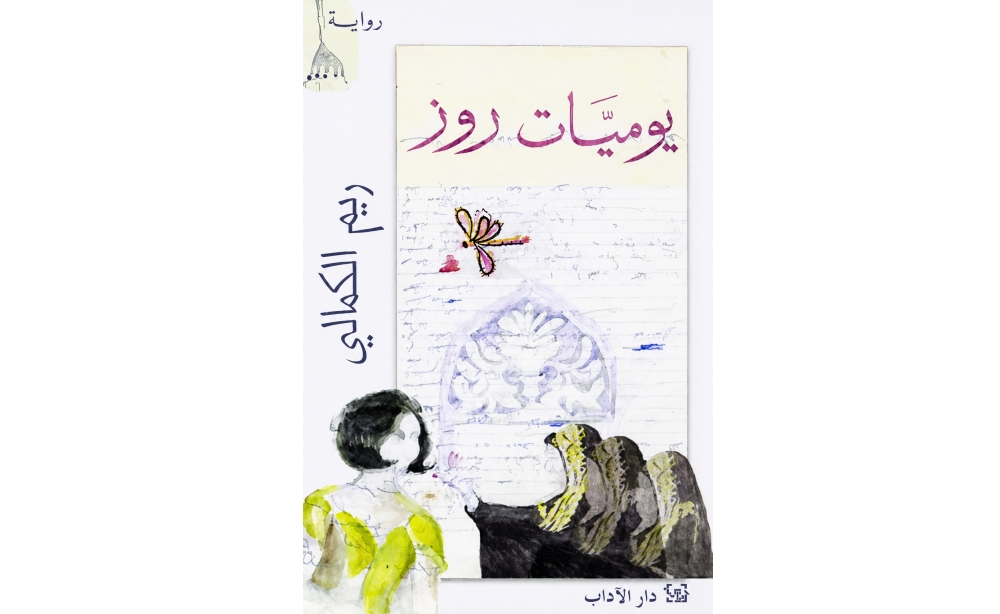





In Reem al Kamali’s 2021 novel Rose’s Diaries, published by Dar Al Adab in Beirut, the story is dominated by a single wounded and suppressed voice: Rose, who narrates in the first person. She appears at different stages of her life, so the narrative moves back and forth across time. The setting also shifts between two main places, Dubai and Sharjah, while much of the story unfolds against the background of the 1960s.
Rose responds to pressure through silence and writing. After growing up in relative freedom in Sharjah, she loses her mother and is taken by her paternal uncles to live in Al Shindagha, Bur Dubai. The large family house there becomes the main setting of the novel. From this confined space, Rose escapes through memory into other places and earlier moments of her life.
Her new world is governed by restrictions, silent love, family authority and imposed expectations. Eventually, she is forced to marry a man decades older than herself, supposedly to protect her inheritance from opportunists.
Although Rose is the central character, many others move in and out of her story: her uncle, grandmother, aunt by marriage, a one-eyed young man, Mrs Taylor, pearl merchants and a madman. They appear either directly or through memory, forming the human background against which Rose’s private suffering unfolds.
The diaries themselves are crucial to the novel. Rose shows them to no one. She writes for herself alone, then throws the pages into the creek, where the ink is left to dissolve. This gives the narrative an unusual structure: the reader is presented with a hidden story that should, in theory, have disappeared.
The novel begins near the end of Rose’s journey, when she is living in the fortress-like home of her elderly husband. The house is less a home than a prison. From this point, the narrative moves backwards to her childhood in Sharjah, her mother’s death, and her forced move to Dubai. The contrast is sharp: the relatively gentle authority of her maternal family gives way to the oppressive control of her father’s family.
Writing becomes Rose’s only refuge. Her ambitions, including the possibility of travelling abroad to study, are cut short. Unable to resist openly, she chooses voluntary silence before others and confession on the page. Yet even writing is temporary because she destroys what she writes.
That act of erasure is deeply symbolic. Writing normally assumes a future reader, but Rose removes that possibility herself. Her words exist only briefly before disappearing into water. In this sense, the destruction of her diaries becomes a kind of emotional self-erasure.
The novel also uses Rose’s memories to explore the changing history of the Emirates, especially Dubai. Her recollections move between old neighbourhoods, coastal settlements, pearl trading and the emergence of a modern state. Personal memory and social history become intertwined.
Place therefore becomes one of the novel’s major themes. Rose remembers Sharjah as a space of childhood, family and possibility. Dubai, by contrast, becomes associated with duty, confinement and the loss of choice. Her move from one city to another is not simply geographical; it marks the transition from one life to another.
The novel presents several layers of place. There is the remembered landscape described by older generations: small numbers of houses, wells, mosques, ruins and watchtowers. There is also the new city Rose herself experiences as society begins to modernise. Finally, there is the emotional landscape, where every place acquires meaning through memory, fear or longing.
Rose’s journey from Sharjah to Dubai is particularly important. She leaves behind the possibility of education and independence and enters a household governed by family expectations. The road between the two places becomes a symbolic boundary between freedom and restriction.
Through silence and memory, Rose’s Diaries recreates a disappearing world while giving voice to a woman whose life has been controlled by others. Rose chooses not to speak, yet writing allows her to preserve a private self beyond the reach of family authority.
The novel’s most striking paradox is that these writings are supposedly destroyed. Rose dissolves them in the waters of the creek, yet the reader is somehow able to encounter them. This is the literary game at the heart of the novel: water, which should erase the words, becomes the means through which they are imaginatively restored.
In the end, Al Kamali transforms silence into narration and disappearance into memory. Rose may erase her diaries, but fiction gives them another life. What was meant to vanish beneath the water returns as testimony, allowing a silenced woman to speak long after her words should have disappeared.
Translated by Badr al Dhafari
This is an adapted translation of the original Arabic article published in the print edition of the cultural supplement of the Oman Daily newspaper on July 30, 2026.
Mahmoud al Rahbi
The author is an Omani short-story writer and novelist
Oman Observer is now on the WhatsApp channel. Click here