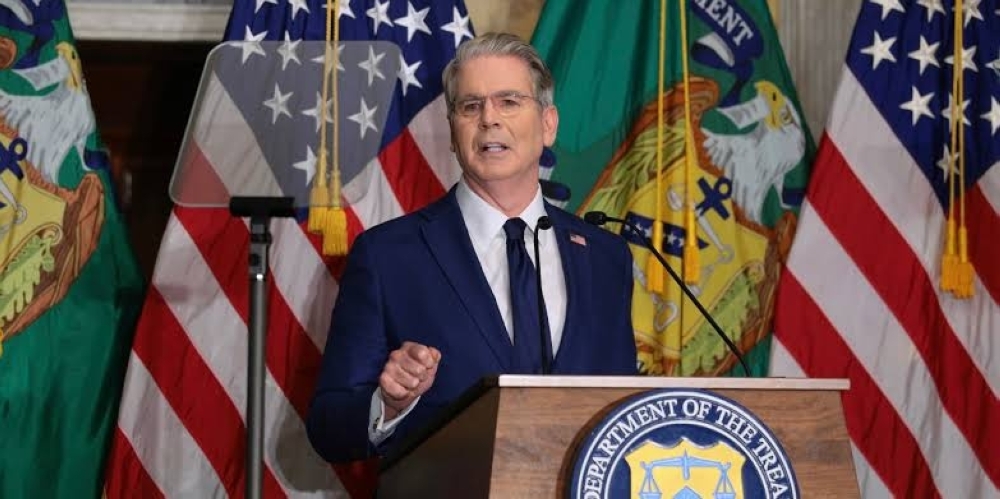





US Treasury Secretary Scott Bessent on Monday announced a sweeping new sanctions campaign targeting Iran's economic ties with the rest of the world, as Washington seeks to increase pressure on Tehran nearly six months into the war.
"The new sectoral sanctions determinations issued today target five of Iran's most vital lifelines that it exploits in other countries: digital assets, technology, gold, aviation and shipping," Bessent warned a press conference.
The measures are part of a campaign dubbed "Operation Economic Outcast," aimed at cutting off sources of revenue for Iran's powerful Islamic Revolutionary Guards Corps (IRGC) and forcing Tehran into concessions, including reopening the Strait of Hormuz.
In addition to threatening countries that continue to do business with Iran with secondary sanctions, Bessent warned that any financial institution facilitating money laundering on Tehran's behalf would be cut off from the US dollar system. He said a "major announcement" concerning one such institution would be made by the end of the week.
Bessent, however, offered few specifics despite President Donald Trump's promises of an unprecedented economic offensive.
Iranian parliament speaker Mohammad Bagher Ghalibaf dismissed the US threats, saying that "no one buys their bombast."
He argued on X that Washington was not economically capable of further restricting its relations with other countries.
Trump vows 'historic scale' sanctions against Iran
Last week, Trump had vowed action at an "historic scale" and said the sanctions would be the "most devastating economic operation" ever launched against a country, comparing it to an "economic D-Day" for Iran.
Asked why the crippling measures previewed on Monday were not being imposed immediately, Bessent said: "Why would I want to blow up the global financial system?"
But he said Washington was prepared to "move very quickly."
"Treasury has mapped every node, every facilitator, and every network that Iran has used to smuggle oil and evade sanctions," Bessent said.
"Beginning today, the actions of Treasury and other agencies will tighten the noose and block every potential source of revenue that funds the IRG," he added, using an abbreviation for the Revolutionary Guards.
Bessent said teams from the Treasury and State departments and the US military were meeting international counterparts to press them to end activities identified by Washington.
Countries had been given deadlines to halt those activities, he said, warning that Washington would otherwise take unilateral action.
Sanctions target companies and individuals
Separately, the US government announced sanctions against individual companies, people and vessels accused of helping Iran generate revenue from its oil trade.
The measures also target companies and individuals in the Middle East and East Asia that Washington accuses of providing Iran with financial and logistical support in acquiring technology for nuclear research and missile development. They include companies in China.
The US State Department also imposed sanctions on several senior military officials, including the head of Iran's IRGC.Trump threatened 'massive economic consequences'
Last week, Trump threatened Iran with an unprecedented "economic war" and warned that countries supporting Tehran, including through their financial institutions, companies, airports and government agencies, would face "massive economic consequences."
Attempts to isolate Iran economically are not new.
For decades, the United Nations, the US and the European Union have used sweeping sanctions to exert economic pressure on Iran over its disputed nuclear programme, human rights violations and support for Russia in its war against Ukraine.
The latest sanctions come nearly six months into the war launched by the US and Israel against Iran, with Washington yet to achieve a breakthrough in the conflict.
While mutual attacks have declined in recent weeks, key points of contention remain unresolved, including the future of Iran's nuclear programme and the Strait of Hormuz.
The strategic waterway, which was open before the war, has become a central point of dispute and a major source of disruption to the global economy and international trade. Iranian controls on shipping through the strait, combined with a US naval blockade of Iranian ports, continue to severely disrupt reliable oil trade.
Oman Observer is now on the WhatsApp channel. Click here