




John Yoon
Flying across the world? You’re now more likely to stop in Asia than you would have been before war broke out in the Middle East.
Major Persian Gulf airlines like Emirates, Qatar Airways and Etihad dominated intercontinental travel before the war, accounting for roughly a third of the traffic between Europe and Asia and about 1 in 2 travelers between Europe and Australia.
But transfer traffic in the Middle East on routes connecting Asia to Europe has nearly halved since the war started in late February, according to one estimate.
And for now, at least, travelers between Asia, Australia and Europe who once flew through the Middle East are taking nonstop flights or transiting through airports like Hong Kong; Istanbul; Seoul, South Korea; and Singapore. Airlines have added flights to handle this new demand.
Here’s how the war is reshuffling international flights, and why this is an opportunity for Asian airports and airlines.
How We Got Here
The major Middle Eastern hubs — Dubai and Abu Dhabi in the United Arab Emirates, and Doha in Qatar — sit at the intersection of Africa, Asia and Europe, a few hours by air from most of the world’s population. They grew rapidly over the past two decades with hefty government backing.
Last year, 16 per cent of the world’s 417 million connecting passengers transited through the region, according to the International Air Transport Association, the airline trade group.
But after the war started, the drop was stark. Middle Eastern transfer traffic on routes connecting Asia and Western Europe fell 47% in April year over year, according to Alton Aviation Consultancy, an advisory firm headquartered in New York.
As the conflict dragged on and airports in Doha, Dubai and Abu Dhabi were targeted by airstrikes, many flights were suspended or rerouted. Some governments urged passengers not to travel through the region.
“People have been looking for alternative routes,” said John Strickland, an aviation consultant in London. “Asian hubs have been natural alternatives.” Major Asian airports handled massive traffic before the war and had the infrastructure to process more flights and travelers.
IATA reported in May that bookings for June to September had fallen across all regions except the Asia-Pacific, where they grew 33% year over year. It also said in July that bookings to the region had expanded the most at the height of the war disruptions.
Airports
This has been good for Asian hubs.
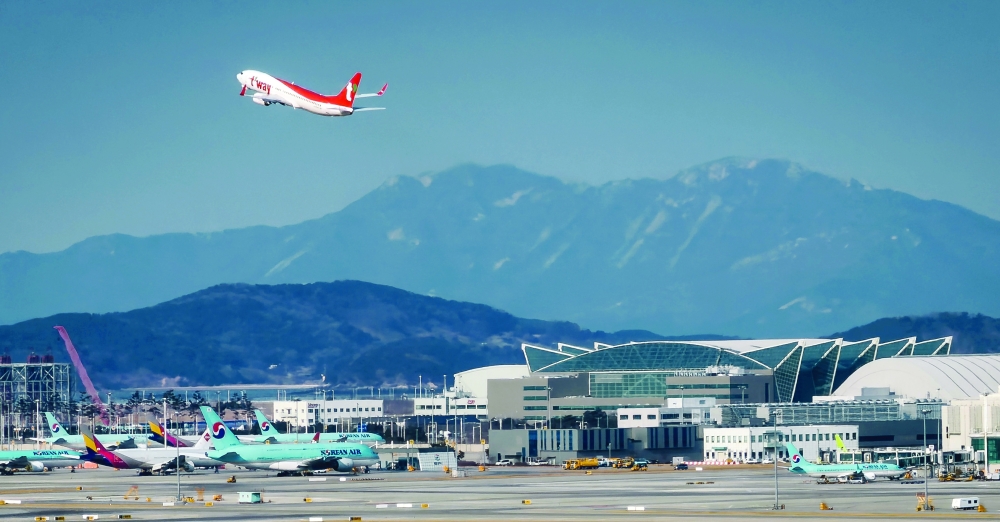
Incheon International Airport, which serves greater Seoul, said this month that its transfer traffic in the first half of 2026 had increased 18% year over year and 63% on European routes. That helped make it the busiest international airport in the world in that period, according to preliminary internal data from the trade group Airports Council International that Incheon provided to The New York Times.
Incheon said it had risen from third place — surpassing Dubai International Airport and London’s Heathrow Airport — because the geopolitical crisis had pushed travelers away from the Gulf hubs.
The data also shows that international passenger traffic at Hong Kong International Airport grew more than 11% in the same period and nearly 10% at Taiwan Taoyuan International Airport.
Singapore’s Changi Airport, the connecting point for about 1 in 4 passengers traveling between Europe and Australia, said airlines had added more than 800 flights between Singapore and cities like London, Munich, Paris and Sydney between March and July.
These airports stand to benefit because travelers, whether landing or transiting, pay passenger fees. Each traveler also spends roughly $7.57 on average on airport shopping, dining and other nonaviation expenses that are critical to airports’ financial viability, according to Airports Council International.
Airlines
The disruption has also helped airlines outside the Middle East capture more customers.
A snapshot:
In April, Cathay Pacific, a Hong Kong airline, said that a 24% rise in passengers in March compared with the same month last year was a result of shifting demand created by the “ongoing situation in the Middle East.” — Singapore Airlines attributed its 7% rise in passenger traffic to the rerouting of travel to Europe and the Americas.
— Turkish Airlines reported earlier this month that it had added capacity to China, Hong Kong and Thailand as passengers avoided flying to, or through, the Middle East.
— Lufthansa Group said in May that its airlines had added additional flights, particularly to Asia and Africa, while Air France said in June that it had redeployed aircraft to meet surging demand on Asian routes.
Where We Go From Here It remains unclear how long this trend will last. As Iran and the United States settle into an uneasy standoff, the threat of a flare-up remains. But the major Middle East airlines have started to rebuild passenger confidence and aggressively reduced prices, and aviation experts said the windfall in Asia is already eroding as a result.
IATA said that bookings to the Middle East had steadily recovered since April.
“You might be tempted to take a risk of flying through the Middle East because the price is so good,” said Jeffrey Goh, a managing director at Alton. — The New York Times
GRAPH POINTS
1. Incheon said its transfer traffic in the first half of 2026 had increased 18% year over year and 63% on European routes
2. Passenger traffic at Hong Kong International Airport grew more than 11% and nearly 10% at Taiwan Taoyuan International Airport.
3. Cathay Pacific reported a 24% rise in passengers while Singapore Airlines attributed its 7% rise in passenger
4 Middle Eastern transfer traffic on routes connecting Asia and Western Europe fell 47% in April year over year
5. Bookings for June to September had fallen across all regions except the Asia-Pacific, where they grew 33% year over year
Oman Observer is now on the WhatsApp channel. Click here