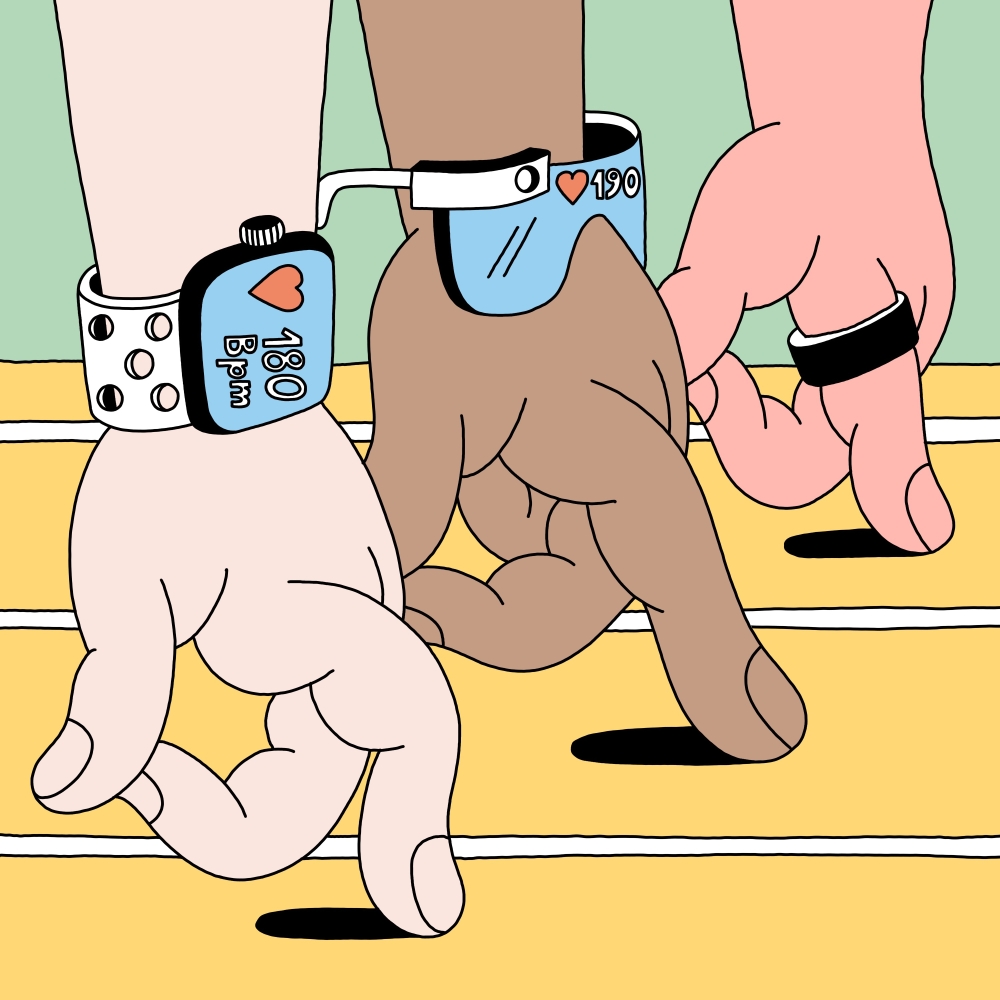





The year is 2035. You, like most people you know, have a small, button-sized device implanted in your forearm. For a recurring fee, it continuously monitors your blood pressure, core temperature, cardiovascular activity and all other health measures a physician would value. Anything suspicious is promptly flagged to your doctor by a personalized artificial intelligence system. Disease and illness is caught — and treated — as early as possible.
This is the healthmaxxing future that the $44 billion global wearable industry is rapidly manifesting, as a swath of smartwatches, smart rings and smart bands offer new takes on tracking health and fitness data.
Since the release of the pioneering Fitbit Tracker in 2009, consumer interest has powered the category. But what has caught the attention of venture capital firms and some of the biggest companies in the world — including Apple, Samsung, and Google (which paid $2.1 billion for Fitbit in 2021) — is a vision that could be even more profitable.
“The end goal is to be part of the medical ecosystem,” said Jitesh Ubrani, an industry analyst with IDC, a technology research company. “It’s a very lucrative market to be in if every hospital and doctor recommends one of these devices.”
That long game also partly explains why the knives are out: The smart ring maker Oura, which recently filed confidentially for an initial public offering, has sued seven competitors over patent infringement. It has won against three, with four cases pending. Apple Watch, which sells more devices in a quarter (around 8 million) than Oura has ever sold, is also embroiled in at least two patent infringement lawsuits.
Amid the fierce competition, companies have taken small steps toward integrating with hospitals and healthcare providers. Apple has partnered with healthcare data giant Epic Systems. Oura paired up with Dexcom, a maker of continuous glucose monitors, which invested $75 million into the Finnish-American ring maker in 2024. (Rather than “fitness wearable,” Oura CEO Tom Hale prefers to describe his product as “a health intelligence platform.”)
In May, Google introduced Google Health, an app that combines Fitbit data with third-party app data and your health records, meant “to be the one platform to manage all of your health data,” said Fitbit’s head of product, Andy Abramson.
And last year, Samsung, which makes a smart ring and smartwatch, acquired Xealth, a platform that connects consumer health data to hospital systems.
The acquisition would help transform Samsung “into a connected care platform,” the company said in a statement.
The Vision
As wearables become even more enmeshed in the healthcare system, parsing all of that data will require sophisticated AI assistance, experts say, and there are also weighty data privacy concerns to navigate.
But the upsides are compelling. Beyond flagging illness far earlier than currently possible, a wearable-enhanced healthcare system could supercharge telehealth opportunities. Diagnostic tests that once would’ve required a trip to the hospital would be unnecessary — the requisite data (very, very much of it) will have already been beamed to a doctor via a wearable.
“You could see any patient at any time, anywhere in the world,” said Dr. Andrew Jagim, director of sports medicine research at Mayo Clinic Health System, who studies the accuracy of wearables.
Beyond health, wearables are increasingly adding features that turn the device into a key. Apple Watch, for example, lets you unlock your Mac automatically when nearby. Future devices might use your gait, heart rate or other biometrics to log you into systems, grant building access or authorize online purchases.
But healthcare is where the real money lies.
The technology is reliable enough for use in some medical contexts already, experts say. Whatever shape they come in, wearables depend on a small array of sensors — optical detectors, accelerometers, thermistors — that track your blood flow, movement and skin temperature. Onboard algorithms then infer physiological signals such as heart rate, sleep stages and blood oxygen from the noisy raw data produced.
Over the years, they have steadily improved in their accuracy, said Jagim, especially in tracking sleep-time spent in deep sleep, or REM, versus light sleep. A decade ago, Jagim said, he would have “totally discarded that data.” Not anymore.
Many Paths
As brands work toward integration with the healthcare industry, they are building their customer bases in varying ways. Whoop, a subscription wristband that costs as much as $359 per year, attracts a wealthier fitness-focused consumer (their bands are often worn alongside expensive watches or luxury handbags, notes Ubrani.) But the brand has also earned the loyalty of many athletes who value its recovery and strain scores, which translate heart rate variability and sleep data into a daily readiness number.
Apple Watch and Fitbit, which provide users with less hyperdetailed health metrics, tend to appeal to a more “general wellness crowd,” said Jagim. Garmin smartwatches, infused with advanced GPS capabilities and even altitude readings in some models, appeal to extreme athletes (the company recently released a screenless smart band). Oura, whose newest iteration is as thin as any normal ring, has leaned into its popularity with women by trumpeting features that predict menstrual cycles and ovulation windows.
Wearables are becoming more proactive, too. Rather than just tracking health fitness data, they now offer recommendations on what to do with it: when to work out and how; when to sleep and how much to eat. This is where more established brands such as Apple and Google, which can pull information from other products in their universe, may have a leg up, said Ben Arnold, an industry analyst with Circana.
“Gemini, for instance, knows me in other venues, so those recommendations are even more drilled into me as a user,” Arnold said. “That’s a big differentiation factor.”
Arnold adds, your AI “coach” could comb through your email inbox looking for things like correspondence from a gym, or DoorDash or Instacart receipts, which could then inform coaching recommendations.
The Long Game
Full-on healthcare integration is still in utero. “The medical industry moves very, very slowly and is very bureaucratic,” said Ubrani. “There are real hurdles to get over.”
Last year, Whoop ran into one such hurdle. After it launched a feature estimating users’ daily blood pressure, the Food and Drug Administration declared Whoop an unapproved medical device. Whoop publicly refused to pull the contentious feature, arguing that the smart band did not constitute a medical device. “It’s designed to help you understand how your body responds to daily life, not to diagnose or treat any condition,” the company said in a statement.
In June, the FDA officially backed down after issuing new guidance exempting wellness blood pressure measurements from medical device regulation — a win not just for Whoop but for the wearable industry writ large.
In a LinkedIn post, Whoop’s CEO, Will Ahmed, celebrated with a nod toward the future. “We have tremendous respect for the agency’s role in ensuring that medical devices are safe and effective,” he wrote. “We look forward to continuing to work with the FDA as Whoop brings more regulated medical technologies to market.”
This article originally appeared in The New York Times.
Oman Observer is now on the WhatsApp channel. Click here