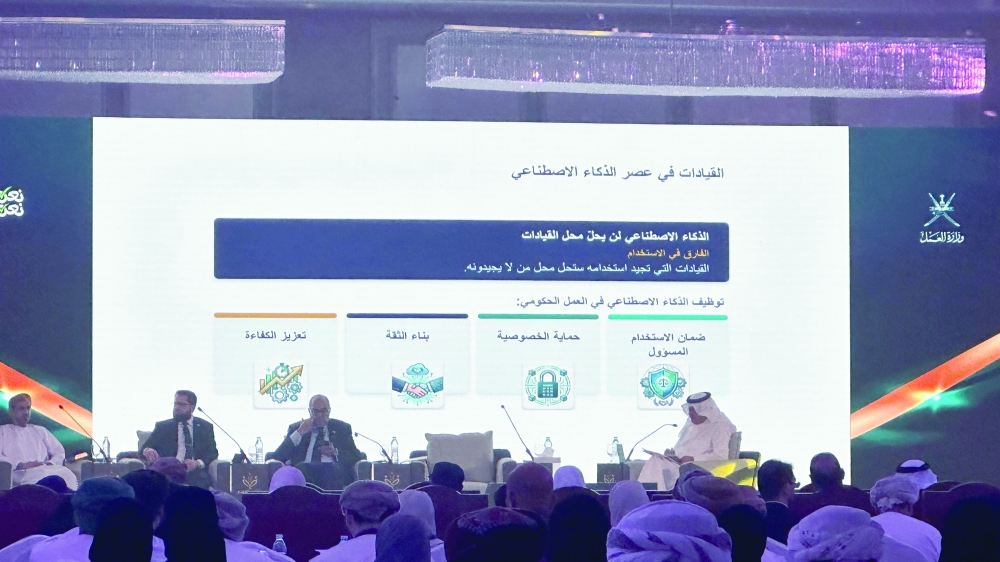





SALALAH: Artificial intelligence will not replace leaders capable of understanding and using it, but leaders who master the technology will replace those who do not, according to a presentation by Eng Hatem Nabil, head of Egypt’s Central Agency for Organization and Administration, in Salalah on Tuesday.
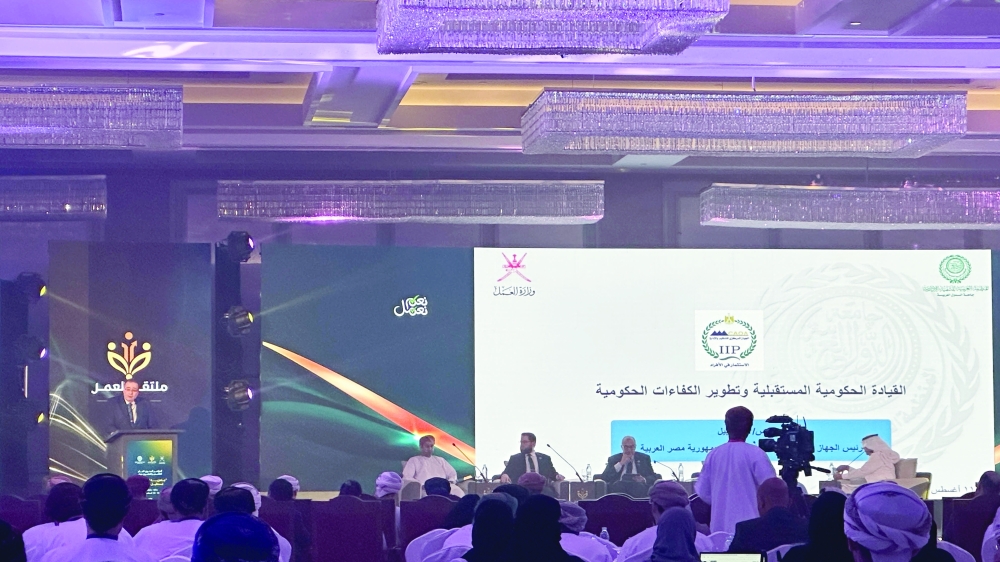
Nabil delivered the presentation on future government leadership and the development of government competencies during the 25th Annual General Conference on “Government Readiness for a Sustainable Future”.
Artificial intelligence, digital transformation, global crises and shifting citizen expectations are reshaping government leadership, the presentation said.
“The question is no longer how government bodies are managed, but how we build leaders capable of adapting to the future,” one slide said.
Nabil said technology, funding and legislation — three elements commonly associated with public-sector reform — were insufficient on their own.
Technology could not produce institutional transformation by itself; funding could not deliver development without the capacity to execute; and legislation could not change conditions unless translated into effective practice.
Leadership connects these elements by setting a vision, leading change, building institutions, deploying technology and fostering a culture of innovation, he said.
Nabil contrasted traditional public-sector leadership with the model required in a rapidly changing environment.
Traditional leaders manage operations, rely on experience, focus on regulations, avoid risks and work in isolation. Future leaders, by comparison, lead transformation, use data, focus on results and measurable impact, manage risks intelligently and work through partnerships.
He identified nine competencies required of government leaders: strategic thinking and foresight; change management; continuous learning; managing teams and productivity; crisis management; innovation management; the use of technology and data; decision-making; and governance and ethics.
On artificial intelligence, the presentation identified responsible use, privacy protection, public trust and greater efficiency as essential requirements for its deployment in government.
Leaders must verify the accuracy and reliability of AI-generated outputs, maintain data quality, guard against algorithmic bias and understand how systems arrive at decisions, it said.
The approach to data should move beyond collection towards analysis, anticipating trends and verifying outputs. Prompt engineering was also identified as an emerging capability required when working with technology and data.
Data should be analysed and used to anticipate developments before decisions are taken, the presentation said.
It also challenged a technology-centred understanding of innovation. Purchasing new systems, increasing spending, relying solely on technical solutions and running disconnected projects were presented as traditional approaches.
The alternative was to redesign services, improve efficiency, combine institutional, legislative and human solutions, and treat development, learning and sustainability as continuous processes.
Nabil also highlighted continuous training, e-learning, knowledge exchange, workplace learning and knowledge communities as components of leadership development.
The presentation concluded with a call for sustained investment in human capital and leadership development, institutional systems for continuous learning, data- and evidence-based decision-making, the responsible and ethical use of artificial intelligence, and innovation as an institutional culture and method of work.
The session was chaired by Dr Nasser Al Hatlan al Qahtani, director-general of the Arab Administrative Development Organization.
The conference opened under the auspices of Dr Mahad bin Said Baowain, Minister of Labour. Organised by the Arab Administrative Development Organization in cooperation with Oman’s Ministry of Labour, it runs in Salalah from August 11 to 13.
Oman Observer is now on the WhatsApp channel. Click here