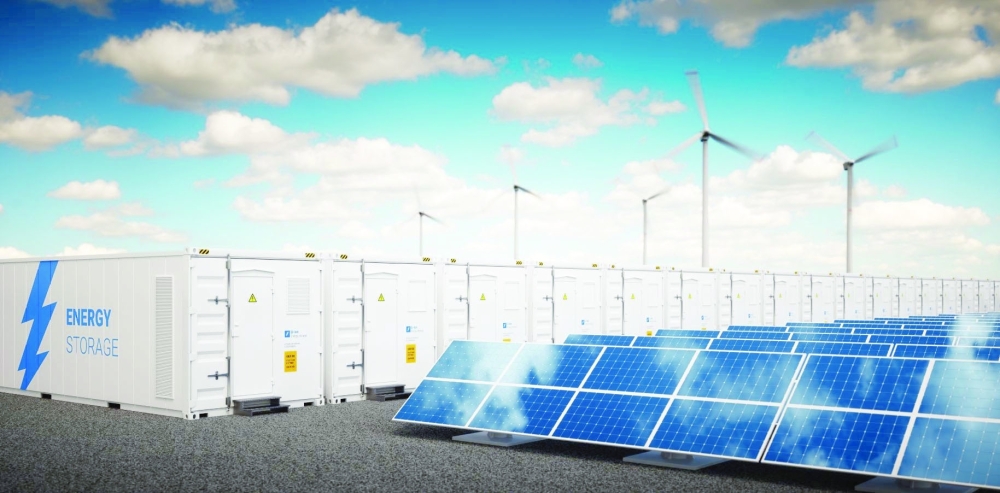
Picture a solar park in the Omani desert at three in the afternoon, running at full tilt and picture the same park at nine that evening, contributing nothing at all. That gap between abundance and darkness is no longer a technical footnote. It is fast becoming the single variable that will decide which Gulf economies turn cheap sunlight into durable industrial advantage and which end up with stranded panels and unmet demand. The region has already won the race to build solar at scale. The race that will actually determine its energy future is the one now under way to store it.
For over a decade, the Gulf's clean-energy narrative has been told in gigawatts installed and record-low tariffs bid, as Saudi Arabia, the UAE and Oman have each claimed some of the cheapest solar electricity ever contracted. That achievement is real, but it obscures a harder question: what happens to an economy built on cheap daytime power once factories, desalination plants, data centres and hydrogen electrolysers need electricity at every hour, not just the sunniest ones? The answer increasingly determines whether renewables strengthen energy security or quietly undermine it.
The global numbers show how quickly the ground has shifted. The International Energy Agency's Electricity 2026 report finds that utility-scale battery storage capacity worldwide grew more than twelvefold between 2020 and 2024, to around 124 gigawatts, while average costs fell by roughly 58 per cent over the same period, from about $511 to under $213 per kilowatt-hour. The IEA's Global Energy Review 2026 shows the pace still accelerating, with 108 gigawatts added globally in 2025 alone. To support a global tripling of renewable capacity by 2030, the agency estimates storage deployment must grow roughly sixfold, to some 1,500 gigawatts. That is not an engineering detail. It is the difference between renewables that merely generate electricity and renewables that can actually replace baseload power.
Oman's response illustrates what strategic thinking on storage looks like in practice. In June 2026, a consortium led by EDF Power Solutions signed a framework agreement to develop the 2,000-megawatt Jabal Abyad pumped-hydro project near the Wadi Dayqah Dam, with approximately 17,970 megawatt-hours of storage set to become the largest facility of its kind in the Middle East. It sits alongside the Manah 1 and Manah 2 solar plants, which added a gigawatt of capacity to a grid where peak demand has been climbing by around 2.7 per cent a year, reaching 7.5 gigawatts in 2024. Individually, these are infrastructure projects. Together, they mark a shift from generating renewable electricity to managing it as a dependable national asset, which is precisely the shift Oman Vision 2040 requires if renewables are to underpin, rather than merely decorate, the country's economic diversification.
That logic extends into manufacturing. Future Fund Oman has backed Orion Solar's integrated solar cell and module facility in the Sohar Freezone, with an annual production capacity of six gigawatts — the first facility of its kind in the Middle East — alongside the Gallant Industrial Project, which will produce 66,000 tonnes a year of lithium iron phosphate cathode material, the chemistry that now dominates grid-scale batteries. With global battery supply chains still heavily concentrated in Asia, this is a wager that Oman can capture value as a producer of storage technology, not merely a buyer of it, strengthening both industrial competitiveness and supply security.
The stakes extend well beyond electricity grids into the hydrogen economy Oman is betting on. Oman has earmarked some 50,000 square kilometres of land, chiefly around Al Duqm and Salalah, to support renewable hydrogen production targeted at 8.5 million tonnes a year by 2050, an effort estimated to require some $140 billion in investment, alongside a nearer-term goal of around one million tonnes by 2030. Electrolysers, however, are only as productive as the clean power supplied to them; without storage to smooth the mismatch between variable solar generation and continuous industrial demand, the economics of green hydrogen and ammonia weaken considerably. Storage, seen this way, is close to a precondition for Oman's hydrogen ambitions, not a side issue.
The rest of the Gulf is reaching similar conclusions by different routes. Saudi Arabia has prequalified 27 developers, including Masdar, KEPCO and ACWA Power, for a battery storage programme targeting 3 gigawatts and 12 gigawatt-hours, part of a build-out that positions the kingdom among the region's largest emerging storage markets. In Abu Dhabi, Masdar and EWEC have broken ground on a gigawatt-scale project combining solar generation with battery storage to deliver renewable power around the clock, managed in part by artificial intelligence. The common thread is unmistakable: Gulf utilities have concluded that solar without storage is an incomplete product, however cheap it is to build.
None of this will happen automatically. The IEA itself flags multi-year delays in grid connections and permitting, and uncertain revenue frameworks, as persistent constraints even in the world's most mature storage markets. For Oman and its neighbours, getting tariff design, grid codes and investment frameworks right will matter as much as the pumped-hydro dams and battery plants themselves.
The Gulf has proven it can out-build almost anyone on solar. Its next test and its more consequential one is whether it can turn that sunlight into power that is there when it is actually needed — at nine in the evening, in a hydrogen plant running through the night, in a factory that never stops. That is the race Oman and its neighbours are now running and it is the one that will decide who leads the region's clean-energy economy, not just who built the most panels.
Oman Observer is now on the WhatsApp channel. Click here