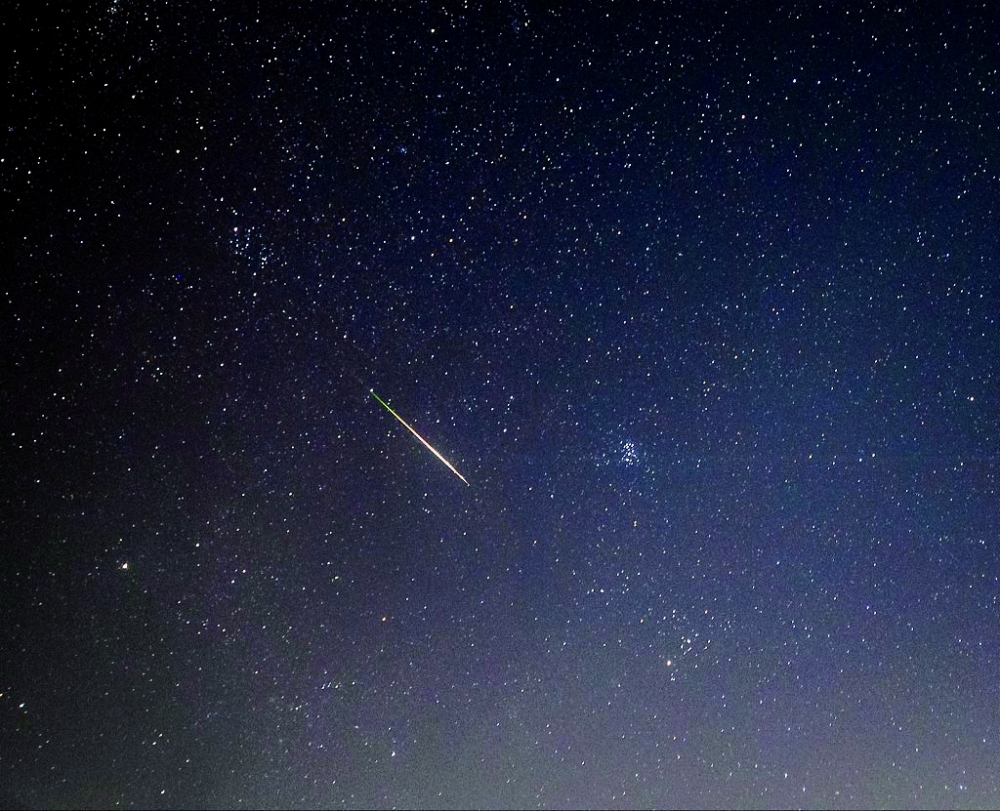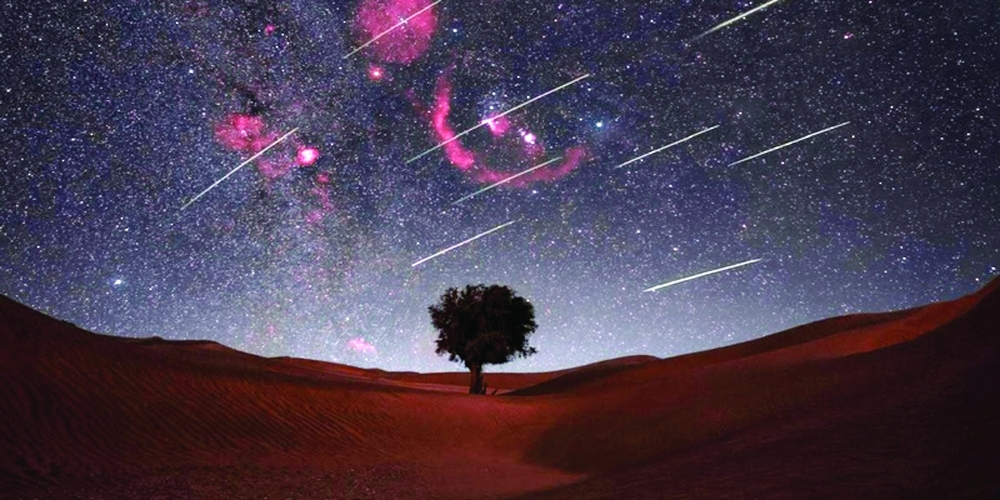





MUSCAT: The skies over the Sultanate of Oman are experiencing the annual Perseid meteor shower, which can be observed with the naked eye across various governorates, particularly from dark locations away from artificial lights. The shower will continue until August 24, reaching its peak on Wednesday evening and continuing into the early hours of Thursday. It is one of the most captivating astronomical phenomena for stargazers and astrophotographers worldwide.
Speaking about the phenomenon, Ashwaq bint Nasser al Siyabi, Deputy Chairman of the Members’ Affairs Committee at the Oman Astronomical Society, said meteor showers occur when Earth, in its orbit around the Sun, passes close to the path of a comet and encounters a stream of meteoroid particles left behind by the comet in space.
She explained that the Perseids originate from the famous Swift-Tuttle comet, which orbits the Sun approximately once every 133 years. Its nucleus is about 26 km in diameter. As Earth passes through its debris, dust grains and tiny fragments — some no larger than grains of sand — enter the atmosphere at speeds of up to 59 km per second. They collide with air molecules and burn up, producing bright streaks across the night sky.
Al Siyabi noted that the meteors could range from faint to exceptionally bright. The brightest are known as “fireballs”, one of the features that distinguish the Perseids from other meteor showers. Studies indicate that the Perseids produce more fireballs than any other meteor shower.
She said successful observation depends mainly on two factors: the altitude of the radiant — the apparent point from which the meteors originate, located in the constellation Perseus in the north-eastern sky — and the darkness of the observing site.
This year’s Perseid peak coincides with the new moon, providing ideal conditions for observation. With moonlight absent, the sky will be at its darkest, allowing observers to see even faint meteors, as well as bright fireballs streaking clearly across the night sky.
The best viewing time is from after midnight until just before dawn, when Perseus is high above the horizon. Observers are advised to choose open, elevated locations away from artificial lights and obstructions, and allow their eyes at least 20 minutes to adjust to the darkness.
A good number of meteors can also be seen on August 14, although activity gradually decreases after the peak.
Al Siyabi concluded that no special equipment is required to enjoy the Perseids, making them an accessible and awe-inspiring spectacle for everyone.
Oman Observer is now on the WhatsApp channel. Click here