




SALALAH: Oman should establish a national observatory on the future of work; and use artificial intelligence and big-data analysis to anticipate what its labour market will need, as policymakers seek to make employment policy more responsive to technological and economic change.
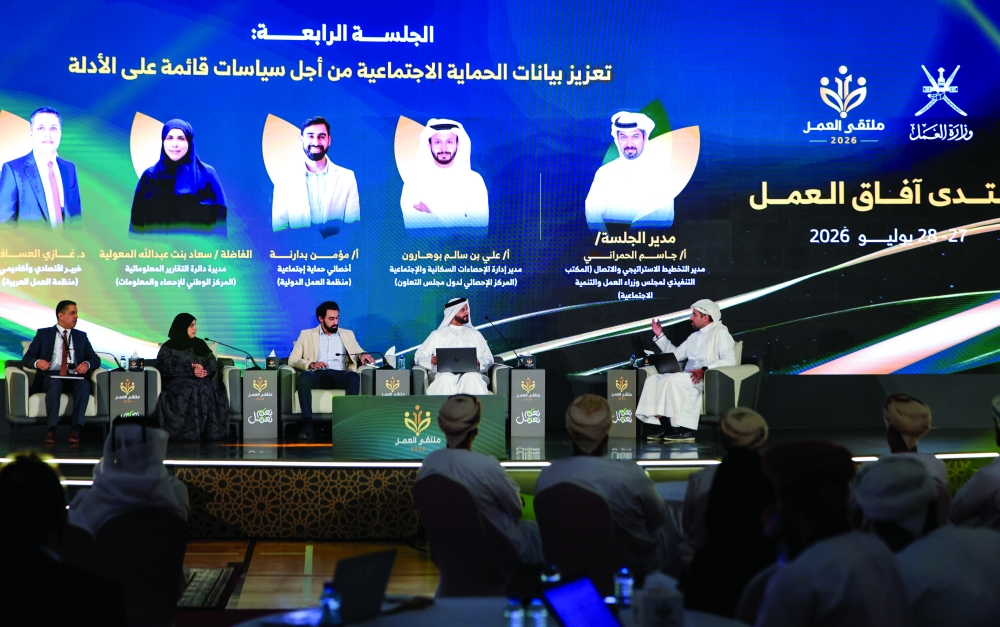
The two proposals were among the main recommendations issued at the close of the Labour Horizons Forum 2026 in Salalah, where experts and officials also called for a unified national system to exchange employment and social protection data between the institutions responsible for them.
Together the recommendations place data, artificial intelligence and predictive analysis at the centre of future labour policy, with the aim of identifying emerging skills gaps, changing workforce needs and the likely effect of new technologies on different forms of work.
The two-day Labour Horizons Forum was held under the auspices of Khalid bin Salim al Ghammari, Under-Secretary of the Ministry of Labour for Labour, as part of Labour Forum 2026, which runs in Salalah until August 13.
The forum did not specify when the proposed National Observatory for the Future of Work would be established, where it would be based or which institution would lead it. Nor did it say what the observatory would do beyond supporting evidence-based decision-making.
Those questions will determine whether the proposal becomes a working policy tool or remains a forum recommendation.
A further recommendation called for a unified national system to measure the performance of employment and social protection programmes — a common yardstick that does not currently exist across the institutions running them.
Taken together, the proposals point to a shift in labour policy: from responding to unemployment and skills shortages after they emerge, to identifying them earlier and adjusting training, education and protection systems accordingly.
The system they would reshape is already large. The Social Protection Fund told a media briefing in March that 1,676,493 people were insured as of January 2026 and that the wider protection system covered 64 per cent of the population, or about 3.3 million people.
The forum also called for legislation to be updated to reflect modern and non-traditional forms of employment. Those forms were not defined in the recommendations. Oman has already legislated in this area — the Ministry of Labour reported some 2,300 registered freelance professions in January — so the recommendation points to further extension rather than a first step.
Social protection should be extended to all categories of the workforce, the recommendations said, supported by flexible insurance products and more diverse sources of financing. The emphasis on financing reflects the central difficulty of any protection system: widening coverage while keeping benefits affordable over the long term.
That balance ran through the forum’s closing sessions, which examined the governance of social protection systems, the move towards collective insurance funds, cover for work injuries and occupational diseases; and rehabilitation and safe return-to-work policies.
Speakers stressed the role of specialist medical diagnosis and of work environment records in identifying occupational diseases — a question that becomes harder as workplaces and working arrangements change.
Another group of recommendations addressed the relationship between social support and economic participation. The forum called for support programmes to be linked to training, skills development and entrepreneurship; and for educational curricula and vocational training to be aligned with the requirements of promising economic sectors.
The approach would make employment outcomes, rather than financial assistance alone, a measure of whether social programmes are working.
The recommendations further urged the private sector, academic institutions and civil society organisations to invest in human capital and called for the empowerment of women, young people, persons with disabilities and other priority groups.
The forum also called for stronger regional and international partnerships and exchange of expertise, which it linked directly to the competitiveness of the Omani labour market.
At regional level, it examined an initiative to establish a unified GCC statistical system for social protection, intended to strengthen integration among the statistical agencies of member states and provide unified data for policymaking. Discussions also covered the International Labour Organisation’s methodology for social protection statistics and Sustainable Development Indicator 1.3.1 on actual coverage, which the forum linked to monitoring Oman Vision 2040 and the Sustainable Development Goals.
The value of the forum’s recommendations will now depend on implementation: whether the observatory receives a mandate, whether institutions agree on how data can be shared; and whether legal and insurance reforms are accompanied by deadlines and measurable targets.
Oman Observer is now on the WhatsApp channel. Click here