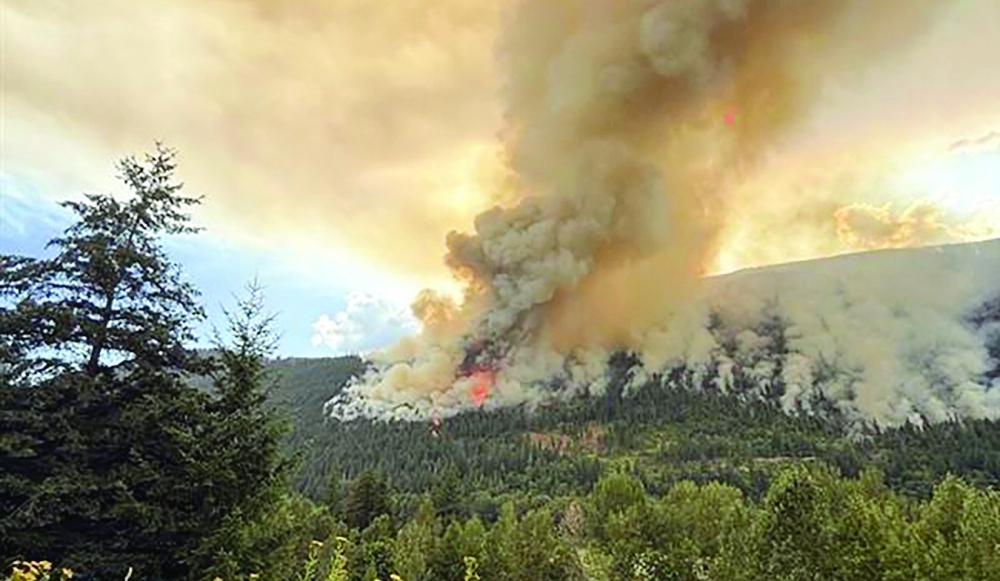





MONTREAL: With nearly 1,000 active fires and an area as large as Belgium already burned, Canadian Prime Minister Mark Carney says his country is facing one of the "most intense" wildfire seasons in its history. Barely halfway through the summer, virtually all Canadian provinces and territories have been affected. The largest fire, in Ontario, has forced mass evacuations and spread smoke as far as the US East Coast.
-Thousands of firefighters
While recent rainfall has slightly slowed the spread of the fires, more than 200 remained out of control across the country. More than 5,000 firefighters and 300 water tankers have been mobilised, as well as the Canadian Armed Forces. So far, three million hectares (7.4 million acres) have burned. In Quebec, authorities said assistance from the United States and France arrived at the weekend to "address the significant workload" in the northwest of the province.
Still, Yves Bergeron, a professor at the Centre for Forest Studies at the University of Quebec at Montreal, said it is "unrealistic to think we would have enough firefighters to extinguish all these fires," which are mostly in remote areas, inaccessible by road. "The important thing is to focus our energy on protecting villages and infrastructure," Bergeron said.

-Repeated fires
Canada's 270 million hectares of boreal forest — that is forest in high-latitude environments — comprises 28 per cent of the world's boreal zone. It is naturally affected by lightning fires that spread rapidly through the canopy, making them difficult to control. "Unlike Californian forests, where preventative measures can be taken through thinning, boreal forests, which are very dense, cannot be controlled," Bergeron said.
These trees "need natural disturbances such as fires," according to the government department Environment Canada, but suffer from repeated, intense fires that prevent them from regenerating. Heat waves, low rainfall, and droughts contribute to the intensification of these violent fire seasons. "There is real concern that the forest will become less resilient to climate change," said Bergeron, who added it is normal for between 0.5 and 1.0 per cent of Canadian forests to burn each year.
- Summer prospects
While still far from the devastating 2023 fire season, when nearly 18 million hectares went up in smoke, the current season could nevertheless reach new records, particularly due to the low rainfall forecast for Canada's north and west. Fires further south, near settlements, could force authorities to order new evacuations, as happened on Monday in Ontario. "In the future, we will need to focus on prevention, for example, by avoiding the possibility of villages being surrounded by forests," Bergeron said, advocating for human adaptation to these fires, which are likely to intensify year after year.
President Donald Trump said he held talks on Sunday with Canadian Prime Minister Mark Carney and called for damages over wildfires that have sent smoke across the northeast US. Trump threatened Canada with tariffs before Sunday's match, which the smoke had threatened to disrupt. "I have a good relationship with Mark Carney, but you know, we got to stop the fires up there," Trump told reporters after arriving back in Washington. "If we can help them, we'll help them. But maybe they should pay us some damages or something, or we should do some tariffs."
Dense wildfire smoke billowing down from Canada and northern Minnesota set off unhealthy air quality alerts across the US. On Friday, Trump accused Canada of "wilful negligence" and said the "cost of this pollution must of necessity be added to the TARIFFS Canada is currently paying." — AFP
Oman Observer is now on the WhatsApp channel. Click here