




MUSCAT: The Ministry of Heritage and Tourism has published a new scientific study titled ‘Antiquities of the Ancient Nomadic Bedouin in Remote Areas: Three Stone Evidences in Southeast Arabia,’ offering the first comprehensive academic examination of the three-stone monuments found across the Arabian Peninsula.
Authored by Roman Garba, the publication is the 15th volume in the Omani Archaeological Heritage series and has been released in cooperation with the international publisher Archaeopress Oxford. Issued in English, the study presents new archaeological, spatial and chronological insights into one of the region’s least studied ancient stone structures.
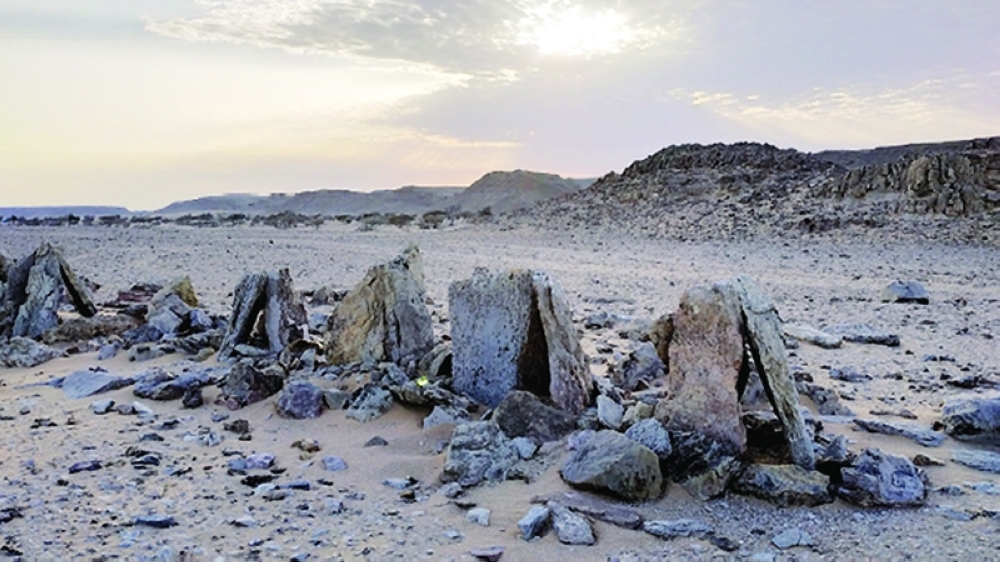
The research focuses on distinctive triangular arrangements of small stones believed to have served multiple functions, including platforms, hearths, navigation markers and possible cultural or ritual sites.
Based on extensive field surveys, excavations and advanced techniques such as remote sensing and radiocarbon dating, the study challenges earlier assumptions and highlights the complexity of their use.
Covering sites across Oman and Yemen, the publication documents 921 locations containing 3,880 three-stone monuments, revealing a far wider and more structured distribution than previously recorded. It also confirms that these formations cannot be interpreted as burial sites alone, as their frequent association with hearths, routes, water sources and settlement areas points to broader cultural and functional significance.
A key highlight of the study is a refined chronological framework based on radiocarbon dating, which places the use of these monuments between 400 BC and 150 AD. The findings also indicate regional variations over time, offering new perspectives on ancient mobility patterns, tribal landscapes and cultural interaction in the Arabian Peninsula.
The publication further notes the transfer of a row of three-stone monuments from the Nafun area in Al Duqm, Al Wusta Governorate, to the National Museum in Muscat, where they are now preserved as part of Oman’s archaeological heritage display.
Officials said the study not only advances academic understanding but also strengthens efforts to preserve and showcase Oman’s cultural legacy through museums and research institutions, making it a key reference for future archaeological studies in the region. — ONA
Oman Observer is now on the WhatsApp channel. Click here