


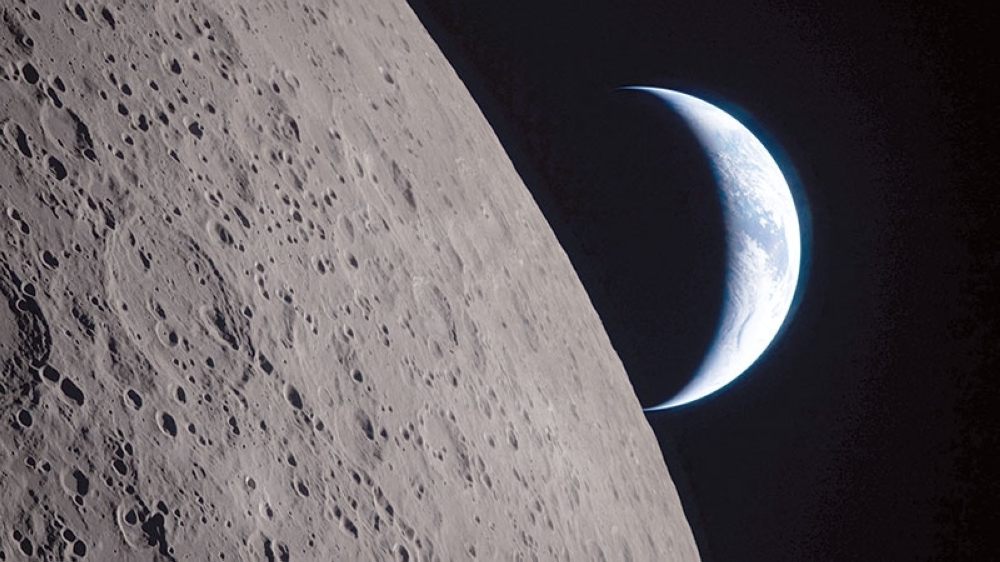





Houston: NASA on Tuesday released a historic photograph of Earth dipping below the lunar horizon, more than 57 years after an iconic "Earthrise" image was captured by an Apollo 8 astronaut.Members of the Artemis II crew captured the shot from their Orion capsule during the mission's record-setting lunar flyby, echoing the legendary "Earthrise" photograph taken by US astronaut Bill Anders in December, 1968 during the first space mission to carry humans around the Moon.
The US space agency posted its "Earthset" photo on X, as did the White House."Humanity, from the other side," the White House said. "First photo from the far side of the Moon. Captured from Orion as Earth dips beyond the lunar horizon."The crew of four — US astronauts Reid Wiseman,
Christina Koch, and Victor Glover, as well as Canadian Jeremy Hansen — are on a historic mission to loop around Earth's natural satellite as part of a broader program paving the way for a Moon landing in 2028.The astronauts have reported in vivid detail features of the lunar surface and later witnessed a solar eclipse, when the Moon passed in front of the Sun.
The White House also posted a NASA photograph of the eclipse, revealing what it said is "a view few in human history have ever witnessed."Back in 1968, Apollo 8 orbited the Moon 10 times without landing. During one orbit, Anders captured Earth's brilliant blue hue standing out against the vast darkness of space and accentuated by the desolate, grey lunar horizon in the foreground."Earthrise" often appears in selections of the most iconic images, and was included in 2003 in Life magazine's book entitled "100 Photographs That Changed the World." — AFP
Oman Observer is now on the WhatsApp channel. Click here


